The TC Prague’s post of 8th April 2024 reported on the participation of European countries in the European Defence Fund (EDF) in the period 2021-2022. (EDF registered 18 participations for the Czech Republic with a claimed EU contribution of €9.7 million). We would like to follow up on it and focus on the participation in Cluster 3 – Civil Security for Society. Cluster 3 focuses on a comprehensive, multidisciplinary approach to addressing civil security issues – the main objective is to protect citizens and the European economy, public spaces and critical infrastructures from terrorism, crime and natural disaster threats, as well as to ensure a secure digital environment. Research includes understanding the root causes of terrorism and crime to ensure effective prevention and innovation of technologies and practices for early warning as well as for rapid and effective response in the event of a real threat. The protection of external borders is aimed at the legal, safe and rapid movement of people and goods. The objective in the field of cyber security is to create a trustworthy and, above all, secure digital environment using the latest technologies and services.
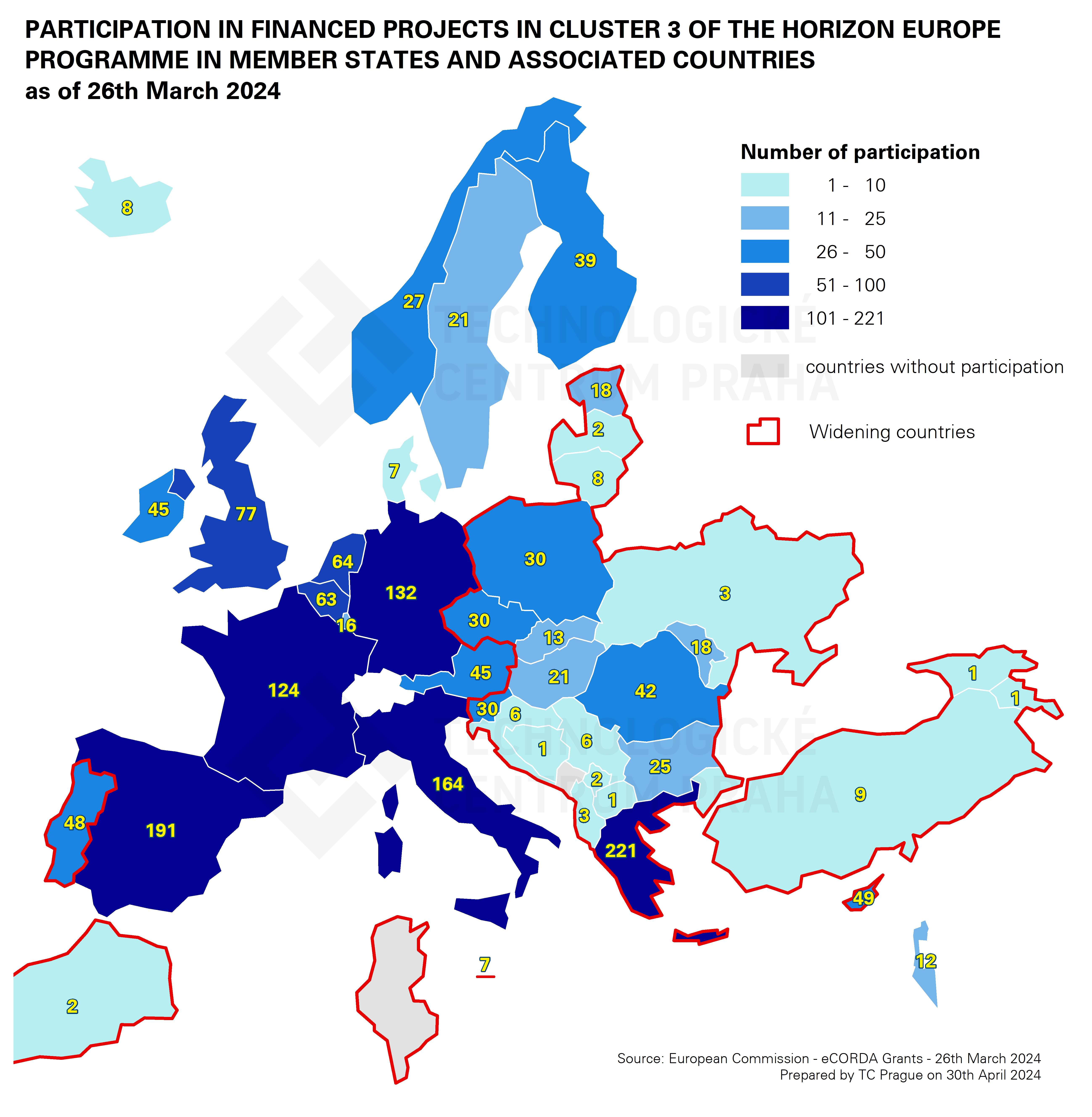
As of 26th March 2024, the European Commission's eCORDA database recorded a total of 1,673 participations in 100 projects in Cluster 3, with a claimed net EU contribution of €428 million. Greece (221), Spain (191), Italy (164), Germany (132), France (124), the United Kingdom (77), the Netherlands (64) and Belgium (63) have the highest number of participations (see cartogram below). The highest net EU contribution is then reported by Greece (€61 million), Spain (€50 million), Germany (€49 million), Italy (€49 million), France (€33 million) and the Netherlands (€20 million). The set of so-called Widening countries (including Greece) accounted for 597 participations in 96 projects with a claimed net EU contribution of €136 million. Despite the data published by eCORDA as of 26th March 2024, it shows the results of the calls only for 2021 and 2022, i.e. only 2/3 of successful participation and project proposals. It is important to note that the data is inputted into eCORDA with a time lag, the reason for this is data cleaning and validation.
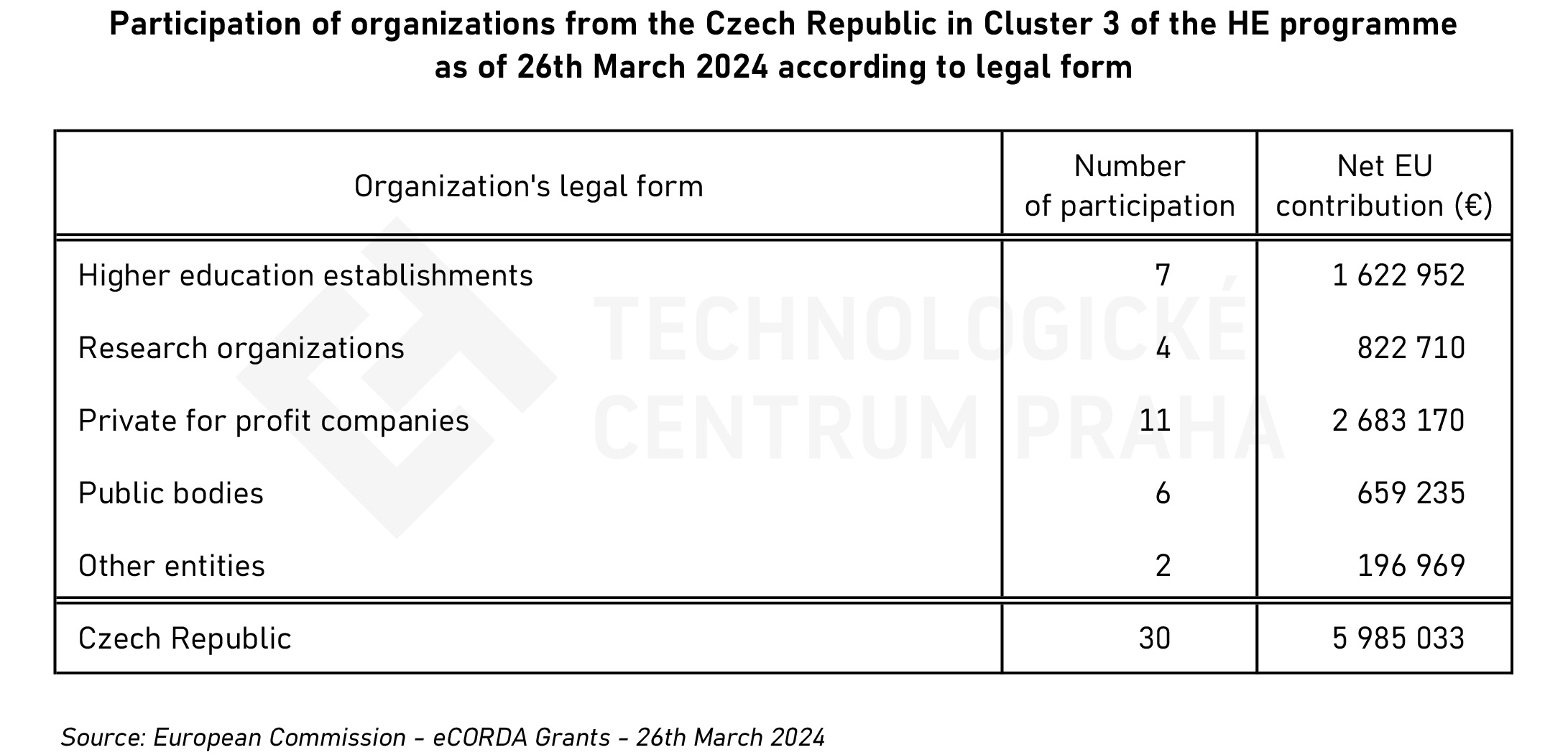
Czech organisations in Cluster 3 reported 30 participations in 21 projects and claimed a net EU contribution of €6 million. Among the Member States and HE programme associated countries, the Czech Republic is 15th in terms of participation (with Poland and Slovenia) and 17th in terms of net EU contribution claimed. This corresponds to the overall position of the Czech Republic in the HE programme. In terms of legal form, private enterprises dominated among the Czech organisations participating in the Cluster 3. As of 26 March 2024, they reported 11 participations and claimed a net EU contribution of €2.7 million. This represents one third of the participations and two fifths of the funding. Higher education institutions were the second most represented type of organisation, with 7 participations and €1.6 million claimed. None of the Czech organisations were in a coordinating role. The TC Prague provides long-term consultancy support to half of the organisations listed in the table below.
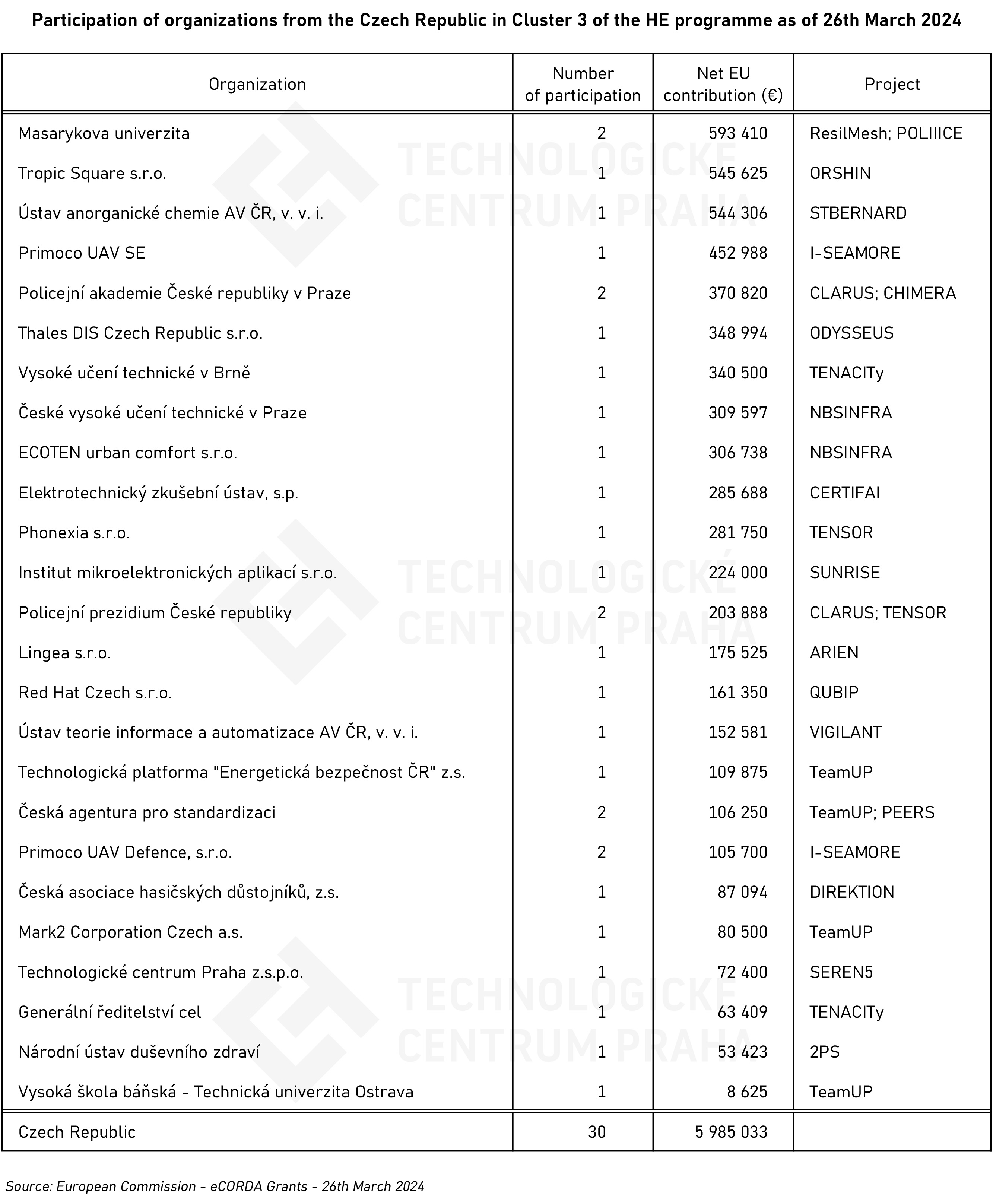
Regarding Czech organisations, Primoco UAV Group participated in Cluster 3 the most, with 3 participations. Masaryk University, the Police Academy of the Czech Republic in Prague, the Police Presidium of the Czech Republic and the Czech Agency for Standardization each participated 2 times. The highest net EU contribution was claimed by Masaryk University (€593 thousand), Primoco UAV Group (€559 thousand), Tropic Square s.r.o. (€546 thousand), Institute of Inorganic Chemistry of the CAS (€544 thousand) and Police Academy of the Czech Republic in Prague (€371 thousand).
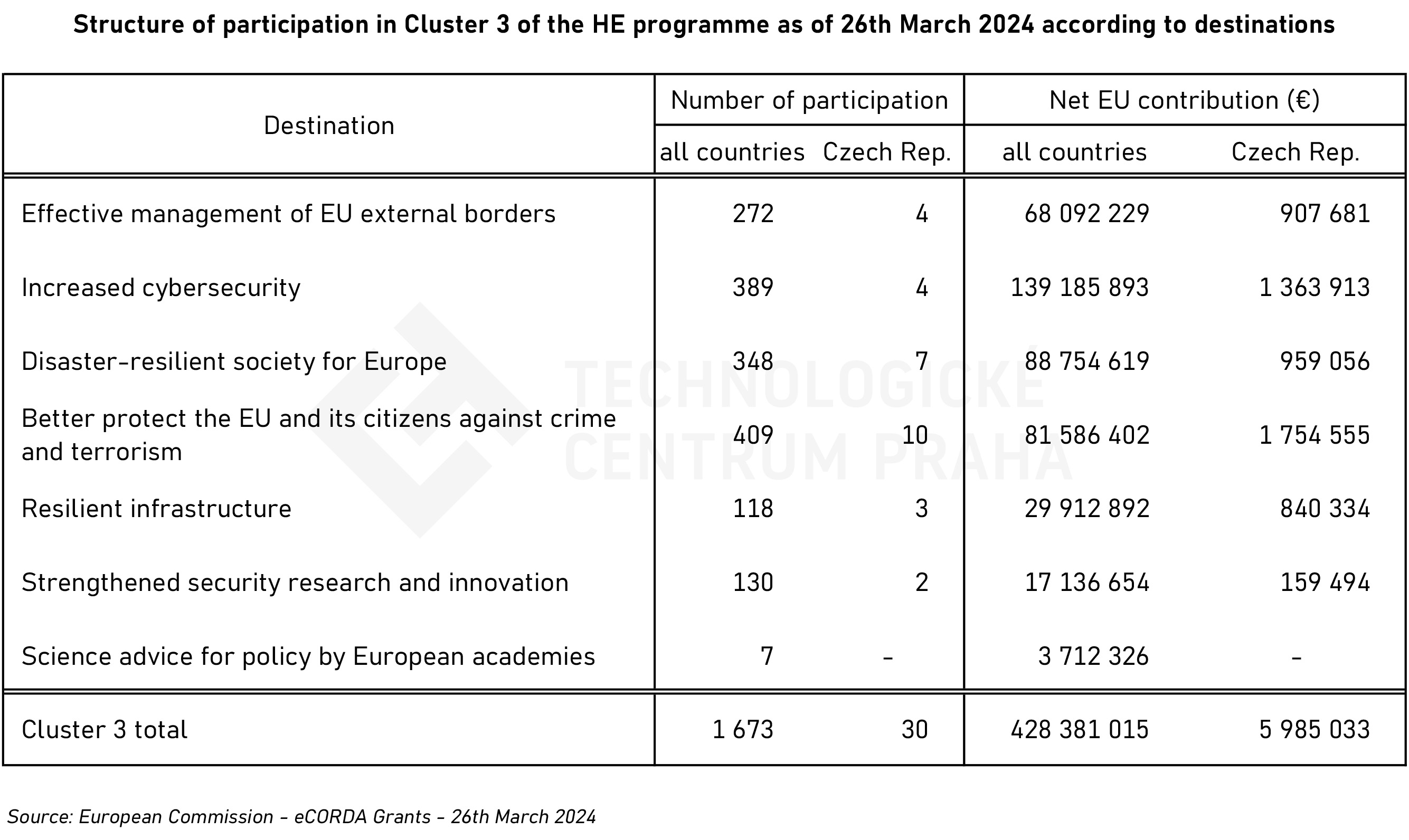
Of the individual destinations in Cluster 3, Czech entities participate most in Better protect the EU and its citizens against crime and terrorism destination – 10 participations with a claimed net EU contribution of €1.8 million. In terms of Czech participation, the second largest destination is Disaster-resilient society for Europe (7 participations and net EU contribution just under €1 million). In terms of net EU financial contribution claimed by Czech actors, the second largest destination is Increased cybersecurity (4 participations and €1.4 million).
Compared to the overall participation in Cluster 3, Czech participation is strongly concentrated on the Better protect the EU and its citizens against crime and terrorism destination, which accounts for almost one third of the net EU contribution claimed by Czech participants in Cluster 3. Conversely, the destination with the highest overall participation in Cluster 3 is Increased cybersecurity.
As for domestic participation in project proposals in Cluster 3, as of 26th March 2024, eCORDA recorded 111 participations (in 77 projects) with a requested EU contribution of €27.9 million. Only one domestic project proponent was in the role of coordinator. Czech entities in Cluster 3 have an above average participation in successful project proposals. While in Cluster 3 overall, the average success rate for participation in project proposals is 15.5%, for Czech entities it was 20.9%. Other Widening countries (i.e. countries with lower research and innovation performance) are also successful – Hungary (32.3%), Slovenia (26.1%) and Moldova (21.8%).
Finally, it is necessary to briefly mention other sources of European funding in the areas of security and cyber security, namely the Digital Europe Programme, the Internal Security Fund (ISF), the Asylum, Migration and Integration Fund (AMIF) and the Border Management and Visa Policy Instrument (BMVI).
In the Digital Europe Programme Cybersecurity themes, Czech entities reported 6 participations in 4 projects as of 1st March 2024, claiming EU contribution of €3.6 million. This is roughly 2.5 times the net EU contribution in the Cluster 3 destination Increased cybersecurity.
Czech entities have participated in the Internal Security Fund 4 times (in 4 projects) as of 26th April 2024, claiming an EU contribution of €409,000. In the Asylum, Migration and Integration Fund, as of 29th April 2024, Czech entities had two participations (in 1 project) with a claimed EU contribution of €43,000. Czech participation in these EU funds is negligible. Czech entities are not yet participating in the Border Management and Visa Policy Instrument.
Summary:
Cluster 3 - Civil Security for Society is one of the smallest clusters of Pillar II in terms of budget, number of participation and net EU contribution claimed. The €6 million EU contribution for Czech participants corresponds to the overall position of the Czech Republic in the HE programme. Among the Czech participants in Cluster 3, private enterprises predominate, followed by higher education institutions. No funded project in Cluster 3 is coordinated by a Czech institution; there is only 1 coordinator among the unsuccessful Czech project applicants. Czech organisations are mainly involved in projects focused on protection of the population against crime and terrorism and cyber security.
Prepared by: Vladimír Vojtěch, vojtech@tc.cz, TC Prague, 03.05.2024