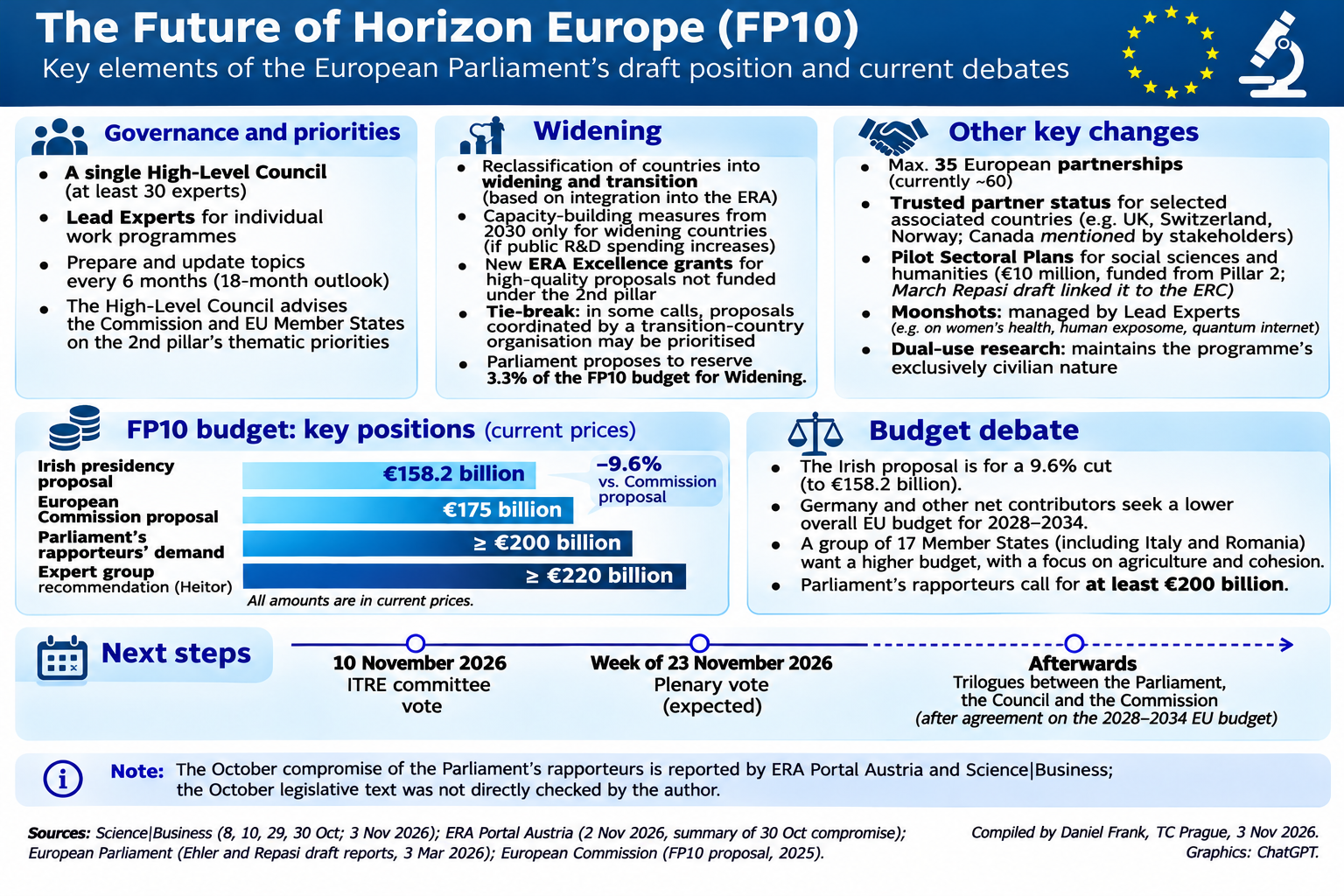
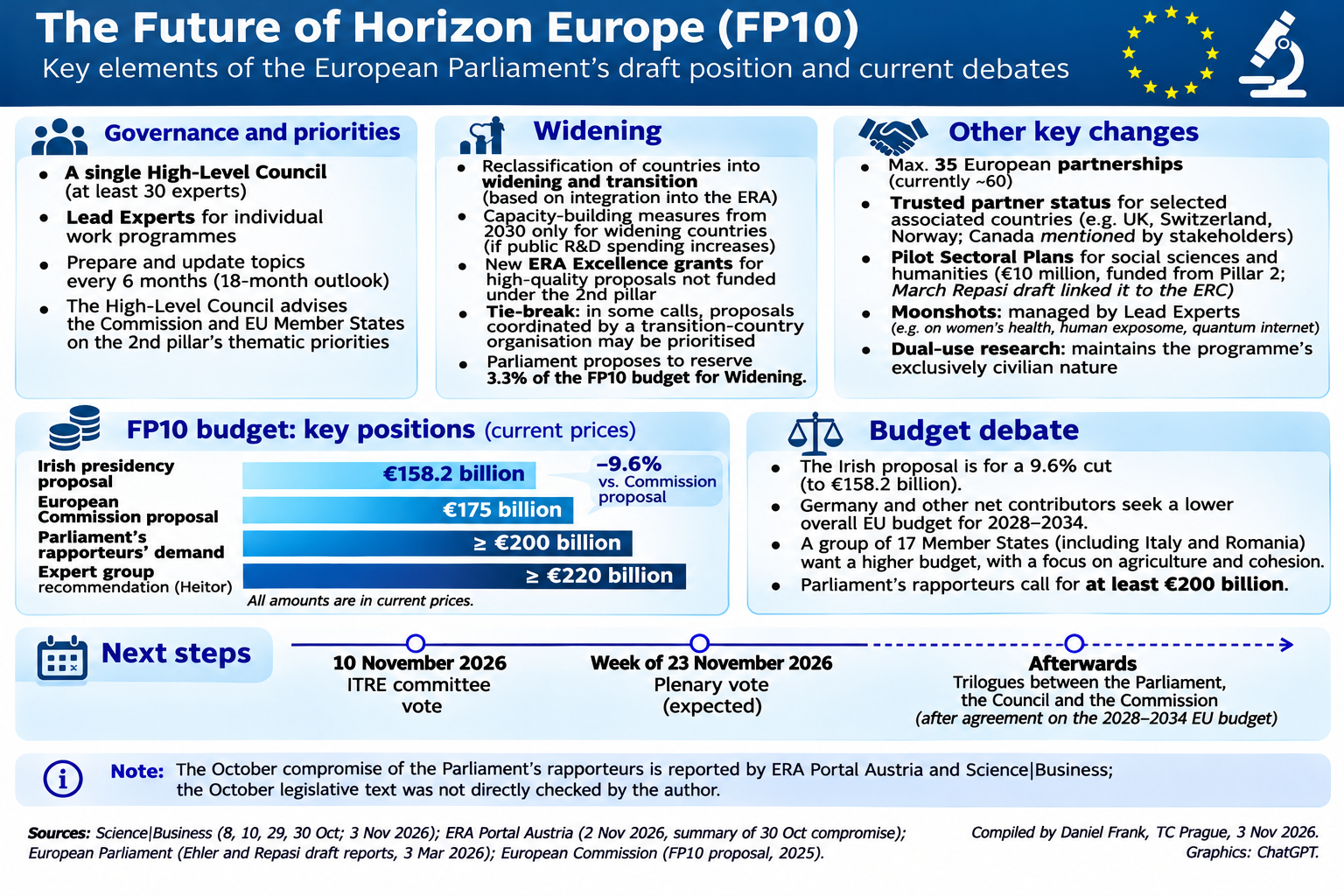
Negotiators from the European Parliament’s political groups have reached a compromise on the next Horizon Europe programme (FP10) for 2028–2034. The proposal would give independent experts a stronger role in setting research priorities, change the rules for Widening and reshape European Partnerships. Research organisations have largely welcomed the agreement. At the same time, a dispute over the programme’s budget is growing: the Irish Presidency of the Council of the EU has proposed a 9.6% cut as part of the budget negotiations.
The agreement on FP10 follows an earlier parliamentary compromise on the European Competitiveness Fund (ECF), under which research programming would remain within Horizon Europe. The draft reports published on 30 October reflect an agreement between rapporteurs and shadow rapporteurs from the political groups in the European Parliament’s Committee on Industry, Research and Energy (ITRE). ERA Portal Austria also confirmed the publication and outlined the main proposals on 2 November. [1] In several important areas, the parliamentary compromise differs from the European Commission’s original proposals and from positions discussed by Member States. [2] [3]
Experts would have a greater say in research priorities
One of the most important changes concerns the governance of Pillar II of FP10, which supports collaborative research and innovation. Earlier parliamentary proposals, published in March, envisaged two expert councils whose decisions could only be changed by the European Commission in exceptional and properly justified cases. However, some MEPs were concerned that these bodies would have too much power and that political oversight would be too limited.
The new compromise therefore proposes a single High-Level Council, made up of at least 30 recognised experts from research, innovation, industry and civil society. The European Commission would appoint its members for up to four years, with oversight from Parliament and the Council of the EU. The council would advise the Commission and Member State governments on the broad thematic priorities of Pillar II work programmes. Programme committees, in which Member States are represented, would continue to approve the work programmes. [1]
The High-Level Council would be supported by Lead Experts responsible for individual work programmes. They would help prepare and monitor calls for proposals. Their teams would also update an 18-month outlook of planned topics every six months. The compromise therefore keeps experts closely involved in programme preparation, while changing how their work would be organised. [1]
According to Science|Business, the proposed model has received strong support from European research organisations. The League of European Research Universities (LERU) described the overall compromise as an impressive achievement. Its Secretary-General, Kurt Deketelaere, particularly welcomed the proposed governance arrangements for Pillar II. Manuel Heitor, who chaired the expert group on the future of the framework programme, also sees the parliamentary proposal as a step in the right direction. [4]
The European University Association (EUA), however, has warned that the new expert bodies must not make decision-making more complicated or delay the launch of the programme. [4]
Widening: new country categories and ERA Excellence grants
The proposed changes to Widening could be particularly important for Czechia. The parliamentary compromise would divide the current group of Widening countries into two categories: widening and transition countries.
While the European Commission proposes using the European Innovation Scoreboard to determine these categories, MEPs favour a different criterion: how closely each country is integrated into the European Research Area (ERA). The exact method for assessing this level of integration has not yet been defined. [2] [5] Parliament also proposes allocating 3.3% of the FP10 budget to Widening measures. [1]
From 2030, under the parliamentary proposal, research capacity-building measures would be available only to widening countries that had increased their public research and development spending in the previous year. The Commission could grant temporary exemptions in exceptional economic or budgetary circumstances. The Irish Presidency of the Council, by contrast, proposes allowing transition countries to access these measures as well. [1]
The proposed ERA Excellence grants would support high-quality collaborative project proposals under Pillar II that had passed evaluation but could not be funded because of budget limits. To qualify, the project coordinator or at least half of the participants would have to come from widening or transition countries. [2]
The Commission could also introduce a rule in certain calls giving priority to proposals coordinated by organisations from transition countries when two or more proposals receive the same evaluation score. This would not be a general advantage for all projects from these countries, but a possible tie-breaking rule. [2]
Partnerships and other changes to FP10
European Partnerships would also undergo significant changes. Parliament proposes a maximum of 35 partnerships operating at the same time, while the European Commission has considered scenarios involving 18, 24 or 28 partnerships. The current framework programme includes around 60 partnerships. Even Parliament’s less restrictive proposal would therefore mean a substantial reduction in their number. [2]
Another proposal would introduce trusted partner status for selected countries associated with the programme. This would allow them to take part in sensitive technology areas without some of the current restrictions. Research organisations have welcomed this approach, particularly in relation to the United Kingdom, Switzerland and Norway. Canada has also been mentioned in the discussion. However, the parliamentary proposal does not include a specific list of countries. [1] [4]
According to Science|Business, the compromise also includes a pilot scheme called Sectoral Plans, intended to support excellent research teams and organisations in the social sciences and humanities. The proposed €10 million pilot would be funded through Pillar II of FP10.
An earlier draft by rapporteur René Repasi, published in March, linked Sectoral Plans to the preparation of the work programme by the ERC Scientific Council. It also envisaged expert sectoral platforms for European Partnerships. [6] Representatives of the social sciences and humanities have stressed that the new pilot should receive additional funding rather than reduce the resources available for existing Pillar II calls. [2] [4]
The parliamentary compromise also changes the approach to major strategic research initiatives known as moonshots. Lead Experts would guide their preparation, while researchers would have more opportunities to propose projects themselves. Possible topics include women's health, the effects of environmental exposures on human health (human exposome) and the quantum internet. Stakeholders and citizens would also have to be involved in preparing these initiatives. [1]
On dual-use research, Parliament continues to support the exclusively civilian nature of research funded by Horizon Europe. However, it would allow funding to continue for projects whose results later prove useful for defence purposes. This differs from the position of some Member States, which want Horizon Europe to be explicitly opened to dual-use research. [1]
Budget: €158.2 billion or at least €200 billion?
While the parliamentary compromise is gaining support from the research community, budget negotiations are moving towards a major disagreement.
The European Commission has proposed a budget of €175 billion for FP10. [5] In October, the Irish Presidency of the Council of the EU presented a negotiating proposal to reduce this amount by 9.6%, to approximately €158.2 billion. [7] Parliamentary rapporteurs, by contrast, are calling for at least €200 billion. [7] [1] All these figures are expressed in current prices. [7]
The Irish proposal does not represent an agreed position of the Council. Germany has described it as an insufficient basis for negotiations and, together with other net contributors to the EU budget, is calling for a more restrained overall EU budget. Meanwhile, a group of 17 Member States led by Italy and Romania supports a larger EU budget, but places particular emphasis on funding for agriculture and cohesion policy.
The disagreement is therefore not only about the total amount of funding, but also about how it should be divided between different EU policies. [7] [8]
Parliamentary rapporteurs Christian Ehler and René Repasi have pointed out that the next Multiannual Financial Framework requires the approval of an absolute majority of MEPs. They warn that cuts to research funding could make it harder to secure that majority. Parliament’s budget rapporteur, Siegfried Mureșan, has also warned that research could face disproportionate cuts during efforts to reduce overall spending. [7] [8]
Manuel Heitor has also criticised the direction of the negotiations. In a statement issued on 2 November, he highlighted three contradictions in the approach taken by Member States.
The first is the ambition to make Europe more competitive without providing the necessary investment in research. The second is the preference for national spending on agriculture and infrastructure over cross-border research cooperation. The third is the focus on short-term budget savings at the expense of long-term economic growth. [9]
Heitor’s expert group had previously recommended a budget of at least €220 billion for FP10, in current prices. Heitor argues that weakening the European research system could lead to more fragmented research capacity, duplicated investment and a further loss of talent. [9]
Research organisations turn their attention to national governments
European universities and research organisations are therefore increasing pressure on Member States, which will play a central role in deciding the next Multiannual Financial Framework. Alongside joint statements, they are preparing direct discussions with national governments and public campaigns to explain the importance of European investment in research.
The research community also argues that the debate should not focus only on the needs of universities and research institutions. Industry partners and other users of research results should play a greater role.
There is also discussion about new sources of revenue for the European Union, which could help finance a more ambitious budget. However, these should not replace the basic funding provided by Member States. [10]
The budget dispute is part of the wider negotiations on the EU’s Multiannual Financial Framework for 2028–2034. Research must compete for funding with agriculture, cohesion policy and other European priorities. [8]
Key decisions are still ahead
The parliamentary compromise is an important step towards FP10, but it is not the final version of the programme.
The ITRE committee is expected to vote on the proposal on 10 November, followed by a vote in the European Parliament’s plenary during the week beginning 23 November 2026. [1] According to the information currently available, European leaders are also expected to discuss budget issues on 13 November. These dates may change. [2] [9]
Under the current timetable, trilogue negotiations between the European Parliament, the Council of the EU and the European Commission are expected to begin after Member States reach an agreement on the overall EU budget for 2028–2034. [4] The outcome will determine the final structure of FP10 and the funding available to the programme.
Prepared by: Daniel Frank, Technology Centre Prague, frank@tc.cz, 3 November 2026.
Sources:
[1] ERA Portal Austria: “EP ITRE Draft Report on Horizon Europe (2028–2034) is published”, 2 November 2026. https://era.gv.at/news-items/ep-itre-draft-report-on-horizon-europe-2028-2034-is-published/
[2] Ole Ellekrog and Martin Greenacre: “Parliament rapporteurs release agreement on next Horizon Europe”, Science|Business, 30 October 2026. https://sciencebusiness.net/news/r-d-funding/horizon-europe/parliament-rapporteurs-release-agreement-next-horizon-europe
[3] Ole Ellekrog: “Parliament ECF compromise keeps research programming in Horizon Europe”, Science|Business, 29 October 2026. https://sciencebusiness.net/news/horizon-europe/parliament-ecf-compromise-keeps-research-programming-horizon-europe
[4] Martin Greenacre and Ole Ellekrog: “Research sector backs MEPs’ Horizon Europe compromise”, Science|Business, 3 November 2026. https://sciencebusiness.net/news/fnw/horizon-europe/research-sector-backs-meps-horizon-europe-compromise
[5] European Commission: Proposal for a Regulation establishing Horizon Europe (FP10), COM(2025) 543. https://eur-lex.europa.eu/legal-content/EN/TXT/?uri=CELEX:52025PC0543R(01)
[6] European Parliament, ITRE Committee: René Repasi, Draft Report on the Specific Programme implementing Horizon Europe 2028–2034, 3 March 2026, PE781.461v01-00, particularly amendments 29 and 50. https://www.europarl.europa.eu/doceo/document/ITRE-PR-781461_EN.pdf
[7] Florin Zubașcu: “Council floats 9.6% budget cut to next Horizon Europe”, Science|Business, 10 October 2026. https://sciencebusiness.net/news/council-floats-96-budget-cut-next-horizon-europe
[8] Ole Ellekrog: “Parliament stands firm on budget as Council readies negotiating box”, Science|Business, 8 October 2026. https://sciencebusiness.net/news/eu-budget/parliament-stands-firm-budget-council-readies-negotiating-box
[9] Goda Naujokaitytė: “Top Horizon Europe adviser calls out EU leaders’ contradictions”, Science|Business, 3 November 2026. https://sciencebusiness.net/news/horizon-europe/top-horizon-europe-adviser-calls-out-eu-leaders-contradictions
[10] Goda Naujokaitytė and Ole Ellekrog: “Research community to appeal to national governments over planned EU budget cut”, Science|Business, 13 October 2026. https://sciencebusiness.net/news/r-d-funding/horizon-europe/research-community-appeal-national-governments-over-planned-eu-budget-cut
Note: This article provides an interpretation of proposals and positions published so far. It is not an official interpretation or the final version of FP10. Budget figures, governance arrangements and implementation rules remain subject to negotiation. The description of the October parliamentary compromise is based on reporting by Science|Business and information published by ERA Portal Austria on 2 November 2026. René Repasi’s March draft report is cited only as evidence of an earlier stage in the legislative process, not as the text of the October agreement. The full October compromise amendments were not directly compared for this article.