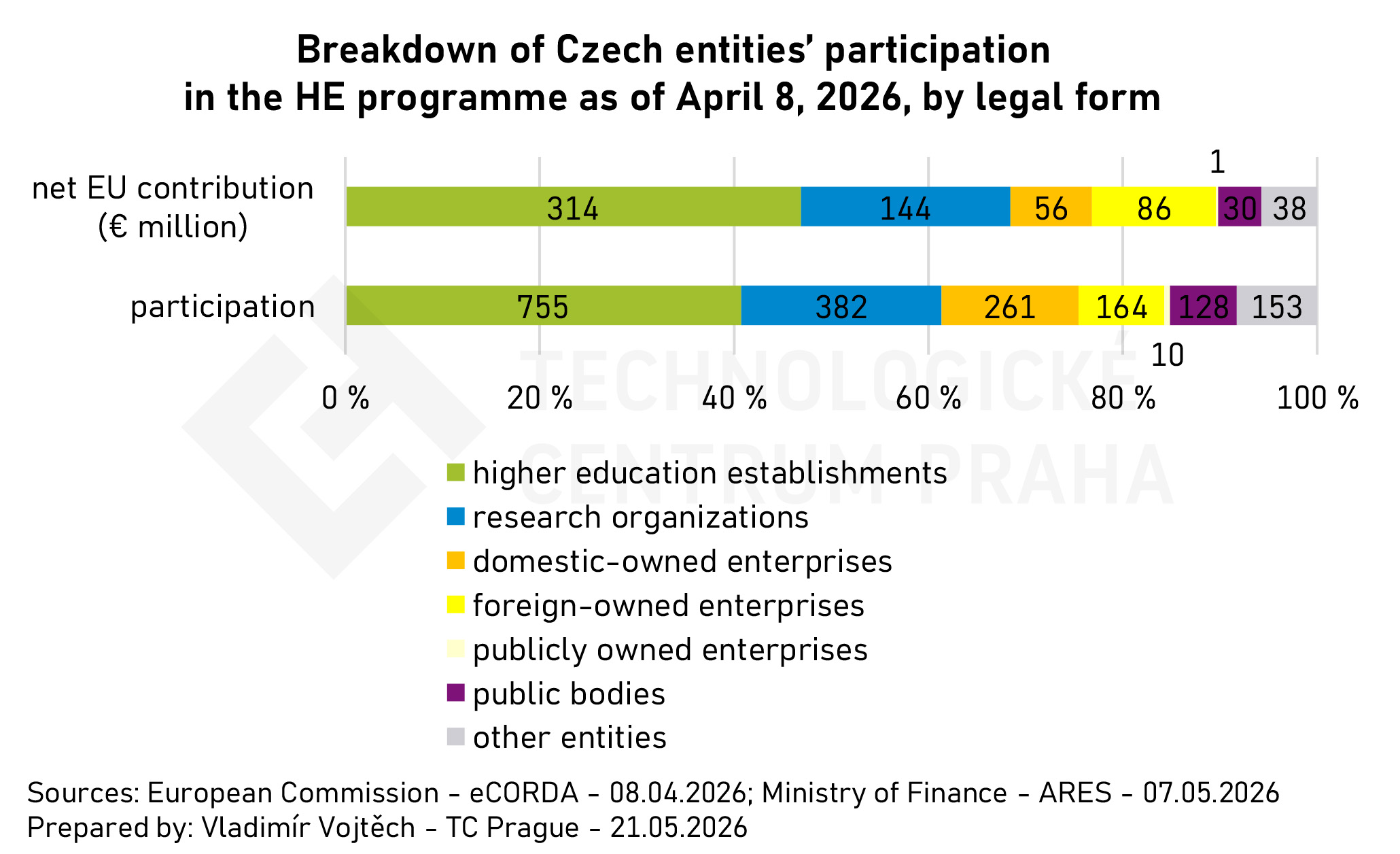
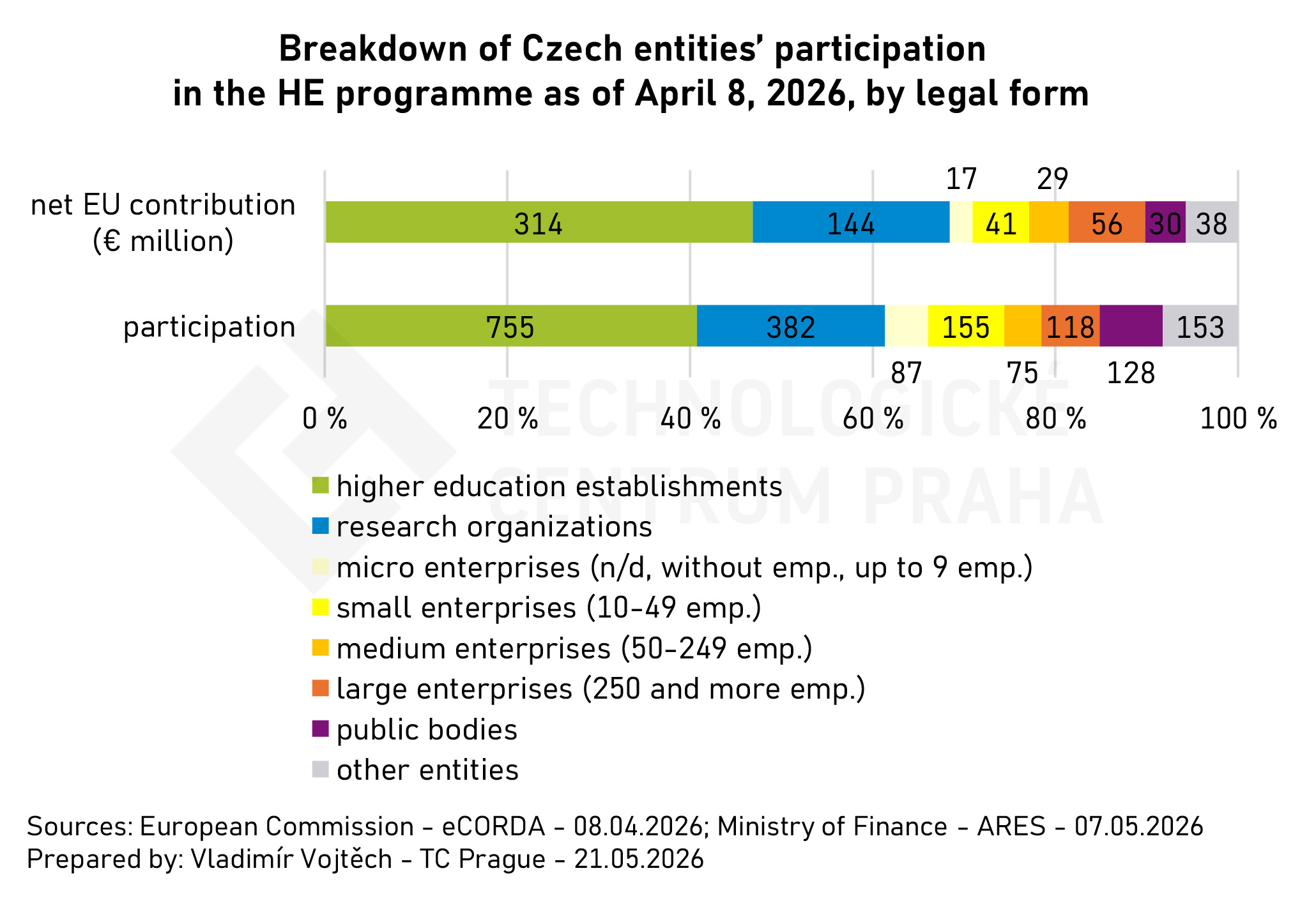
In our previous post dated May 28, 2026, we described the size and ownership structure of Czech companies participating in the EU’s framework programmes. (The figures below provide an overview of the overall context of Czech corporate participation in the Horizon Europe programme.) Given the sufficiently large sample size (232 Czech companies, through 436 participations, had claimed a net EU contribution of €143 million as of April 8, 2026), it is possible to assess which sizes and institutional segments of Czech companies are participating in the individual priorities and clusters of the Horizon Europe programme (hereinafter “HE”) and how the individual priorities and clusters differ from one another in this regard.
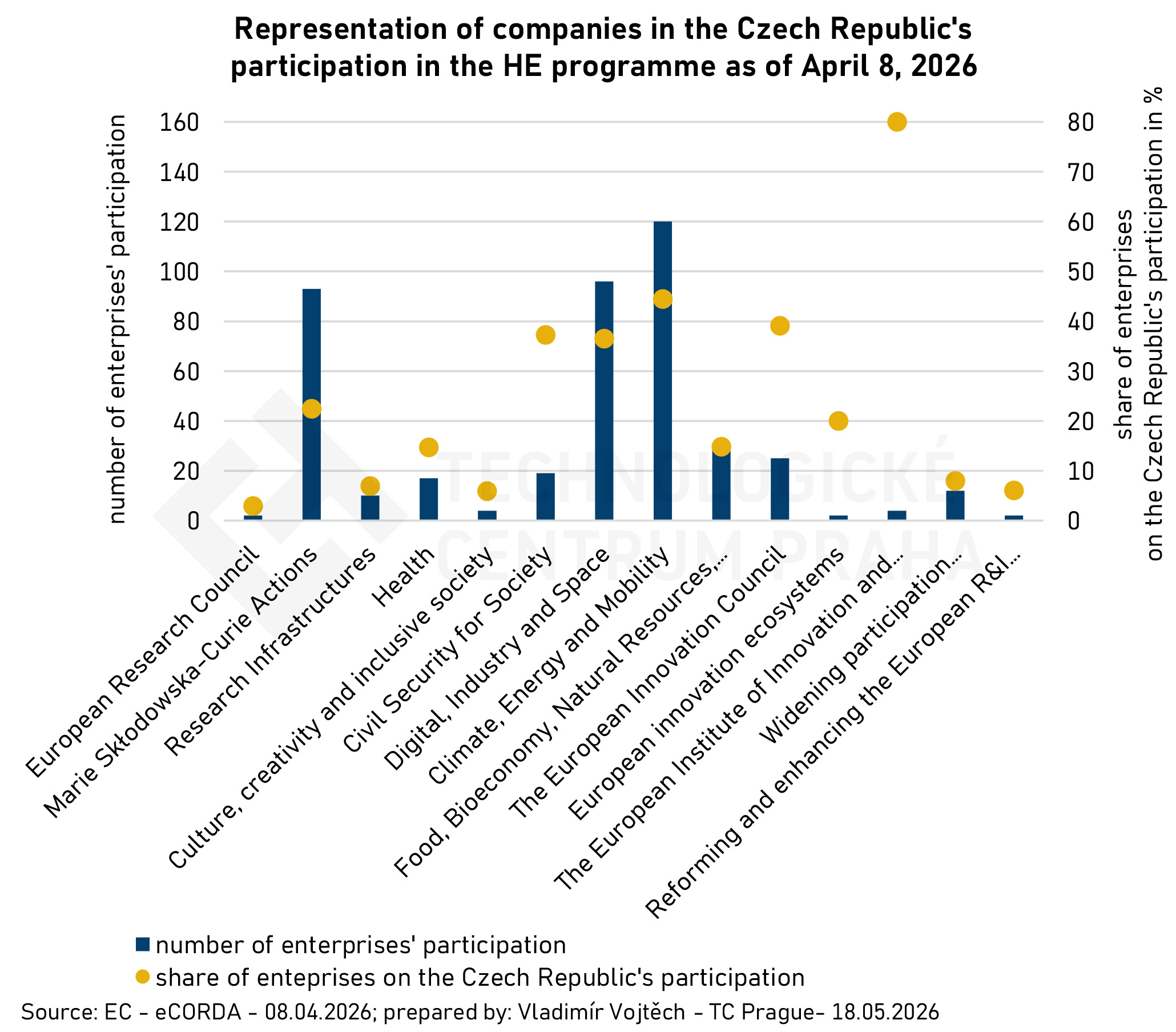
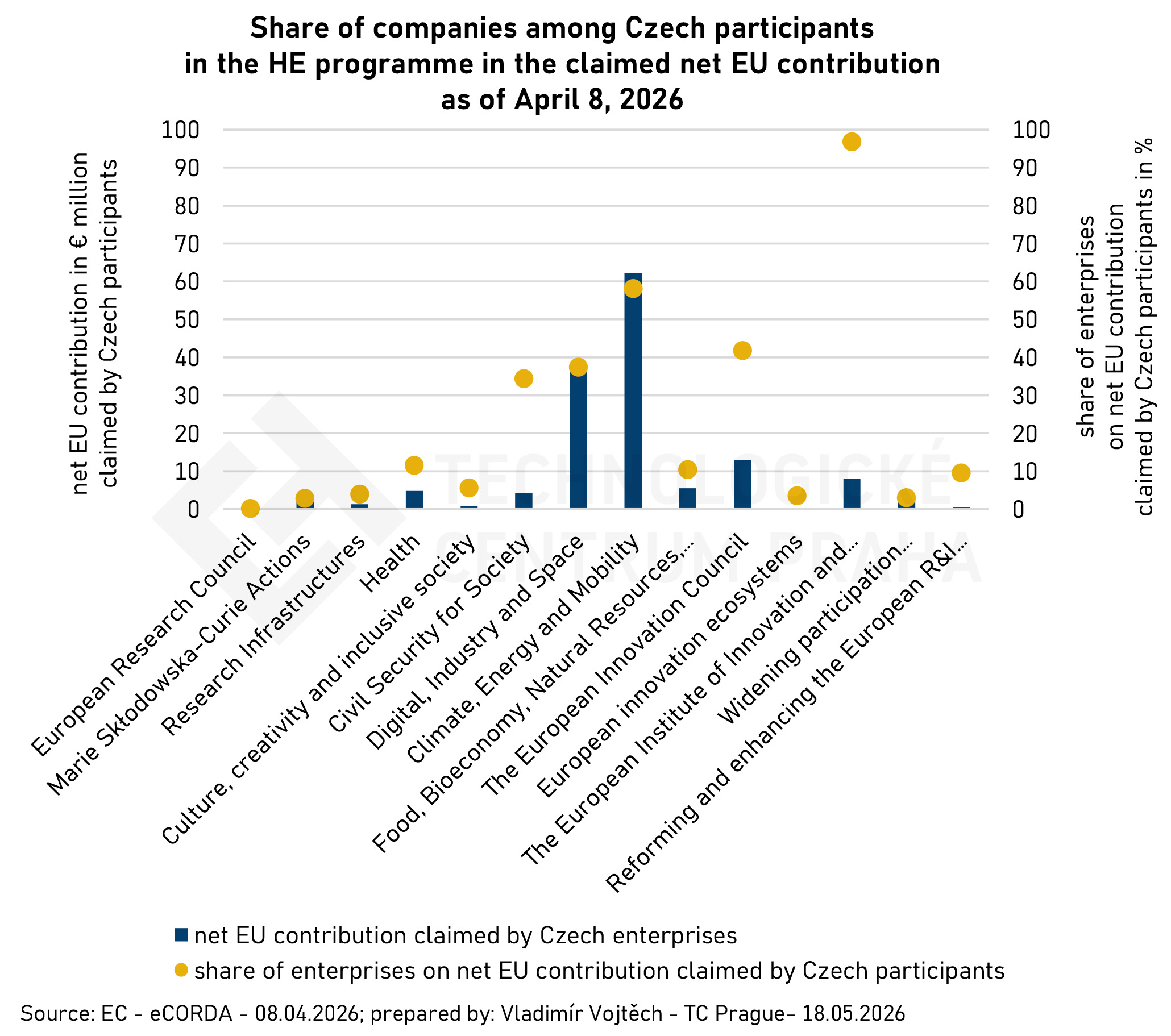
Clusters 5 (Climate, Energy and Mobility; 120 participations) and 4 (Digital, Industry and Space; 96 participations), along with the Marie Skłodowska-Curie Actions (93 participations), recorded the highest number of Czech company participations. This accounts for 71% of all Czech company participations in the HE programme. In term of net EU contribution, the highest total amounts were claimed by Czech companies in Clusters 5 (Climate, Energy and Mobility; €62.3 million) and 4 (Digital, Industry and Space; €38.4 million) and the European Innovation Council instruments (€12.9 million). Together, these account for four-fifths of the net EU contribution claimed by Czech companies in the HE programme.
If we assess the share of companies in total Czech participation across the individual priorities and clusters of the HE programme, the European Institute of Innovation and Technology dominates (80%, though with only 4 company participations), followed by Cluster 5 (Climate, Energy and Mobility; 44%), the European Innovation Council instruments (39%), and Clusters 3 (Civil Security for Society) and 4 (Digital, Industry and Space; 37% each). The same priorities and clusters also dominate in terms of corporate representation in the total EU funding claimed by Czech participants.
In this section of the article, we will briefly note that Czech companies are participating even in those parts of the Horizon Europe programme where their participation would be considered rather rare, surprising, or unexpected. A prime example of this are two business participations in in the European Research Council’s proof-of-concept grants. These grants are intended for principal investigators who aim to commercially apply the results of their research stemming from previous participation in the European Research Council’s so-called “main” grants. A similar example is corporate participation in the Marie Skłodowska-Curie Actions focused on promoting researcher mobility. As of April 8, 2026, the MSCA recorded 93 participations by Czech companies—making it the priority with the third-highest level of Czech corporate participation. On the other hand, in 82 MSCA participations, companies act as associated partners (at whose facilities, exempli gratia, researchers supported by the project may host and receive training) with zero claimed net EU contribution.
If we focus on comparing the participation of Czech companies in the individual priorities and clusters of the HE programme according to their size—as measured by the number of employees—we can conclude at first glance that micro and small enterprises, i.e., those with up to 49 employees, dominate in terms of participation and the EU funds they have claimed in most of these areas. Nevertheless, the share of micro and small enterprises in the total net EU contribution claimed by Czech enterprises is only 41%. This is due to the significant representation of medium-sized and large enterprises in Clusters 5 (Climate, Energy and Mobility; 84%), 3 (Civil Security for Society; 63%), and 4 (Digital, Industry and Space; 61%). As we know from the paragraphs above, it is Clusters 4 and 5 that dominate Czech enterprise participation.
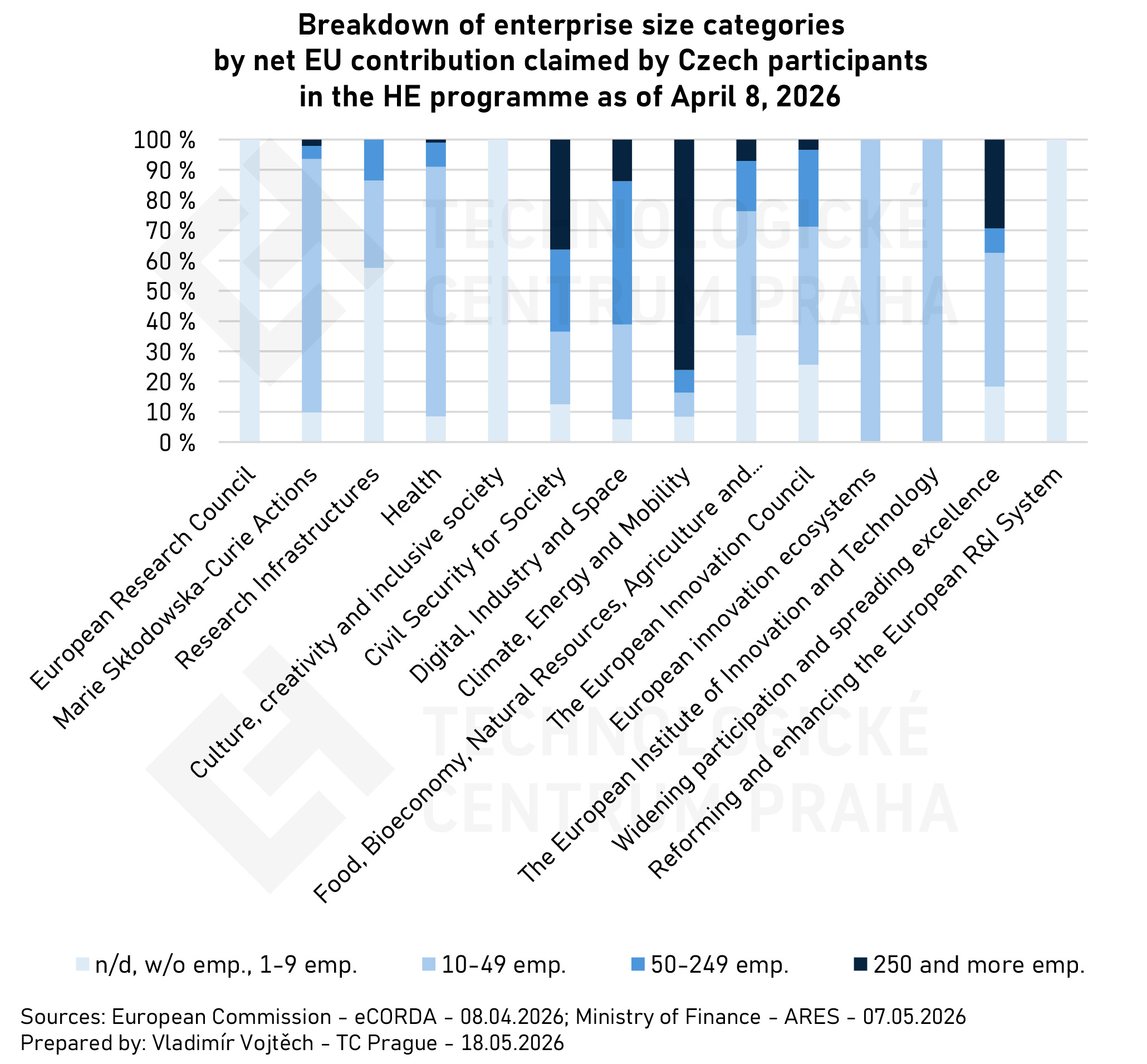
The largest amounts of net EU funding in Cluster 5 are claimed by large enterprises (over 250 employees): Honeywell International s.r.o. (€24.4 million), Chart Ferox, a.s. (€5.7 million), Eaton Elektrotechnika s.r.o. (€4.9 million), AŽD Praha s.r.o. (€4.5 million), followed by Škoda Auto a.s. (€1.6 million), Garrett Motion Czech Republic s.r.o. (€1.2 million), and Thermo Fisher Scientific Brno s.r.o. (€1 million). In the case of Cluster 4, two-fifths of the amount claimed by Czech companies is attributable to Codasip s.r.o. (€15.5 million), which, according to employee data listed in the Administrative Register of Economic Entities, is a medium-sized enterprise. Among medium-sized enterprises (50–249 employees) in this cluster, Institut mikroelektronických aplikací s.r.o. (€1 million) is also worth mentioning; among large enterprises, VALEO AUTOKLIMATIZACE k.s. (€837,000) and NXP Semiconductors Czech Republic s.r.o. (€672,000). In Cluster 3, we must not overlook the large enterprise Thales DIS Czech Republic s.r.o., which accounts for one-fifth (€836,000) of the total net EU contribution claimed by Czech enterprises in this cluster.
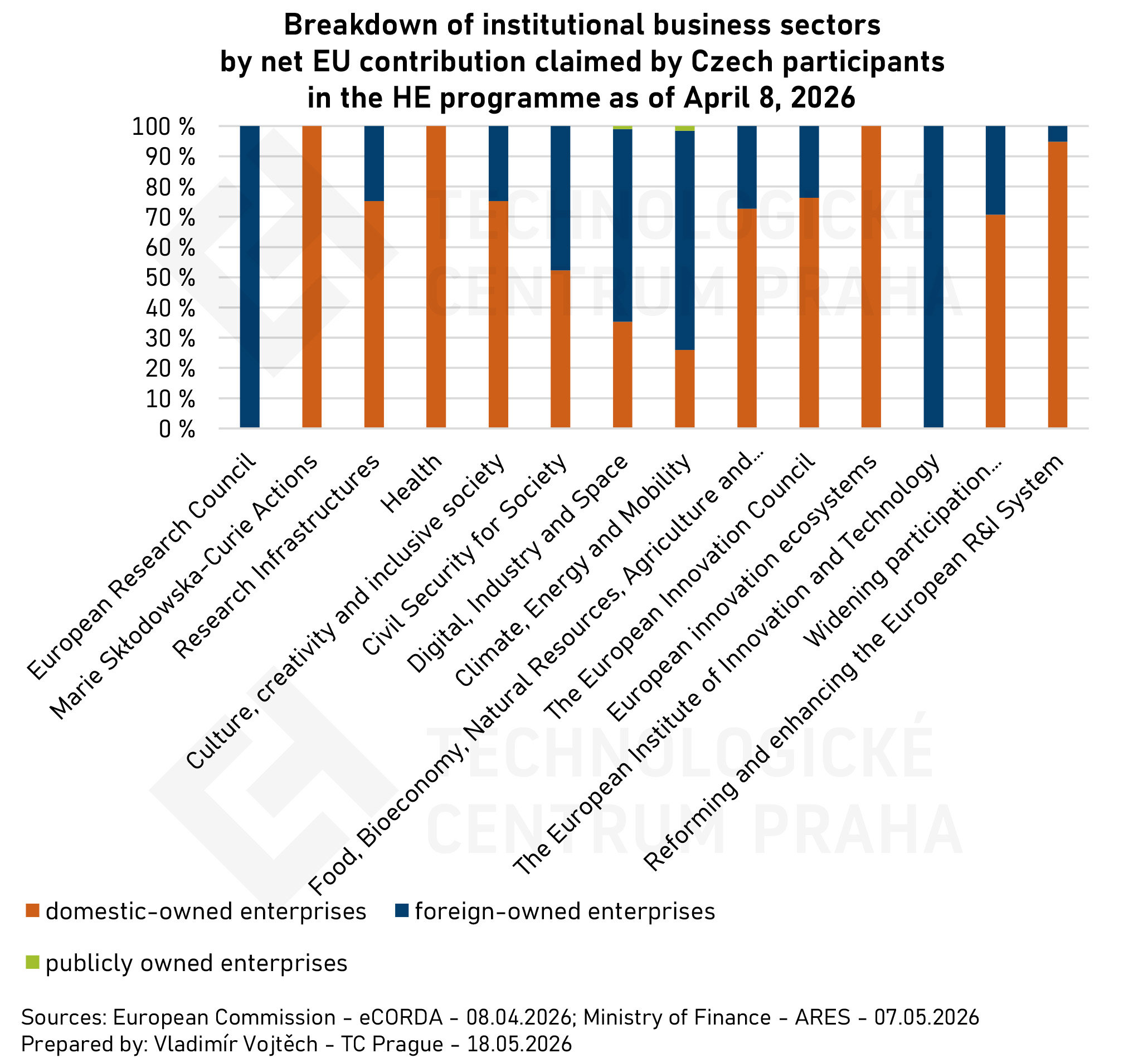
Closely related to the points made above is the fact that the share of foreign-controlled firms in the EU funding schemes in question—excluding the European Institute of Innovation and Technology—is again highest in Clusters 5 (72%), 4 (64%), and 3 (48%). That is, in clusters characterized by the highest participation of medium-sized and large enterprises. As noted in the previous post, medium-sized and large enterprises dominate the participation of Czech firms under foreign control. And apart from AŽD Praha s.r.o., which is domestically owned, the firms mentioned in the paragraph above also fall into this category.
Summary:
Medium-sized and large enterprises (i.e., those with more than 50 employees) account for three-fifths of the net EU contribution claimed by Czech enterprises under the HE programme. Their participation is concentrated in Clusters 5 (Climate, Energy and Mobility) and 4 (Digital, Industry and Space). In contrast, in other priorities and clusters, micro and small enterprises (up to 49 employees) claim the majority of EU funds.
Since Czech companies under foreign control that participate in the HE programme fall predominantly into the category of medium-sized and large enterprises, it is natural that their participation is concentrated in the aforementioned Clusters 4 and 5. Conversely, in other priorities and clusters, domestically owned (primarily micro and small) enterprises predominate.
Prepared by: Vladimír Vojtěch, vojtech@tc.cz, TC Prague, 18.06.2026