In the fall of 2022 and subsequently in a special issue of the journal ECHO (No. 1/2024, pp. 37–38), we examined, inter alia, the size and ownership structure of Czech enterprises participating in the Framework Programmes. The aim of this article is to build on that work and once again evaluate the structure of Czech enterprises participating in the Horizon Europe programme (hereinafter “HE”) by number of employees and institutional sector (ownership). Since we are evaluating three consecutive Framework Programmes, the size categories and ownership at the time of the programme’s conclusion are decisive for us. This means that for the 7th Framework Programme, we consider the year 2014, and for the Horizon 2020 programme, the year 2021. In the case of the current HE programme, ECHO No. 1/2024 presented data on Czech enterprise participation as of June 19, 2023, while data on the ownership and size structure of enterprises were as of 2021. This paper adds data as of April 8, 2026, with data on the ownership and size structure of enterprises as of May 7, 2026.
Data on the ownership and size structure of Czech enterprises comes from two sources. The MagnusWeb database product, operated by Dun & Bradstreet Czech Republic, a.s., served as the data source for the participation of Czech enterprises in the 7th Framework Programme, the Horizon 2020 programme, and HE (as of June 19, 2023). For Czech enterprise participation as of April 8, 2026, data on ownership and size structure were obtained from the Administrative Register of Economic Subjects operated by the Ministry of Finance of the Czech Republic.
Before assessing the size and ownership structure of Czech companies participating in the Framework Programmes, it is important to bear in mind that, over the long term, private for-profit companies have accounted for roughly one-fifth to one-quarter of the Czech Republic’s participation in the Framework Programmes. This holds true both in terms of their share of total participation and their share of EU funding.
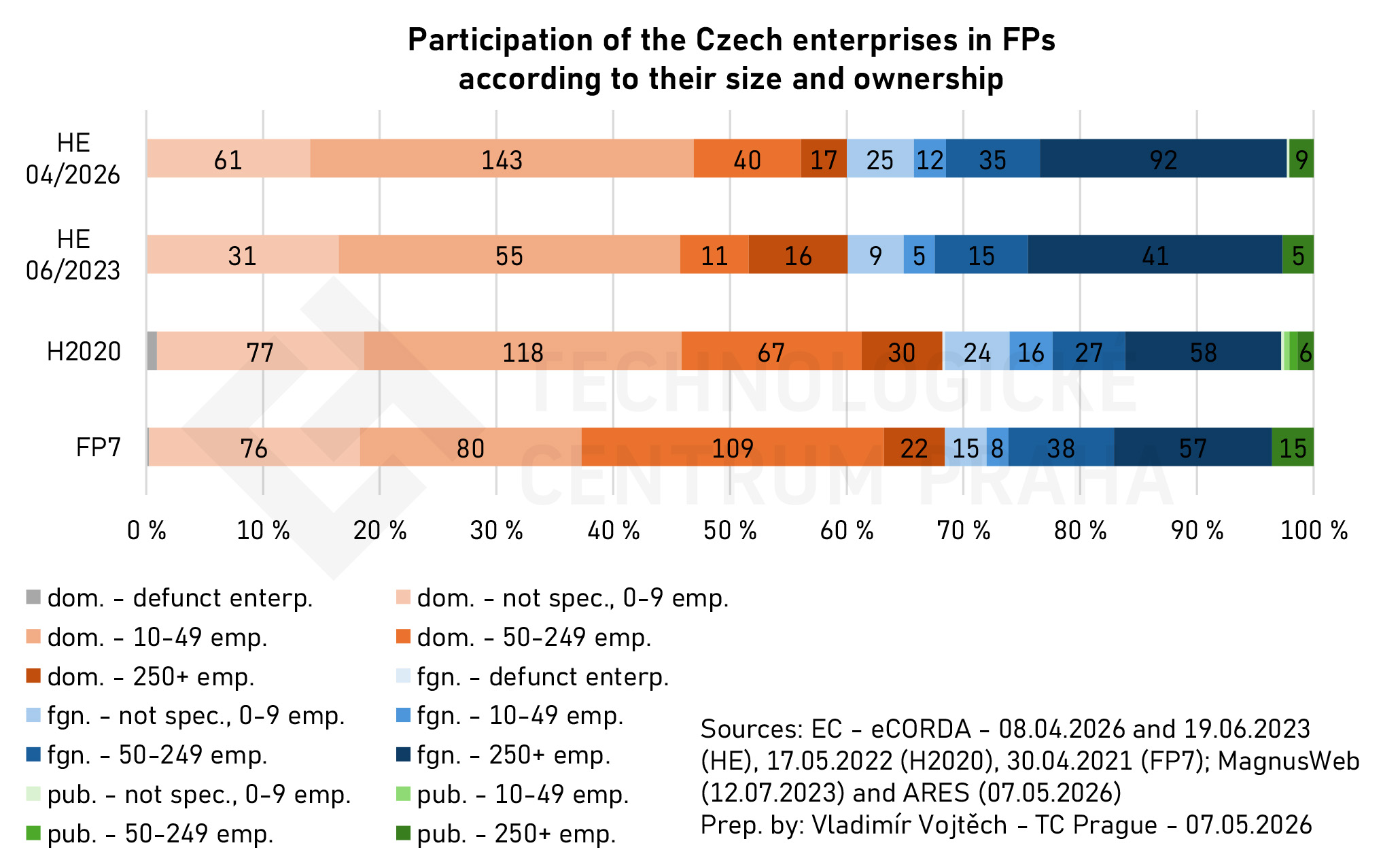
In terms of ownership, domestically owned companies account for the majority of Czech private for-profit companies’ participation in all three Framework Programmes. In both the 7th Framework Programme and Horizon 2020, they accounted for two-thirds of this participation; in the HE programme, they consistently account for roughly three-fifths.
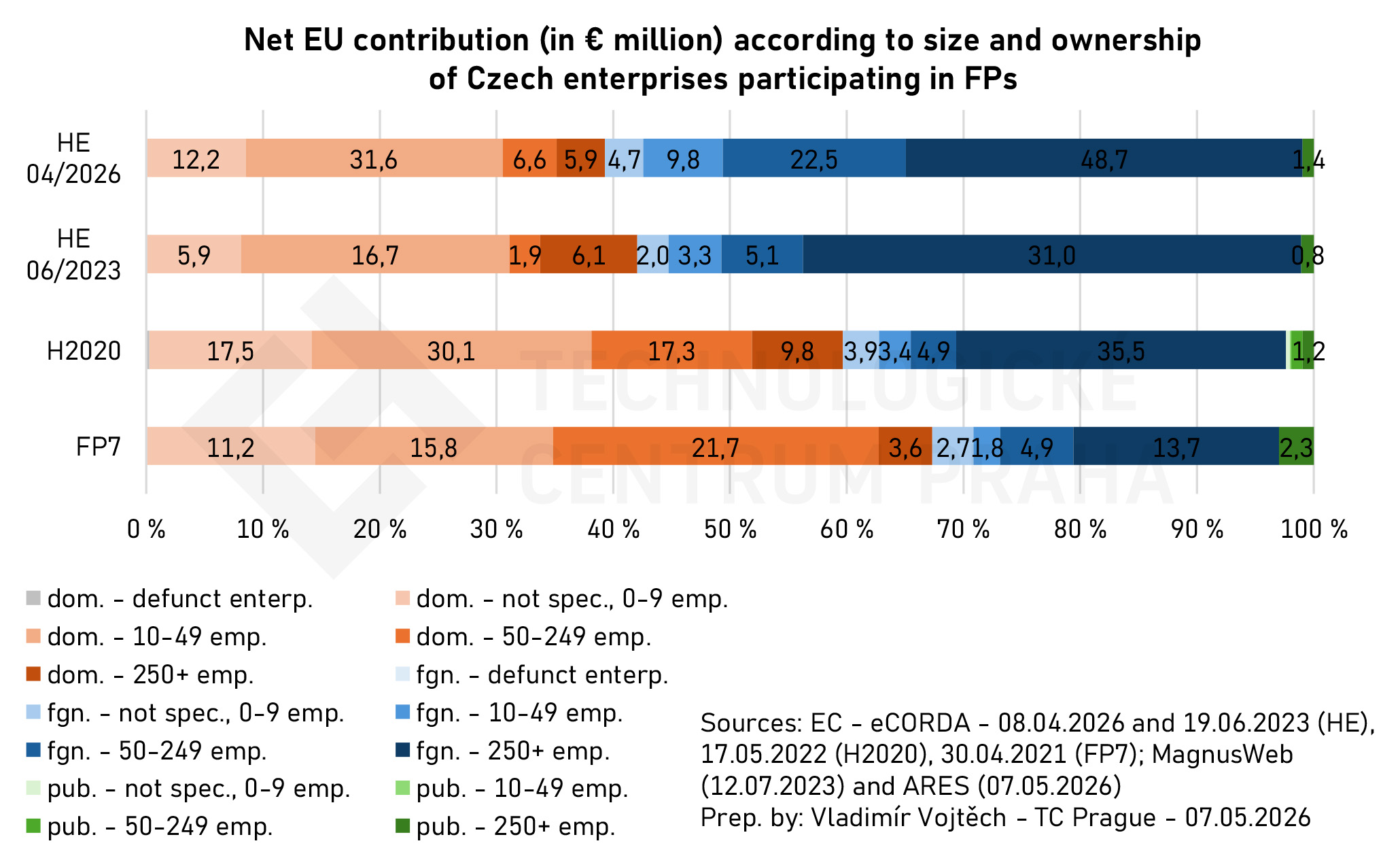
In terms of net EU contribution, the share of domestically owned Czech companies has been declining over the long term, while the share of foreign-owned Czech companies has been increasing. While domestically owned Czech enterprises claimed 67% of the net EU contribution in the 7th Framework Programme and 60% in the Horizon 2020 programme, this segment of Czech enterprises claimed 42% of the net EU contribution in the HE programme in June 2023 and 39% in April 2026. In the case of Czech enterprises under foreign ownership, their share of claimed EU contribution rose from 30% (in the 7th Framework Programme) to 60% (in the HE programme as of April 8, 2026). The share of public enterprises has long been negligible.
In the case of Czech enterprises that are domestically owned and participate in the Framework Programmes, the size structure is changing significantly over the long term. Among these enterprises, the share of medium-sized and large enterprises (i.e., enterprises with 50–249 employees and 250 or more employees, respectively) in EU funding claims has been declining over the long term. In the 7th Framework Program, micro and small enterprises (i.e., enterprises with up to 49 employees) accounted for 52% of the net EU contribution claimed by domestically owned enterprises; in the Horizon 2020 programme this figure rose to 64%, and in the HE programme it was 74% in June 2023 and 78% in April 2026.
In contrast, among Czech companies that are foreign-owned and participate in Framework Programmes, large enterprises (with 250 or more employees) have long been in the majority. They have long accounted for more than half of the net EU contribution claimed by Czech enterprises under foreign ownership. However, the dominance of this segment of foreign-owned enterprises is gradually being eroded by medium-sized enterprises (50–249 employees) and small enterprises (10–49 employees).
Summary:
Over the long term, businesses have accounted for roughly one-fifth to one-quarter of the Czech Republic’s participation in the Framework programmes. In terms of participation, domestically owned enterprises predominate among Czech companies (and within this group, the segment of small enterprises with 10–49 employees is gaining significant ground, while the importance of the segment of medium-sized enterprises with 50–249 employees has declined significantly). Conversely, in terms of EU contribution claimed, foreign-owned domestic enterprises predominate (and among them, the segment of large enterprises with more than 250 employees has long dominated).
Author: Vladimír Vojtěch, vojtech@tc.cz, TC Prague, 28.05.2026