In an article published on March 12, 2026, we looked at the participation of Czech entities in selected other EU’s programmes, with an emphasis—primarily for methodological reasons—on participation in projects. We are addressing this topic—at least tangentially—because documents issued by the European Commission regarding the Horizon Europe programme (position papers, evaluations, work programmes) often mention the need for synergy between the framework programme and other EU’s programmes.
To date, we have primarily obtained data on the Czech Republic’s participation in other EU programmes from the European Commission’s Funding and Tenders Portal, where we essentially tracked the participation of Czech organizations in relevant programmes on a call-by-call, project-by-project basis. However, due to the nature of the Funding and Tenders Portal, we were unable to effectively collect data on the participation of other countries in other EU programmes.
The development of publicly available interactive dashboards by the European Commission allows users to easily track participation and funding claims from the EU budget, as well as from certain other EU programmes besides Horizon Europe. In addition to the Horizon Dashboard for EU framework programmes for research and innovation, this includes the dashboard of the European Climate, Infrastructure and Environment Executive Agency (CINEA) (covering, inter alia, the LIFE programme and the Innovation Fund) and the DIGITAL Dashboard (Digital Europe programme). Using these tools, we can easily obtain information on the participation of countries, individual organizations, and their types in the relevant programmes and their sub-components. And, of course, we can combine this information in various ways. For the purposes of this article, we will focus on comparing the participation of the Czech Republic, new, and old EU member states in the Horizon Europe, LIFE, Digital Europe, and Innovation Fund programmes.
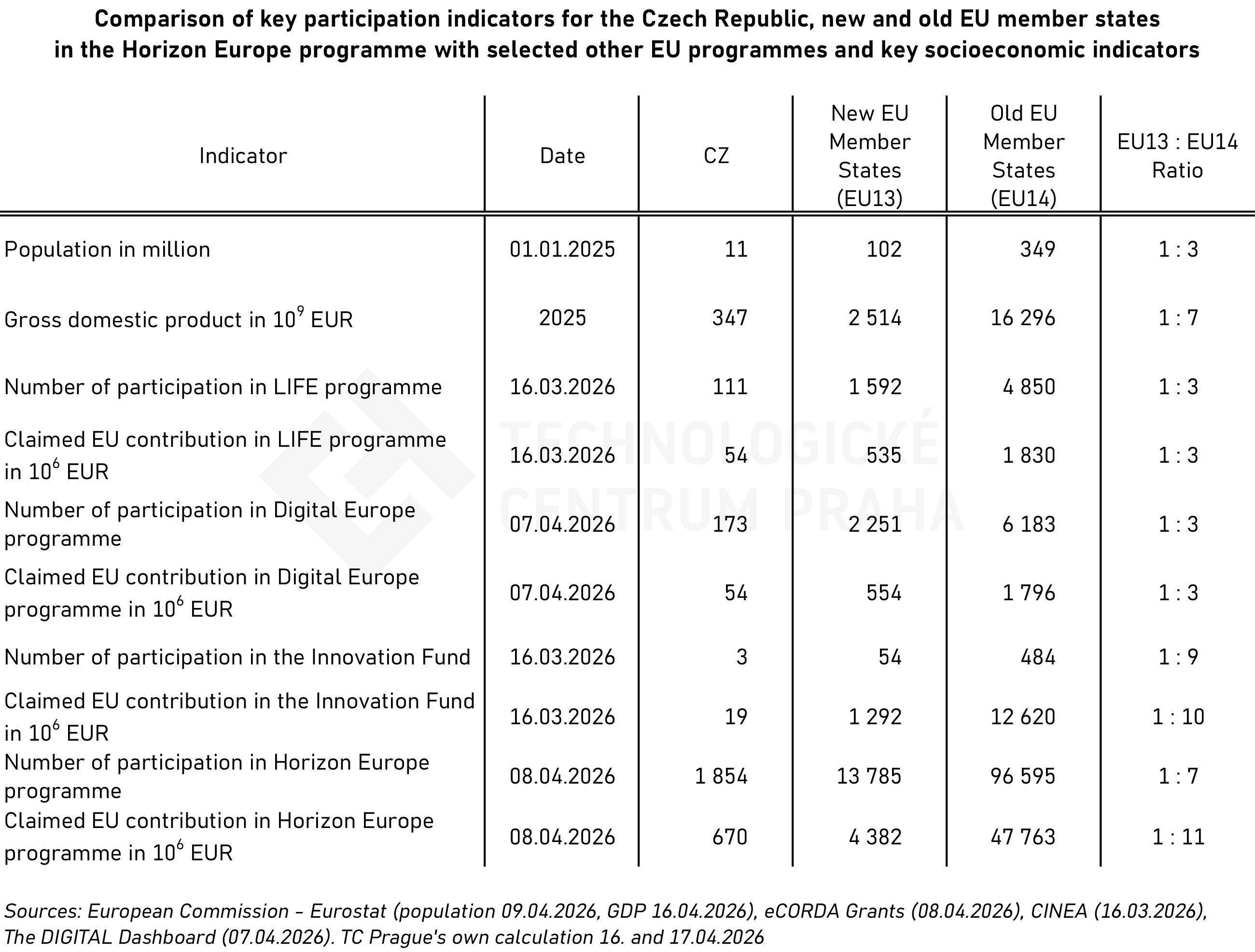
We previously examined the geographical disparities in the distribution of socioeconomic phenomena between the old and new EU member states in 2023 (ECHO journal, No. 4–5/2023). Using the table above, we build upon this article, update it, and expand the presented data to include the Digital Europe and Innovation Fund programmes.
If we take population size as the baseline variable determined by the geography of the EU, we can establish a basic ratio of 1 to 3 between the new and old member states. This means that for every 1 inhabitant of the new EU member states, there are roughly 3 inhabitants in the old EU member states. The same basic ratio is evident in participation and claimed EU contributions in EU programmes focused on environmental protection and restoration (LIFE) and digitalization (Digital Europe). In these programmes, therefore, for every 1 funded participation, or 1 euro of EU contribution claimed by participants from new EU member states, there are 3 participations, or 3 euros claimed by participants from old EU member states.
In contrast, for the Horizon Europe programme and the Innovation Fund, the ratios between new and old member states in terms of funded participation and claimed EU funds reach significantly higher values, ranging from 1:7 to 1:11. According to the principles of the geographical organization of society, therefore, as the sophistication and excellence of socio-economic activities increase, so does the unevenness of their spatial distribution. Based on the ratios cited, Horizon Europe and the Innovation Fund can therefore be considered examples of EU programmes characterized by the highest levels of excellence, prestige, and competition among applicants.
Summary:
Based on data from the European Commission’s publicly available dashboards for the Horizon Europe, LIFE, Digital Europe, and Innovation Fund programmes, the following conclusions can be drawn: The ratio of participation and claimed EU funds between new and old EU member states in the case of the LIFE and Digital Europe programmes does not differ in any way from the distribution of the population. In contrast, for Horizon Europe and the Innovation Fund, for every 1 participation or 1 euro claimed by participants from new EU member states, there are 7 to 11 participations or euros claimed by participants from old EU member states.
Prepared by: Vladimír Vojtěch, vojtech@tc.cz, TC Prague, 21.04.2026