In the European debate on the Horizon Europe programme and its successor, it is increasingly emphasised that so-called Widening countries do not constitute a homogeneous group. These countries differ significantly in terms of the size of their research systems, their level of innovation performance, and their capacity to engage in international collaboration. The design of support measures should therefore reflect these differences rather than follow a uniform approach.
The analysis carried out by TC Prague examines how financial support from the Widening priority is distributed across countries and to what extent this distribution corresponds to their research capacity and need for support. Rather than focusing solely on the absolute volume of funding received, the analysis applies a reference-based approach that makes it possible to assess whether countries receive a share of funding in line with expectations, or whether they exceed or fall short of it.
This approach distinguishes between two key dimensions. The first identifies which countries are the main recipients of Widening funding in absolute terms. The second, analytically more relevant, assesses which countries achieve above- or below-expected funding shares relative to their research capacity and position within the European Research Area.
A further important question is whether a country’s position within Widening reflects a genuinely Widening-specific effect, or whether it largely mirrors its overall participation and performance in the Horizon Europe programme. This comparison provides a deeper understanding of the role that Widening plays within national research systems.
Based on this combined perspective, a typology of 29 Widening countries has been developed, grouping countries along two main dimensions:
- their ability to attract funding from the Widening priority, and
- the importance of this funding for their overall participation in Horizon Europe.
As illustrated in the table below, this typology highlights substantial differences among Widening countries — ranging from those for which Widening constitutes a key component of their participation in the framework programme, to those that use it primarily as a complementary funding source, as well as countries that have not yet fully utilised its potential.
Overview of the main types of Widening countries
1. Leaders
Group 1 (e.g. Estonia, Croatia)
Countries that not only receive a high volume of Widening funding, but for which this priority also represents a key pillar of their participation in Horizon Europe.
Group 2 (including Czechia and Portugal)
Countries that also achieve a high volume of Widening funding, but whose participation in Horizon Europe is not primarily driven by this priority. Widening is important for them, but does not represent a dominant component of their participation.
2. Visible recipients
Group 3 (Lithuania, Slovakia, Serbia)
Countries with a significant volume of funding and a noticeable Widening-specific effect, meaning their position within Widening is stronger than their overall position in Horizon Europe.
Group 4 (e.g. Poland, Greece, Bulgaria)
Countries that also receive substantial funding from Widening, but whose share within this priority broadly corresponds to their overall share in Horizon Europe. For these countries, participation in Widening does not represent a distinct advantage compared to their overall programme participation.
3. Smaller but relatively strong performers
Group 5 (e.g. Malta, Western Balkan countries)
Countries with a smaller absolute funding volume that nevertheless achieve relatively strong results within Widening compared to their research capacity.
4. Countries with limited participation
Group 6 (e.g. Hungary, Romania, Ukraine)
Countries that make less use of Widening instruments than might be expected given their potential, with funding outcomes below the expected level.
5. Specific cases
Group 7 (e.g. Armenia, Morocco, Tunisia)
Countries that could not be fully assessed due to data limitations or lack of comparability.
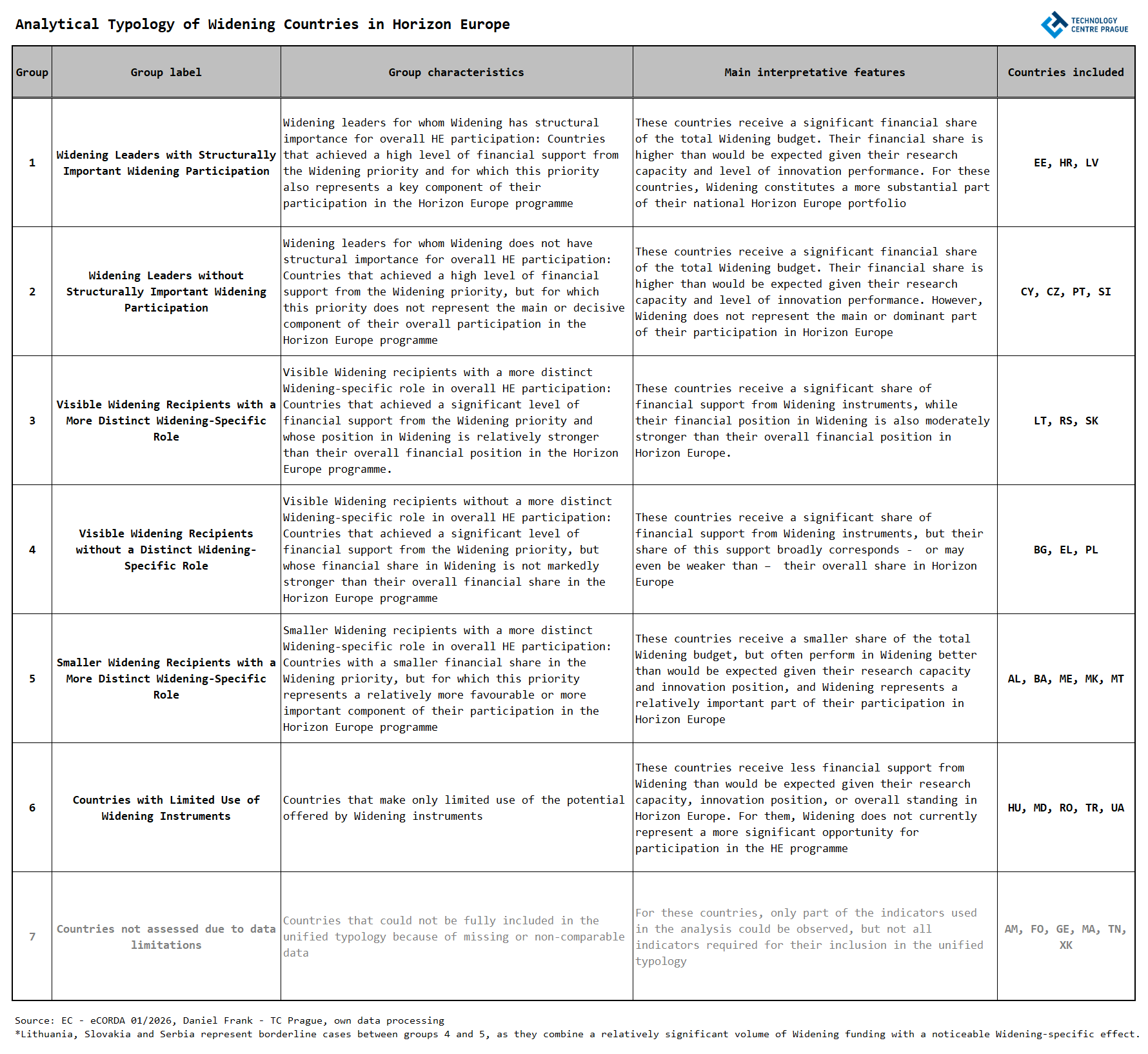
Table: Typology of country participation in the Widening priority of Horizon Europe based on this analysis
The typology confirms that a “balanced” distribution of funding cannot be understood as an equal distribution across all Widening countries. Instead, it shows that actual funding allocation is uneven and shaped by a combination of factors, including research capacity, absorption capacity, and structural need for support.
The analysis thus provides a more nuanced understanding not only of which countries receive the largest amounts of funding, but also of the role that Widening plays in their overall participation. This is relevant both for interpreting the current outcomes of Horizon Europe and for informing discussions on the future design of support measures.
The full analysis is available here (in Czech only).
Author: Daniel Frank, Technology Centre Prague, frank@tc.cz, 10 April 2026