The analysis "Mobility of ERC grant applicants: between excellence and the attractiveness of research systems" (in Czech only) by TC Prague provides a data-based view of the mobility of ERC grant applicants in Horizon Europe. It does not understand mobility merely as the movement of applicants between countries, but also as a structural indicator of openness, international connectedness and the institutional attractiveness of the European research area.
It shows which European research systems are genuinely attractive to ambitious ERC grant applicants. It examines where the capacity to attract international talent is concentrated, and where, by contrast, applicants more often submit proposals through foreign host institutions. The mobility of ERC grant applicants is also an indicator of the quality of the host environment, the reputation of institutions and their ability to offer conditions for excellent research. In addition to mobility between countries, the analysis also looks at differences by countries’ innovation performance, ERC scientific domains and ERC grant types.
Czechia: openness without sufficient grant conversion
For the Czech research environment, the analysis brings an important finding: in this comparison, Czechia does not appear to be a closed research system. The share of foreign ERC grant applicants among all applicants submitting proposals through Czech host institutions reaches 37.0%, which is significantly higher than the EU-13 average of 28.1%. At the same time, the share of ERC grant applicants born in Czechia who submit proposals through a foreign host institution is lower, at 23.0%.
This result, however, captures only one part of the Czech reality. Although Czech host institutions attract a relatively high share of foreign ERC grant applicants, this interest has so far translated into funded grants only to a limited extent. In the period analysed, foreign applicants submitted 153 project proposals through Czech host institutions, of which only 9 grants were funded, corresponding to a success rate of 5.9%.
The structure of these applicants’ countries of birth is also important. Only 18.3% of foreign applicants in Czechia come from countries classified by the European Innovation Scoreboard 2025 (EIS 2025) as Innovation Leaders or Strong Innovators, while the majority come from groups of countries classified by EIS 2025 as Moderate Innovators, Emerging Innovators, or from countries outside this classification. This suggests that although Czech host institutions do attract foreign applicants, they less often attract applicants from countries belonging to Europe’s strongest innovation systems.
The key challenge for Czechia is therefore not only to attract more foreign applicants, but above all to strengthen the quality of the host environment, institutional support and proposal preparation, so that foreign interest and domestic potential are more often translated into competitive project proposals and subsequently into funded ERC grants. Part of this challenge is also to create conditions that give successful ERC grantees a reason to prepare their proposals in cooperation with Czech host institutions and then to implement the funded projects in Czechia for the full duration of the grant.
Asymmetry of the European research area
The analysis shows that European research systems differ markedly in their ability to attract ERC grant applicants. Countries such as Switzerland, Norway, the United Kingdom, Austria, Sweden and Denmark have a high share of foreign ERC grant applicants and act as strong attractors for researchers involved in international scientific mobility.
By contrast, countries with high outgoing and low incoming mobility, such as Ukraine, Bulgaria, Serbia or Romania, show a predominance of applicants submitting ERC proposals through foreign host institutions. In these cases, high outgoing mobility combined with a low share of foreign applicants may indicate that the domestic research environment is not sufficiently attractive for the preparation of ERC proposals.
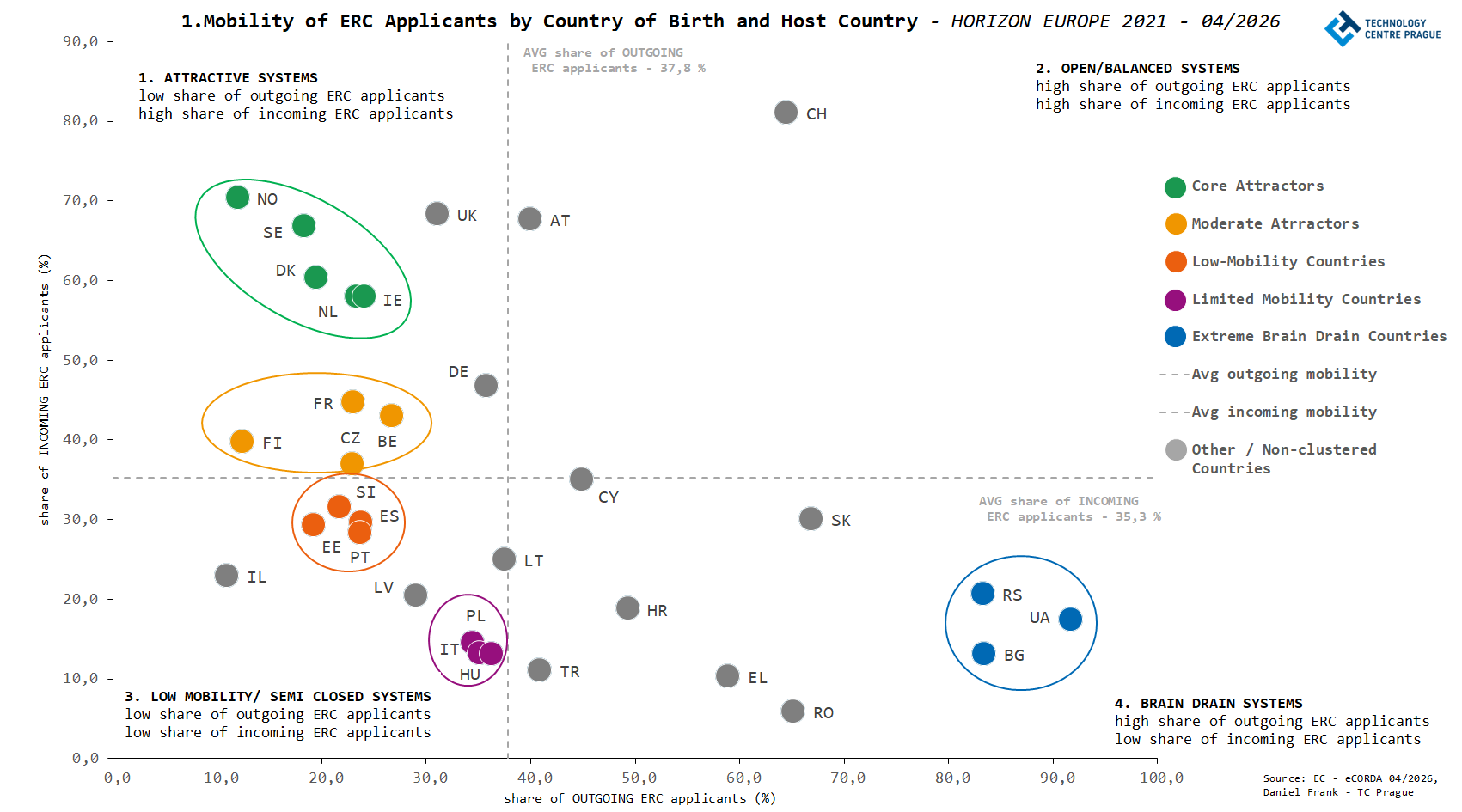
Figure 1: Mobility of ERC applicants by country of birth and host country (incoming vs. outgoing).
Source: EC – eCORDA 04/2025; own data processing by Daniel Frank, TC Prague.
Mobility of ERC grant applicants by scientific domain and grant type
Differences in mobility rates are also visible across ERC scientific domains. The mobility of ERC grant applicants is higher in Physical Sciences and Engineering (PE) and in Social Sciences and Humanities (SH), where it is around 46%, while in Life Sciences (LS) it is lower, at approximately 40%. These differences are likely related to different career paths, institutional anchoring and requirements for the host environment across scientific fields.
There is also a relationship between mobility and the career stage of ERC grant applicants. Mobility is highest for Starting Grants (StG), where almost half of applicants submit their proposal outside their country of birth. Mobility is lower for Consolidator Grants (CoG) and decreases further for Advanced Grants (AdG). This is consistent with the expectation that mobility among ERC grant applicants is strongest in earlier stages of a scientific career, while established researchers are more often linked to a more stable institutional environment.
The full analysis is available in Czech here.
A previous analysis, “Mobility and success rate of ERC grant applicants from three perspectives" (only in Czech) or its shortened version in English "Czechia Attracts More Foreign ERC Applicants under Horizon Europe than Poland, Hungary and Slovakia Combined", also addresses the relationship between mobility and grant success among ERC grant applicants.
Author: Daniel Frank, frank@tc.cz, TC Prague, 7 July 2026