Marie Skłodowska-Curie Actions (MSCA) under Horizon Europe are a key EU instrument for researcher mobility and training—ranging from individual postdoctoral stays to doctoral networks, staff exchanges, and institutional mobility programmes.
This correspondence analysis by TC Prague assesses the position of EU-27 Member States in terms of their capacity to coordinate proposal preparation across the main MSCA training and mobility action types: Postdoctoral Fellowships (PF), Doctoral Networks (DN), Staff Exchanges (SE), and COFUND. The analysis draws on the eCORDA database (status as of 12/2025) and covers all MSCA proposals that underwent expert evaluation in the 2021–2024 calls (31,609 project proposals in total).
The correspondence analysis of submitted project proposals shows that EU-27 countries differ not only in the number of proposals coordinated by their institutions, but above all in the structure of this coordination across action types. The result is the identification of typical country participation profiles in MSCA proposal preparation—from a focus on individual fellowships, through taking on the coordinating role in international consortia for doctoral education and research-related staff exchanges, to running their own programmes supporting researcher mobility.
PF represent both the most widespread type of submitted proposals and the most common form of engagement of researchers and host institutions in MSCA calls. By contrast, DN and SE differentiate countries more strongly by their ability to assume the coordinating role in international consortia—i.e., to coordinate joint activities across multiple institutions. COFUND is primarily associated with countries that are able to design and manage their own (doctoral and/or postdoctoral) training and mobility programmes co-funded by the EU.
Based on the correspondence analysis parameters, EU-27 countries were grouped into five clusters.
Group A: SE specialists
RO, LV, BG, PL, EL, CY, LT, EE
Countries whose main structural approach to MSCA lies in coordinating Staff Exchanges network projects. Here, MSCA functions primarily as an instrument for network integration (contacts, linkages, know-how transfer), rather than as a main channel for individual mobility or doctoral infrastructure.
Group B: DN hubs
NL, BE, IE, DE
Countries with an above-average capacity to coordinate/anchor and build international doctoral networks. DN function here as a systemic instrument for human resources management and the European doctoral training infrastructure.
Group C: COFUND profile
FI, FR, HU, SK
Countries whose profile is best explained by the COFUND dimension. MSCA functions here more as “programme policy”—co-funding and institutionalising mobility, often with stronger links to national or institutional programmes.
Group D: PF-dominant / DN-deficit
CZ, SI, MT, LU
Countries seeking to use MSCA primarily as an instrument for individualised mobility (PF), while showing a structural deficit in the consortium-based doctoral dimension (DN). Their profile corresponds to systems with greater reliance on individual initiatives and a weaker capacity to build large consortium infrastructures.
Group E: balanced / universal systems
ES, IT, AT, DK, SE, PT, HR
Countries without a pronounced specialisation in a single action type; their portfolio structure is close to the overall structure of the system.
Key implications for the Czech Republic and public policy
-
EU-27 countries differ not only in how many proposals they coordinate, but mainly in which action types they most often assume the coordinator role. Differences appear in the structure of coordination across MSCA schemes: some countries dominate in individual grants, others more often coordinate network projects (DN/SE), and others profile themselves through their own EU co-funded fellowship programmes (COFUND).
-
The Czech Republic is consistently strongest in proposals and projects prepared on an individual basis by researchers. The Czech profile is similar in both coordinated proposals and funded MSCA grants: it is dominated by individual mobility, while the coordinator role in consortium schemes (DN/SE) remains relatively limited.
-
The Czech Republic’s weaker presence as a DN/SE coordinator reflects institutional capacities rather than “failure.” DN/SE are schemes where long-term networks are built and institutions establish reputations as hubs of European cooperation; low coordination therefore implies weaker anchoring in the core of international networks.
-
SE can serve as a practical step towards strengthening the ability to coordinate international cooperation. Staff exchanges support stable collaborations and provide experience in managing international projects—useful for ambitions in more demanding consortium formats (including DN) and in other parts of Horizon Europe.
-
MSCA COFUND is relevant where there is an ambition to build mobility programmes. It is associated with countries and institutions able to design and operate their own programmes (rules, selections, quality assurance) co-funded by the EU.
-
If the Czech Republic wants to strengthen its coordinator role in DN/SE, this is a task for institutional policy, not individuals. The key is long-term investment in institutional project support structures, targeted support for coordinators, the development of consortium-management competences, and active portfolio management (a shift from “hosting” to “leading” where realistic).
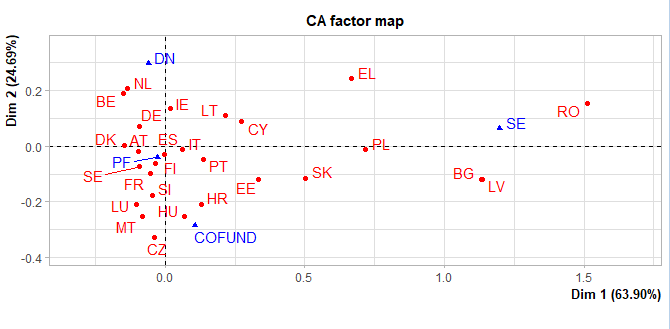
Figure 1: Map A: CA factor map – Dim1 × Dim2 (biplot of countries and instruments; 88.6%). Source: EC – HE eCORDA 12/2025, Daniel Frank – TC Prague, FactoMineR: Multivariate Exploratory Data Analysis and Data Mining with R
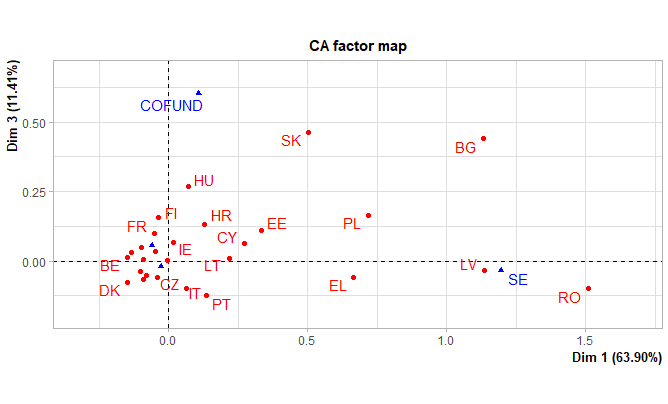
Figure 2: Map B: CA factor map – Dim1 × Dim3 (biplot of countries and instruments; complementary COFUND axis). Source: EC – HE eCORDA 12/2025, Daniel Frank – TC Prague, FactoMineR: Multivariate Exploratory Data Analysis and Data Mining with R
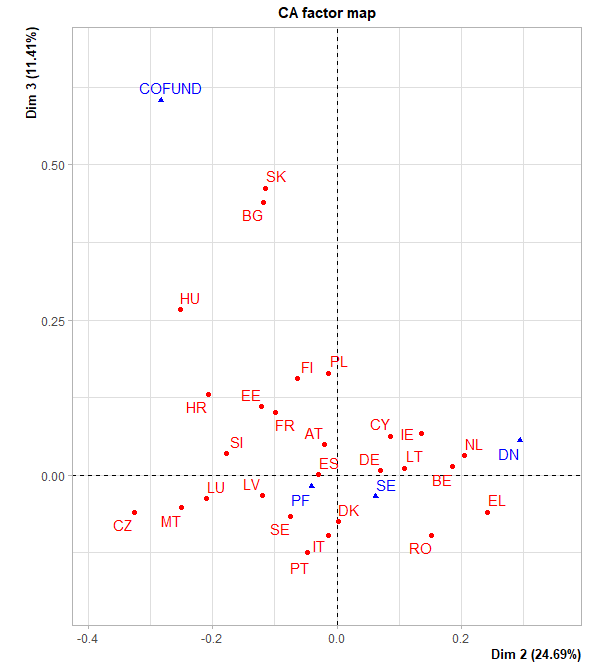
Figure 3: Map C: CA factor map – Dim2 × Dim3 (supplementary visualisation of DN vs COFUND).
Source: EC – HE eCORDA 12/2025; Daniel Frank – TC Prague; FactoMineR: Multivariate Exploratory Data Analysis and Data Mining with R.
A detailed version of the analysis is provided here (in Czech only).