Czech participation in ERC grants strengthened significantly. The number of ERC grants in the Czech Republic between 2008 and 2025 is growing year on year, but unevenly: over time, the structure has shifted by grant type, ERC domain, and the gender of the Principal Investigator (PI). The fastest growth has been observed in Consolidator Grants (CoG), which have become the main driver of the expansion of ERC activity in Czechia—typically reflecting the rise of a “consolidating” cohort of younger, yet already experienced researchers. The number of successful Starting Grant (StG) PIs—targeting early-career researchers—has also been increasing steadily. By contrast, the number of funded Advanced Grants (AdG) remains persistently low; and because this pattern has not changed substantially even after eighteen years since the first ERC calls under the Framework Programmes, it appears to reflect a structural, system-level weakness rather than a single cohort effect.
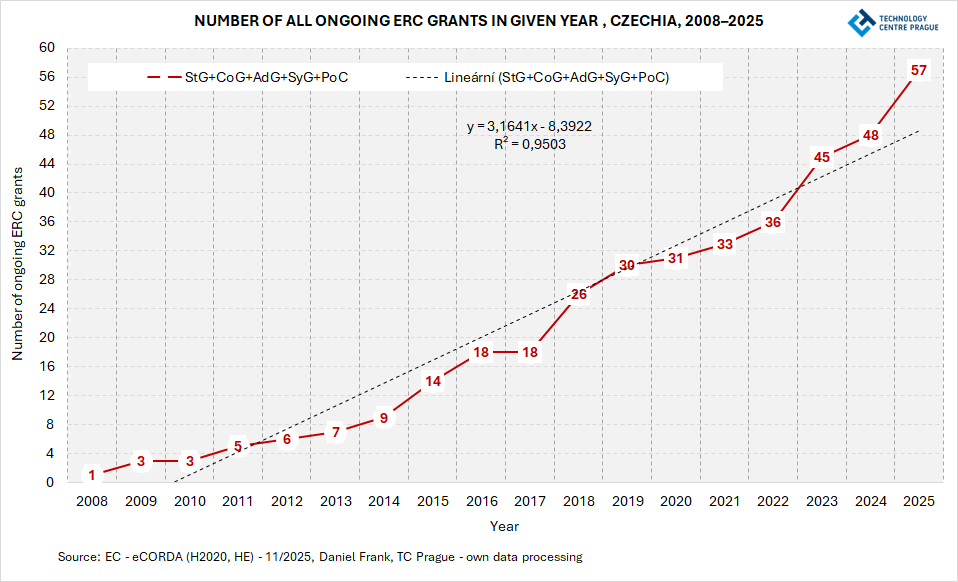
Total number of ongoing ERC grants in a given year in Czechia, 2008–2025
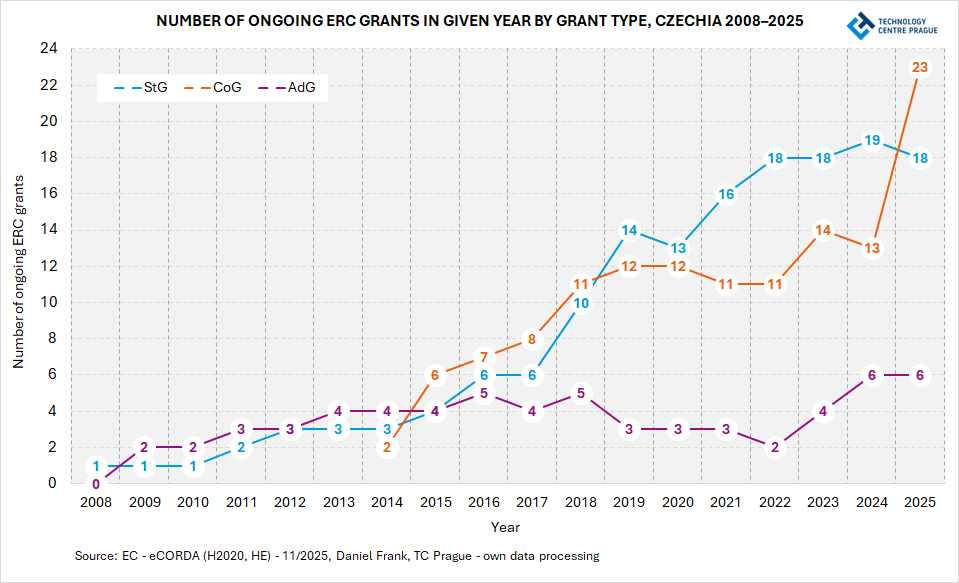
Number of ongoing ERC grants in a given year by grant type, Czechia, 2008–2025
From the perspective of ERC domains, Physical Sciences & Engineering (PE) had an early lead, but Life Sciences (LS) strengthened very rapidly over the last decade. Social Sciences & Humanities (SH) have been growing more gradually, yet their role has been increasing over time—most notably in Horizon Europe.
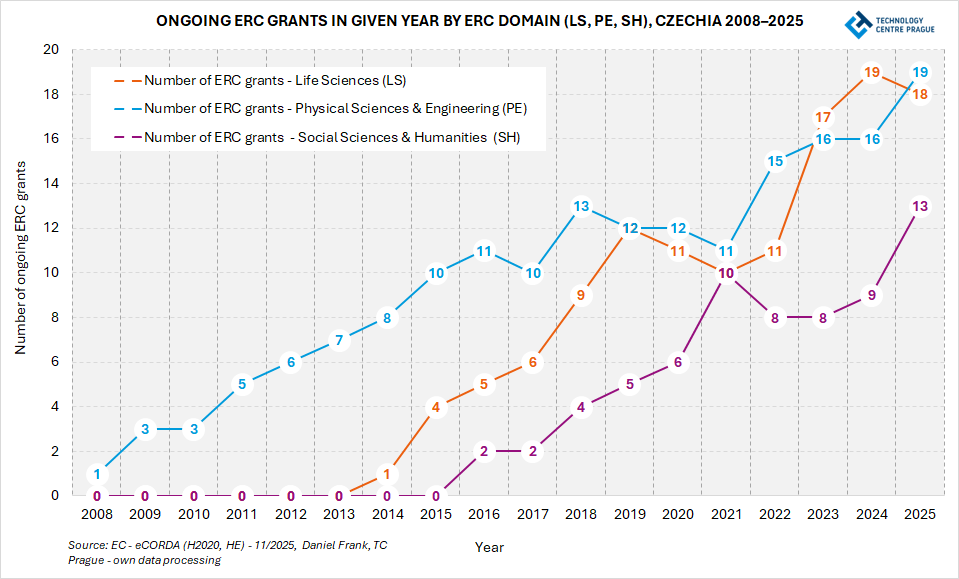
Number of ongoing ERC grants in a given year by ERC domain (LS, PE, SH), Czechia, 2008–2025
ERC participation also has a clear institutional dimension: universities now host a larger share of ongoing ERC grants, while the Czech Academy of Sciences shows a higher level of ERC engagement relative to the size of its research community.
Gender leaves a strong imprint in the data as well. Women account for roughly one third of the research workforce, yet their share among ERC PIs is consistently much lower. In other words, even after accounting for the smaller “baseline” number of women in the system, their representation among ERC grant holders remains disproportionately low and the imbalance persists. According to detailed calculations, women in Czechia would need to lead about 2.6 times more ERC grants to reach the level of participation currently observed among men.
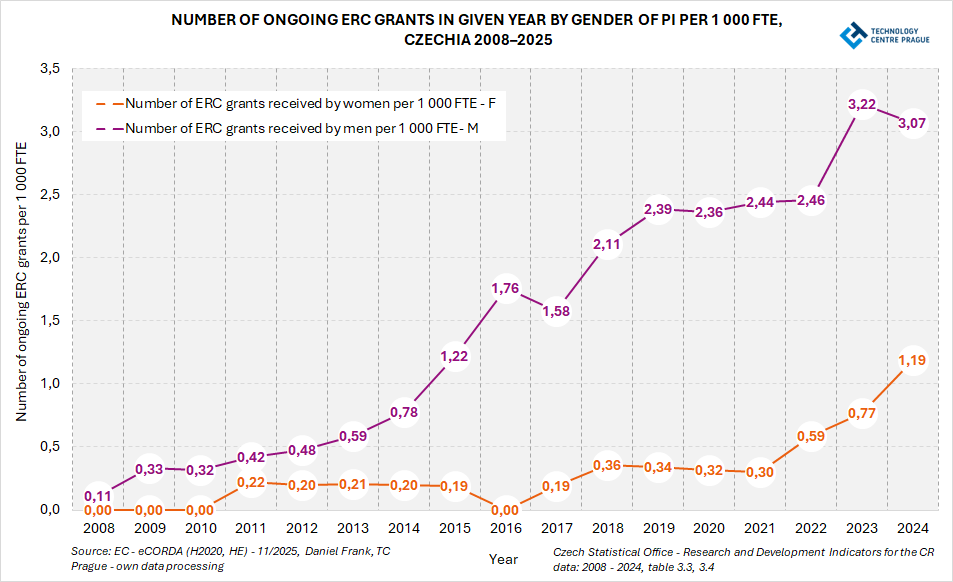
Number of ongoing ERC grants in a given year by PI gender per 1,000 FTE researchers, 2008–2024
Overall, the analysis provides a clear overview of the key trends in Czech participation in ERC—where participation is growing fastest, who is driving the growth, and where Czechia still has the greatest untapped potential.
The first part of the analysis, “ERC grants in Czechia 2007–2025: development and trends – Part 1: How the Czech ERC portfolio is growing: grant types, domains and gender,” is available here ( in Czech only); the second part, “ERC grants in Czechia 2007–2025: development and trends – Part 2: Who is driving the growth in ERC participation: institutions, system-level context and recommendations,” is available here (in Czech only).
Author: Daniel Frank, frank@tc.cz ,TC Praha, 22 December 2025