In its February 2023 report on Austria's participation in the Horizon Europe programme (hereinafter referred to as "HE"), the Austrian Research Promotion Agency (FFG) compares the planned budget of the HE programme at the pillars level and current spending for the entire program (p. 5). The participation of Austrian entities is compared at the level of pillars (p. 6) and at the level of individual parts, respectively (pp. 7 and 8). Therefore, let us look at how the Czech Republic stands in a similar comparison on April 26, 2023. And at the same time let us follow up on the contribution from May 8, 2023, which presents the actual basic outlines of the Czech Republic's performance in the HE programme.
Compared to the HE programme as a whole, Czech participants show a lower net EU contribution in Pilars I, II and especially III. On the contrary, the representation of the Widening participation and Strengthening of the European Research Area section is above average.
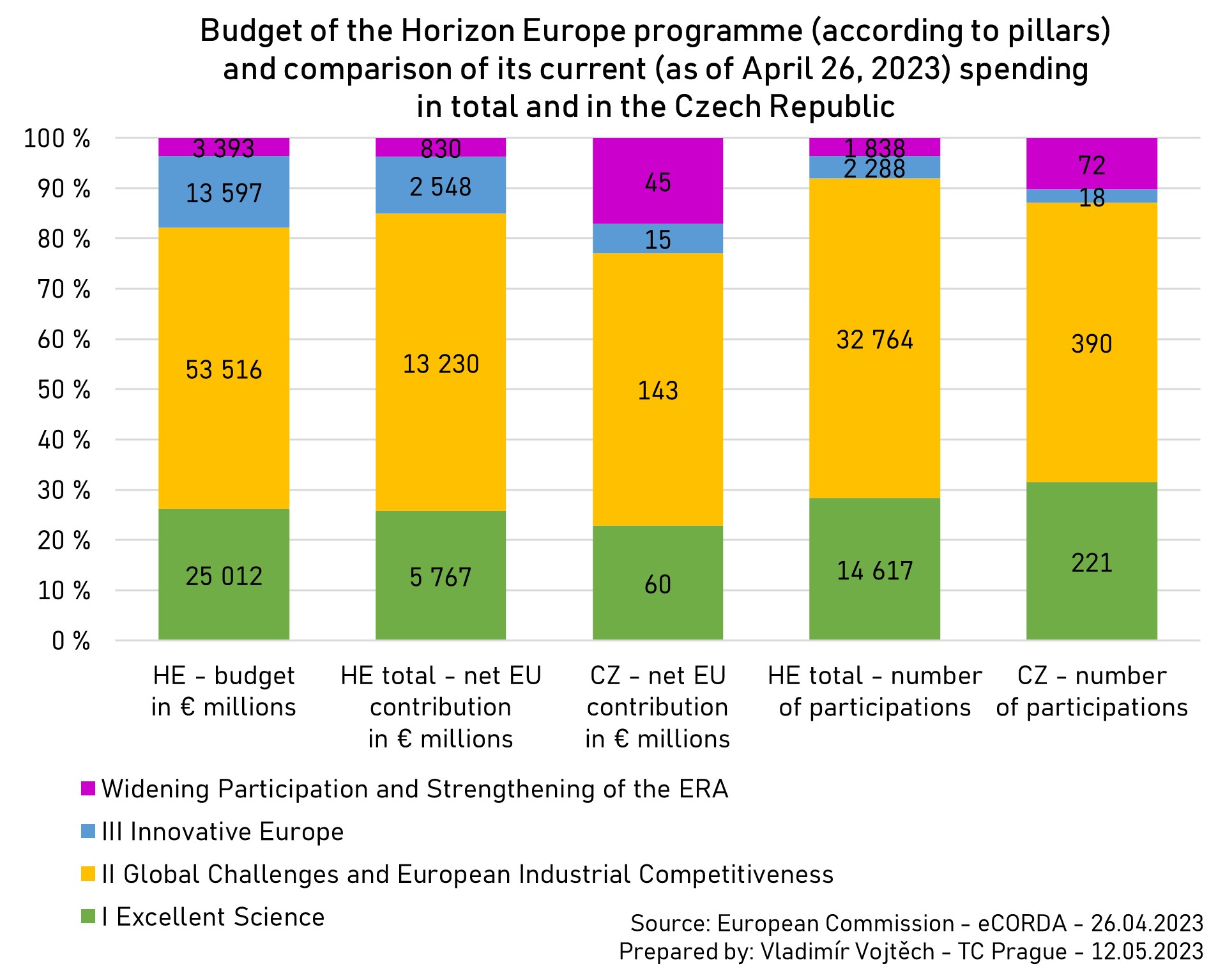
If we look at the level of individual parts, or clusters, then the Czech Republic shows the following in comparison with the HE programme as a whole in the indicator of the net EU contribution:
(1) Higher representation of the Widening Participation and Spreading Excellence component (16.5% of the net EU contribution to Czech participants, vs. 3.1% of the net EU contribution to all HE programme participants) and the Marie Skłodowska-Curie Actions (9.6% of the net EU contribution to Czech participants, vs. 6.8% to all HE programme participants). This is subsequently reflected in the above-average representation of the Czech Republic in the Widening Participation and Spreading Excellence component – 6% of the entire net EU contribution in this component was claimed by Czech entities. On the contrary, Czech participants as a whole claimed 1.2% of the net EU contribution for the entire HE programme. Czech participants also had slightly above-average representation in the overall net EU contribution in the components of the Marie Skłodowska-Curie Actions (1.7%) and Research Infrastructures (1.4%).
(2) On the contrary, the Czech participants had a lower and therefore below average representation in these components:
- European Research Council (10.5% of the net EU contribution to Czech participants vs. 16.6% of the net contribution to all HE programme participants),
- European Innovation Council (4.5% of the net EU contribution to Czech participants, vs. 6.9% to all HE programme participants),
- European Institute of Innovation and Technology (1.1% of the net EU contribution to Czech participants, vs. 4% to all HE programme participants),
- and for the clusters Digital, Industry and Space (11.1% of the net EU contribution to Czech participants, vs. 15.2% to all HE programme participants)
- and Health (7.4% of the net EU contribution to Czech participants, vs. 10% to all HE programme participants).
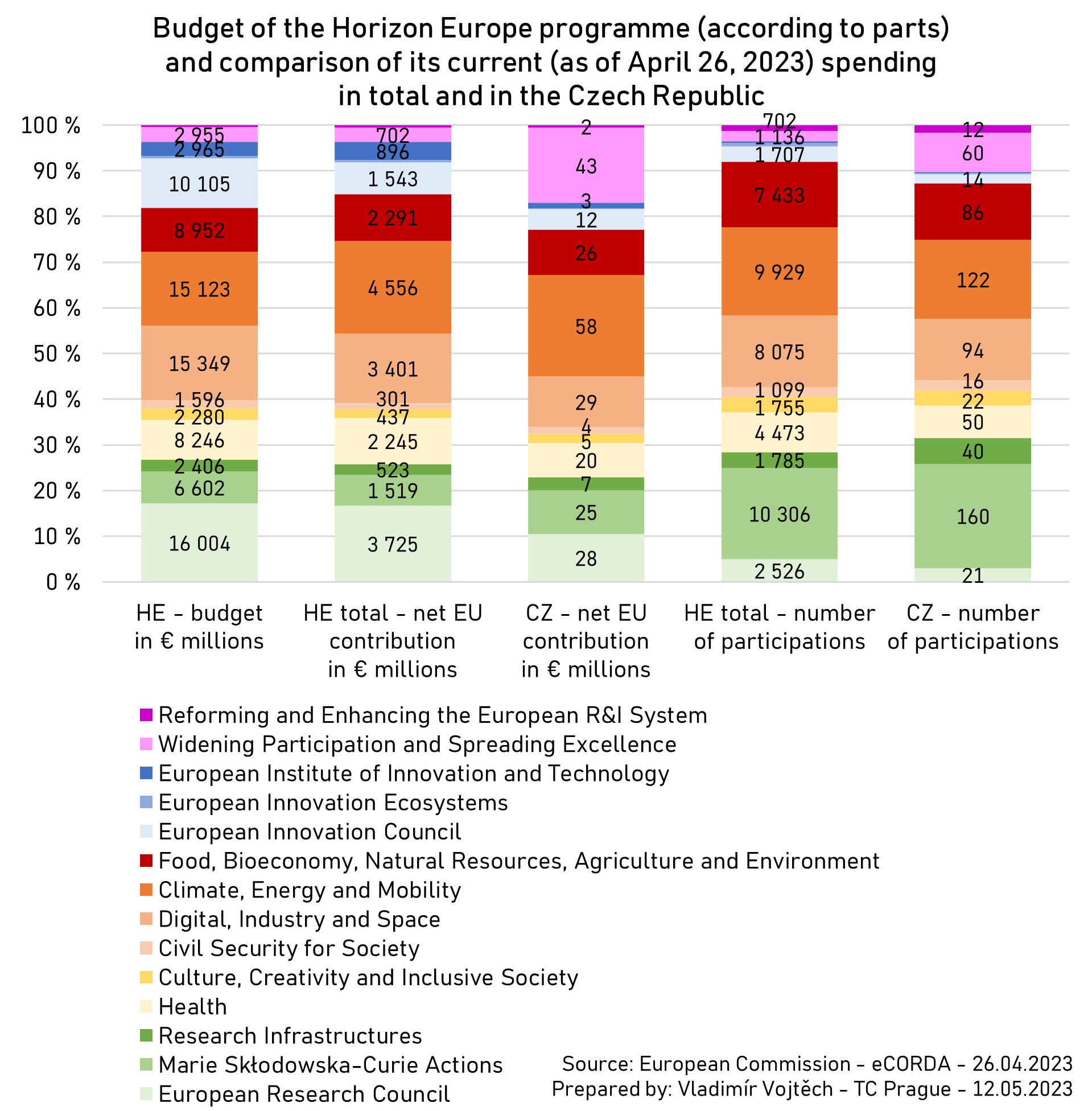
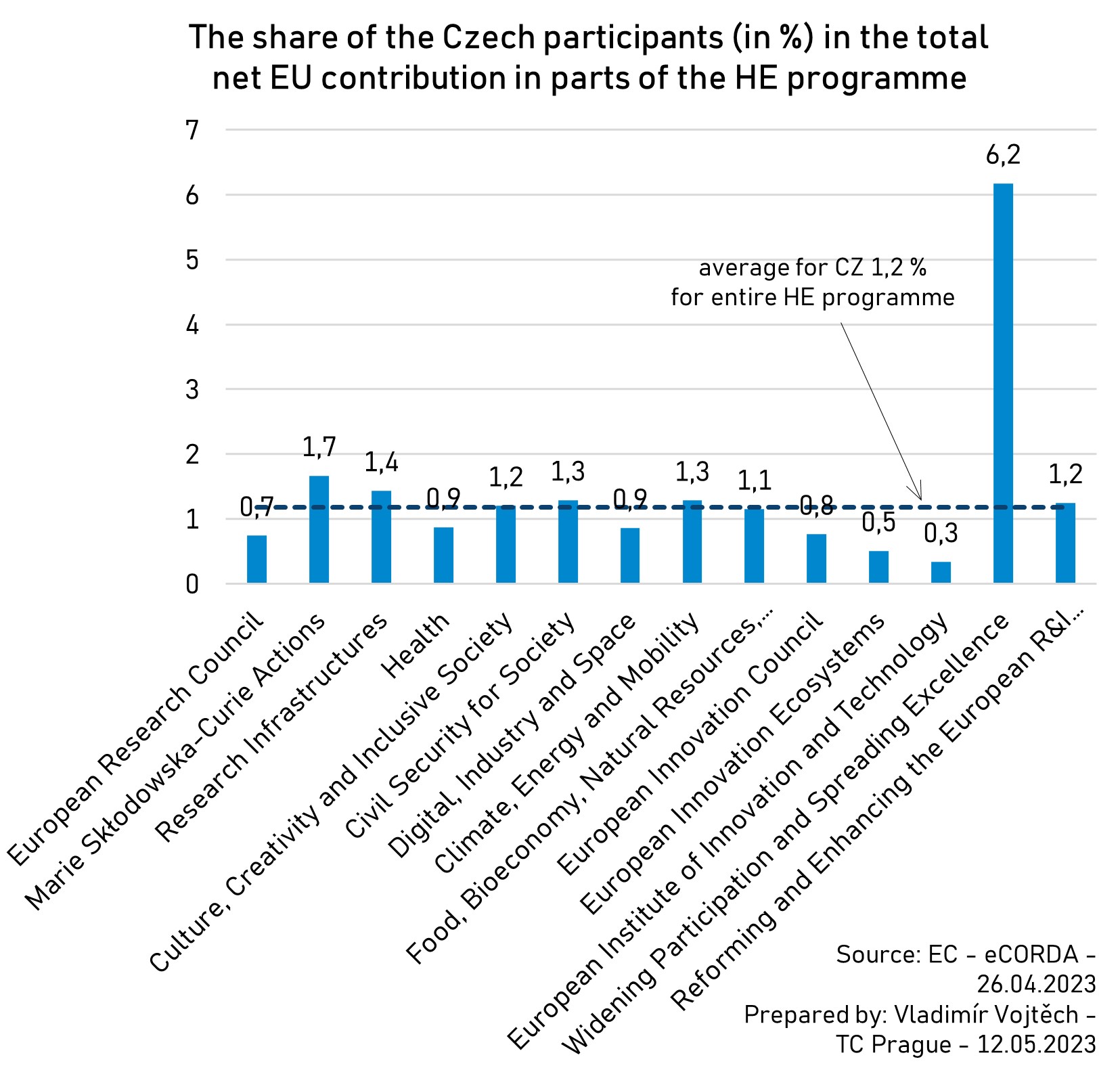
Résumé: Above-average participation of Czech entities was identified in Widening Participation and Spreading Excellence and the Marie Skłodowska-Curie Action. On the contrary, Czech entities participate less in the European Research Council, the European Innovation Council and the European Institute of Innovation and Technology, and the Digital, Industry and Space and Health clusters.
Author: Vladimír Vojtěch, TC Prague, vojtech@tc.cz, 15.05.2023