The previous post from October 12, 2022, briefly evaluated the sectoral structure of the participation of Czech companies in Framework Programmes. The aim of this contribution is to continue and present to the reader the size structure of these enterprises according to the number of employees. The aspect of the institutional sector, or ownership, is also added, as domestic and foreign enterprises of different size categories participate in the Framework Programmes. Again, only participants of the "beneficiary" type, who have signed a grant agreement with the European Commission or are preparing to sign it are evaluated. Since we evaluate three consecutive Framework Programmes, the size category of the enterprise at the time of the end of the programme is decisive. This means 2014 for the 7th Framework Programme, 2000 for the Horizon 2020 programme, as the MagnusWeb database, operated by Dun & Bradstreet Czech Republic, a.s., does not have data from the financial statements of the participating enterprises for the year 2021 at the time of writing this post. In the case of the current Horizon Europe programme, we also use data for 2020.
In terms of ownership, all three Framework Programmes are dominated by domestically owned enterprises. In the 7th Framework Programme and the Horizon 2020 programme domestically owned enterprises represented circa two-thirds of all participations, and in the Horizon Europe programme (as of September 15, 2022), three-fifths of all participations. Even in the case of the contribution of the European Union, the representation of enterprises in domestic ownership is around 60%. The participation of domestic public enterprises in Framework Programmes is negligible.
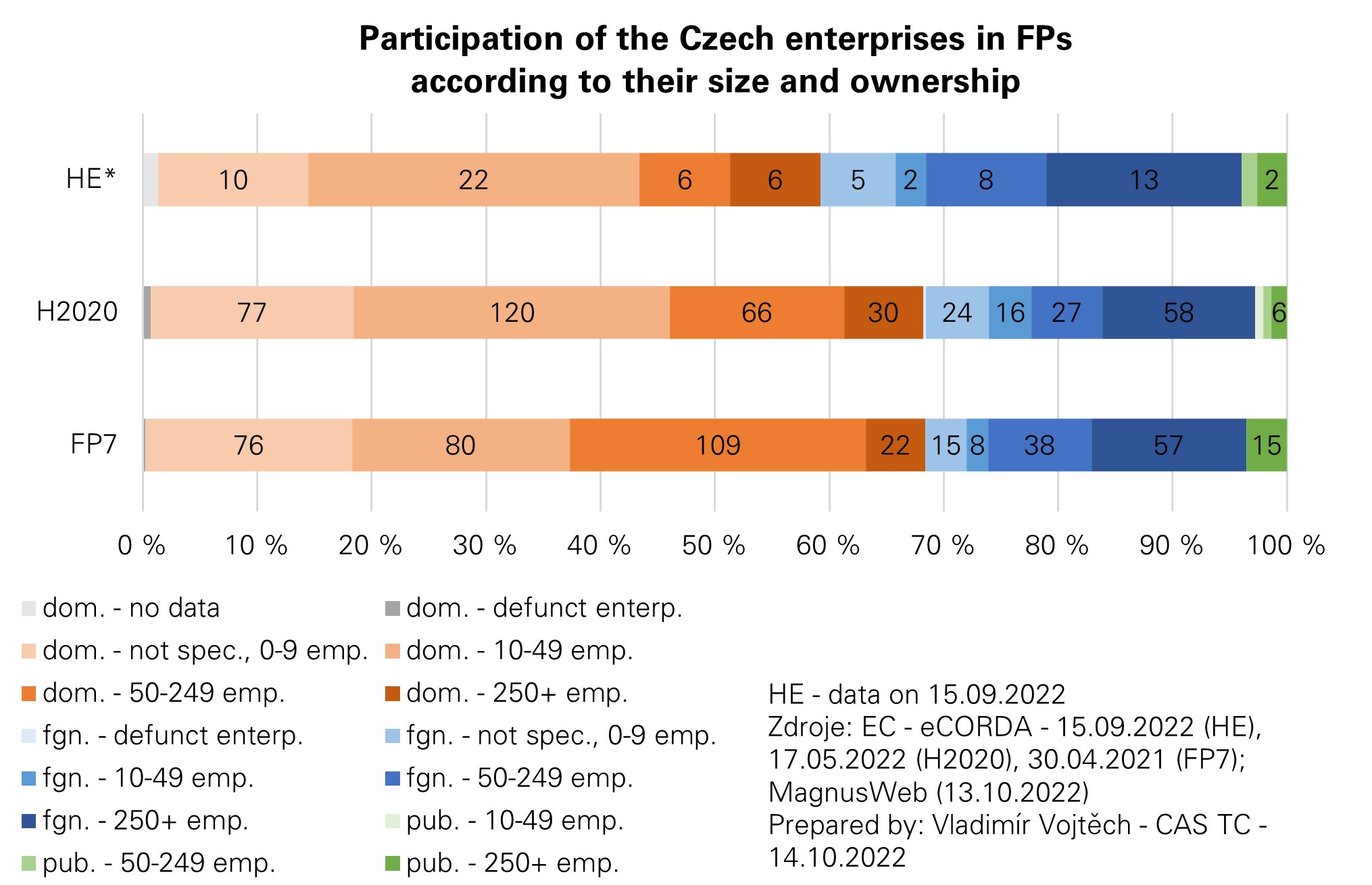
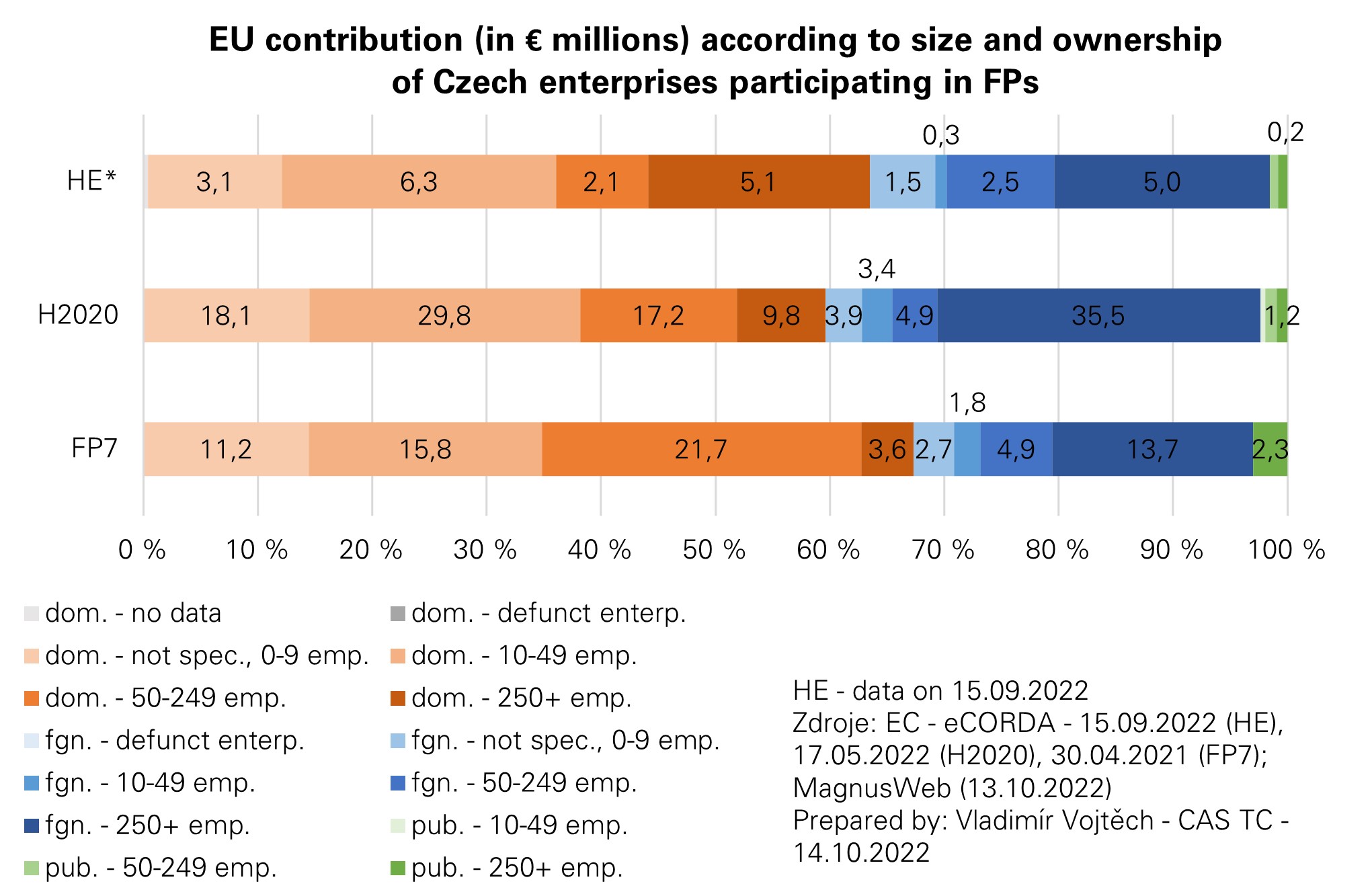
Among domestically owned enterprises, the category of micro and small enterprises prevailed (i.e. enterprises in categories not specified, 0-9 employees and 10-49 employees). In the total number of participations of domestic enterprises, micro and small enterprises together represented more than half – two-thirds in the Horizon 2020 programme, 71% in the current part of the Horizon Europe programme. A similar statement also applies in the case of the amount of the European Union's contribution, but in the case of the Horizon Europe programme, micro and small enterprises are represented by only 56% of domestic enterprises. At the same time, it can be noted that the participation of medium-sized enterprises (i.e. enterprises with 50-249 employees) is decreasing among domestically owned enterprises.
On the contrary, large enterprises, i.e. enterprises with more than 250 employees, prevailed among foreign-owned enterprises. They accounted for approx. half of the total number of participations of foreign-owned enterprises in all three Framework Programmes. Regarding the amount of the European Union's contribution, their representation varied from 59% in the 7th Framework Programme, over 74% in the Horizon 2020 programme, to 54% in the Horizon Europe programme. The second most frequently represented size category for foreign-owned enterprises are medium-sized enterprises (50-249 employees) in the case of the Horizon Europe programme, as well as in the case of the 7th Framework Programme. On the contrary, in the Horizon 2020 program, the second most frequently represented category of foreign enterprises were micro and small enterprises.
Author: Vladimír Vojtěch, CAS TC, vojtech@tc.cz, 14.10.2022