The post from June 7, 2023, based on the data of the European Commission as of April 26, 2023, presented the structure of Czech participation in the Horizon Europe programme (hereinafter referred to as "HE") according to Pillar II‘s destinations. Le us follow up on the post from May 17, 2023, let us first look at the structure of Czech participation in clusters of the Pillar II of the HE programme according to the legal forms of the participating organizations and then let us continue to the destination level.
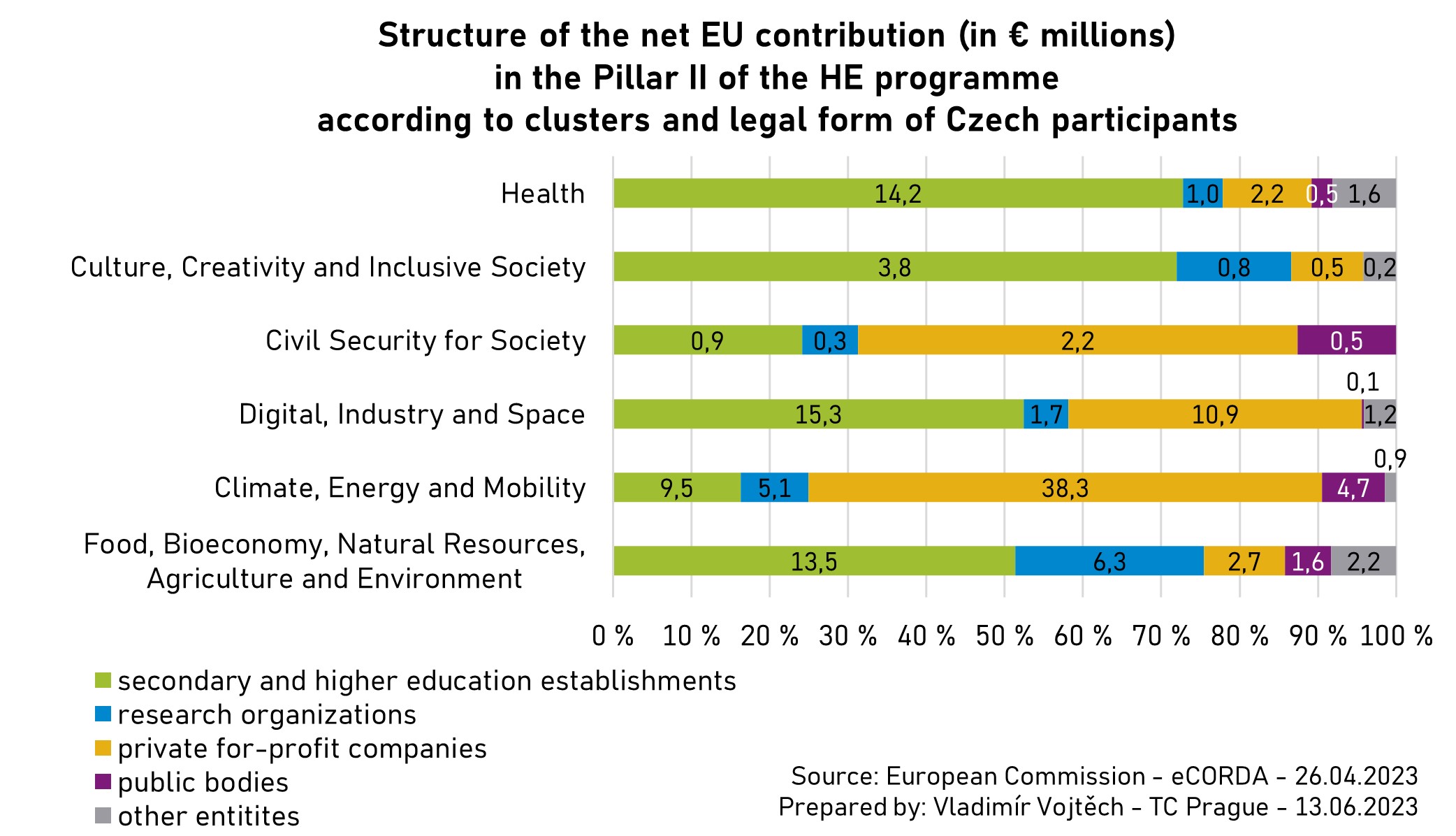
Different Czech organizations in terms of legal form participate in clusters of the Pillar II of the HE programme. In Clusters 1 (Health), 2 (Culture, Creativity and Inclusive Society), 4 (Digital, Industry and Space) and 6 (Food, Bioeconomy, Natural Resources, Agriculture and Environment) among Czech participants, the higher education institutions claim the higher share of the net EU contribution. On the contrary, in Clusters 3 (Civil Security for Society) and 5 (Climate, Energy and Mobility) among the Czech participants, businesses claim the higher share of the net EU contribution. Czech research organizations were significantly represented in Clusters 2 (Culture, Creativity and Inclusive Society) and 6 (Food, Bioeconomy, Natural Resources, Agriculture and Environment). The public sector was more significantly represented in Clusters 3 (Civil Security for Society), 5 (Climate, Energy and Mobility) and 6 (Food, Bioeconomy, Natural Resources, Agriculture and Environment).
On closer look, we find, that even between destinations there are differences in the legal form of participating organizations. In Cluster 1 (Health) as a whole, universities claim 73% of the net EU contribution to Czech participants, but for example in the destination Tackling Diseases and Reducing Disease Burden businesses claim 91% of the net EU contribution.
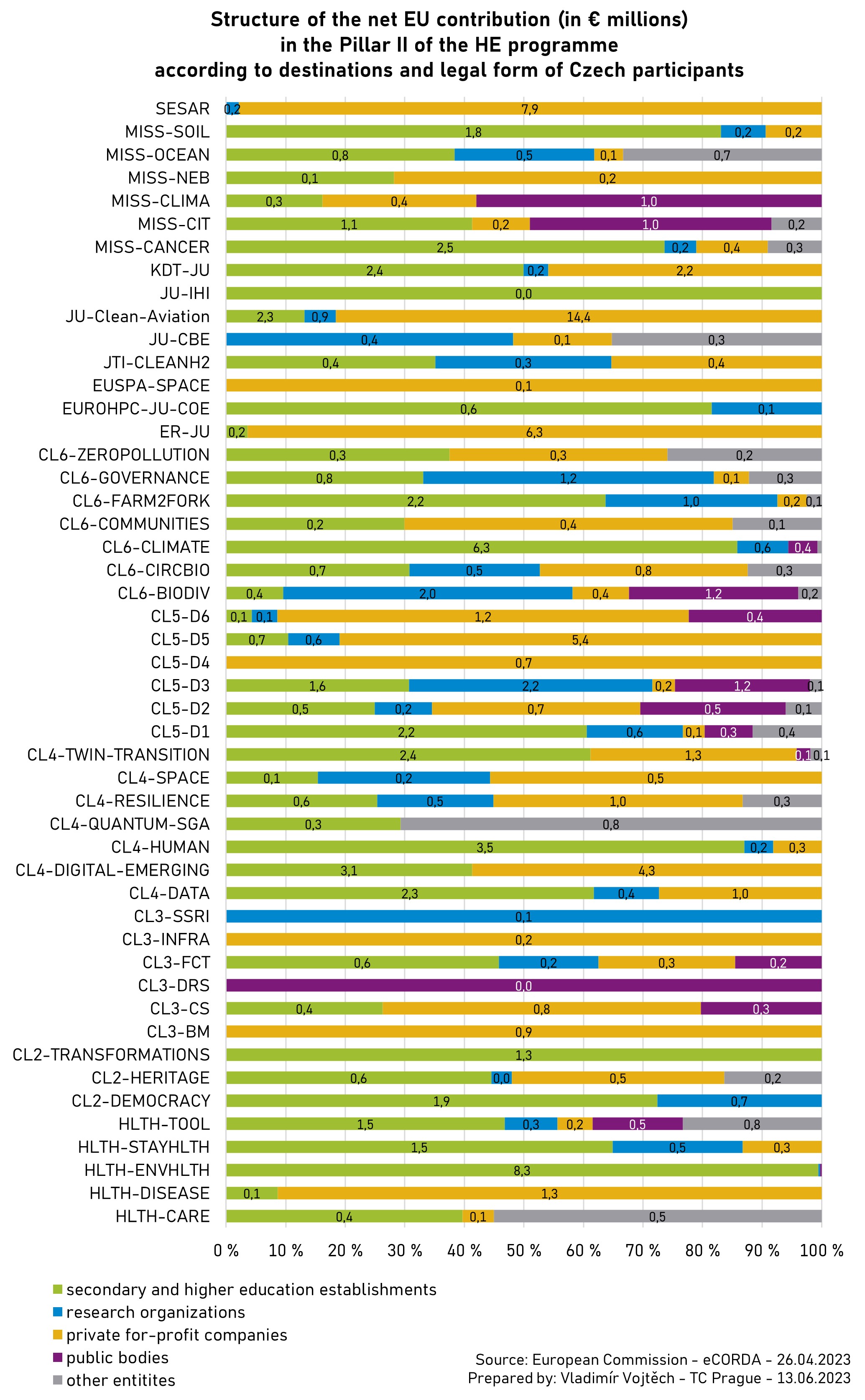
In the destinations of Cluster 2 (Culture, Creativity and Inclusive Society), the higher share of the net EU contribution is claimed by higher education institutions. In the case of the destination Innovative Research on the European Cultural Heritage and the Cultural and Creative Industries, businesses are also significantly represented among the beneficiaries.
The participants of individual destinations in Cluster 3 (Civil Security for Society) are diverse. In this cluster we can find both destinations, in which only businesses participate (Border Management), and destinations with diverse legal forms of participants (Fighting Crime and Terrorism).
In terms of participation, the destinations in Cluster 4 (Digital, Industry and Space) are diverse too. In the destinations World Leading Data and Computing Technologies, A Human-Centered and Ethical Development of Digital and Industrial Technologies and Twin Green and Digital Transition, higher education institutions claim the largest share of the net EU contribution to Czech participants. Conversely, in the destinations Digital and Emerging Technologies for Competitiveness and Fit for the Green Deal, Increased Autonomy in Key Strategic Value Chains for Resilient Industry and Open Strategic Autonomy in Developing, Deploying and Using Global Space-Based Infrastructures, Services, Applications and Data, the largest part of the net EU contribution was claimed by businesses.
In Cluster 5 (Climate, Energy and Mobility) in the destination Climate Science and Responses for the Transformation towards Climate Neutrality, higher education institutions dominate among the Czech entities that claim the net EU contribution. In the Cross-Sectoral Solutions for the Climate Transition destination, businesses and higher education institutions claim a similar amount of the net EU contribution; in the Sustainable, Secure and Competitive Energy Supply destination, higher education institutions and research institutions do. In the destinations Efficient, Sustainable and Inclusive Energy Use, Clean and Competitive Solutions for All Transport Modes and Safe, Resilient Transport and Smart Mobility Services for Passengers and Goods, businesses claim most of the net EU contribution.
In Cluster 6 (Food, Bioeconomy, Natural Resources, Agriculture and Environment) we are able to find destinations, in which the majority of the net contribution is claimed by higher education institutions (Land, Ocean and Water for Climate Action; Fair, Healthy and Environment-Friendly Food Systems from Primary Production to Consumption), research institutions (Biodiversity and Ecosystem Services; Innovative Governance, Environmental Observations and Digital Solutions in Support of the Green Deal), businesses (Resilient, Inclusive, Healthy and Green Rural, Coastal and Urban Communities) or by equally represented organizations (Circular Economy and Bioeconomy Sectors; Clean Environment and Zero Pollution).
In the so-called joint undertakings, we can find both those in which most of the net EU contribution was claimed by businesses (Clean Aviation, SESAR3, Europe's Rail) or research institutions (Circular Bio-Based Europe), and those in which there were participants from higher education institutions and businesses (Key Digital Technologies), or higher education institutions, businesses and research institutions equally represented (Clean Hydrogen).
A similar statement applies in the case of HE missions. In the Cancer and A Soil Deal for Europe missions, higher education institutions claimed most of the EU's net contribution, in the Adaptation to Climate Change mission the public sector did. Higher education institutions and the public sector were equally represented in the 100 Climate-Neutral and Smart Cities mission. This is like the Restore our Oceans and Waters by 2030 mission, where higher education institutions, other entities and research institutions are equally represented.
Résumé: There are differences in the legal forms of participating organizations between destinations within individual clusters of the Pillar II of the HE programme. However, when interpreting, it is necessary to consider the total net EU contribution claimed by participants in individual destinations.
Author: Vladimír Vojtěch, TC Prague, vojtech@tc.cz, 13.06.2023