The contribution from October 14, 2022 was focused on brief evaluation of size of the domestic enterprises participating in Framework Programmes according to the number of their employees. Aim of this contribution is to continue and present the reader the size structure of these enterprises according to their annual turnover. Again, the point of view of the institutional sector (i.e. ownership) is added, as even in the criterion of the turnover is valid, that that domestic and foreign enterprises of different size categories participate in the Framework Programmes. Only participants of the "beneficiary" type, who have signed a grant agreement with the European Commission or are preparing to sign it are evaluated. Since three consecutive Framework Programmes are evaluated, the size category of the enterprise at the time of the end of the programme is decisive for us. This means 2014 for the 7th Framework Programme, 2000 for the Horizon 2020 programme, as the MagnusWeb database, operated by Dun & Bradstreet Czech Republic, a.s., does not have data from the financial statements of the participating enterprises for the year 2021 at the time of writing this post. In the case of the current Horizon Europe programme, we also use data for 2020.
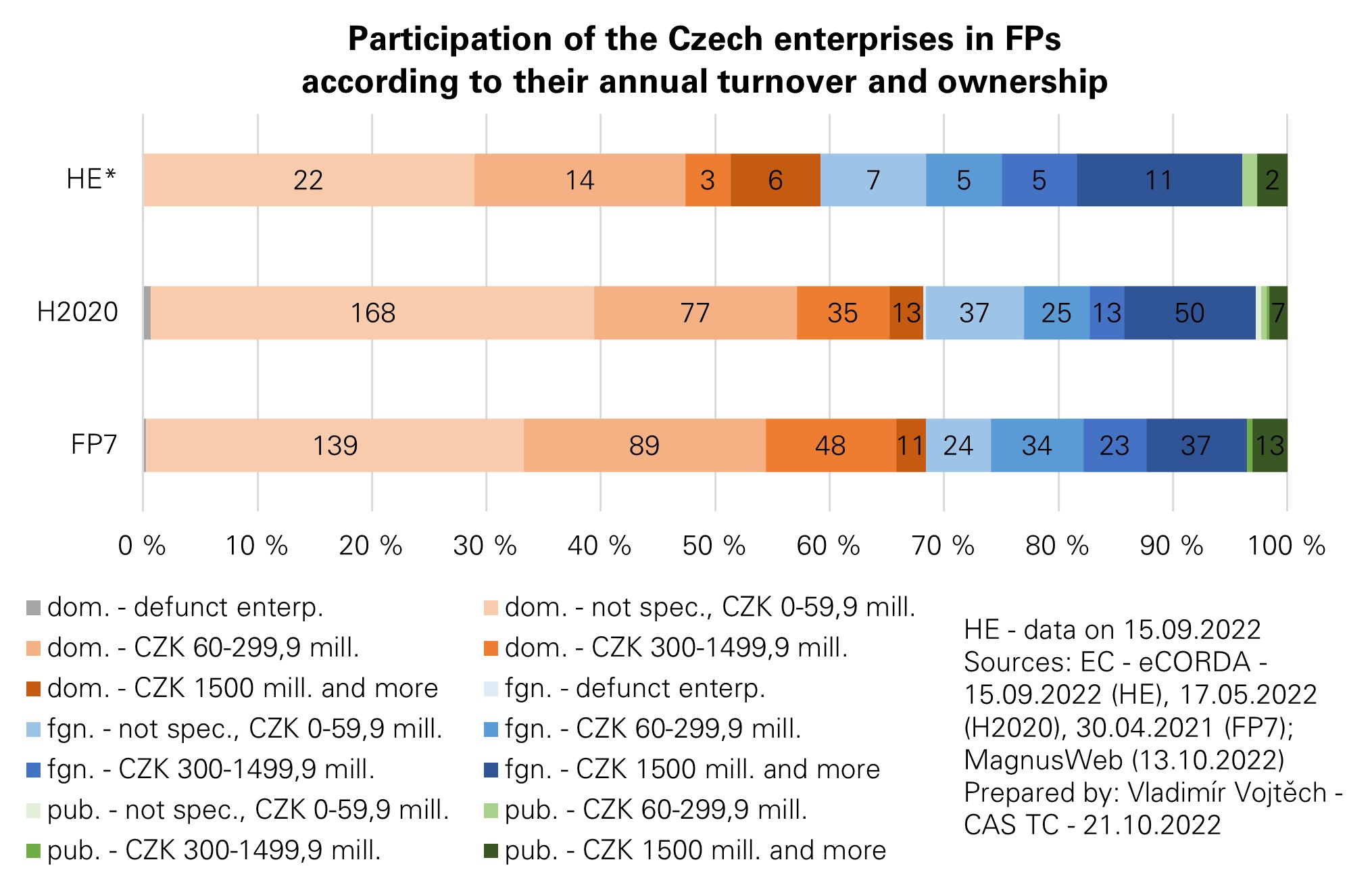
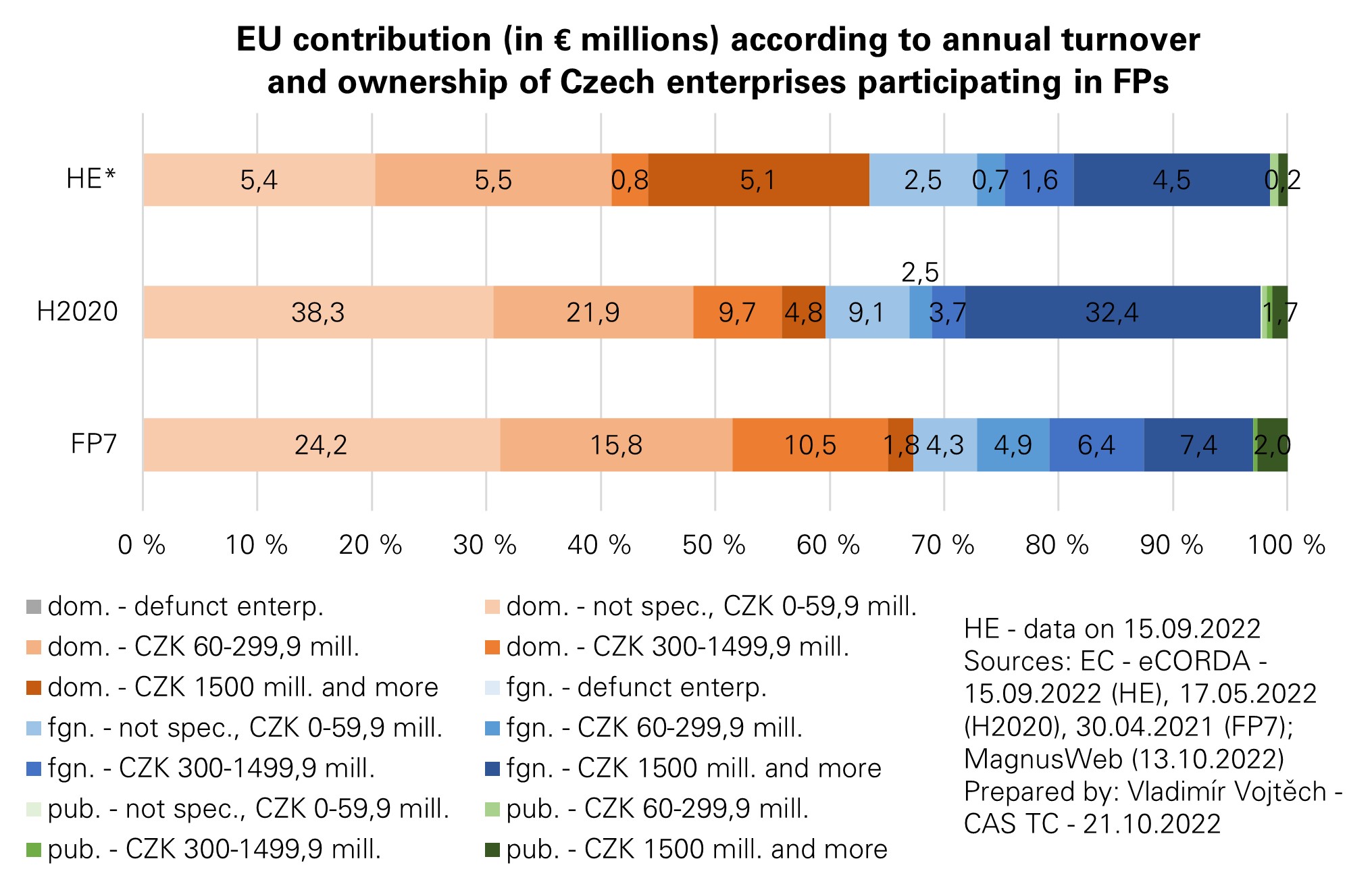
Among domestically owned enterprises, in terms of annual turnover, the categories of micro (with an annual turnover of up to CZK 59.9 million) and small enterprises (with an annual turnover of CZK 60–299.9 million) predominate. These enterprises accounted for four fifths of the total number of participations of domestic companies in all three monitored Framework Programmes. In terms of the amount of the European Union's contribution, in the 7th Framework Programme and the Horizon 2020 programme, micro and small enterprises predominated among domestically owned enterprises (again with a share of roughly 3/4 and 4/5, respectively). On the contrary, in the Horizon Europe programme are equally represented micro, small and large domestic enterprises at the time of processing this contribution. Even in this criterion, it can be noted, that the participation of medium-sized enterprises (i.e. enterprises with an annual turnover between CZK 300 million and 1.5 billion) among domestically owned enterprises is decreasing.
Among foreign enterprises, in terms of the number of participations, large enterprises predominate in all three monitored Framework Programmes, i.e. enterprises with an annual turnover of over CZK 1.5 billion. The predominance of large enterprises among foreign companies is particularly evident in the Horizon 2020 and Horizon Europe programmes in the indicator of the amount of the European Union's contribution. In the Horizon 2020 programme, 2/3 of the European Union's contribution to foreign-owned enterprises went to large enterprises. In the case of the Horizon Europe programme, it was one half of the EU’s contribution. On the contrary, in the 7th Framework Programme, foreign enterprises of particular size categories were more evenly represented.
Author: Vladimír Vojtěch, CAS TC, vojtech@tc.cz, 24.10.2022