1. Introduction
Twinning is one of the main instruments under the Widening Participation and Spreading Excellence priority of Horizon Europe, commonly referred to as Widening. Its objective is to strengthen the research excellence of institutions in lower-performing countries through cooperation with leading European partners. Twinning projects are based on institutional networking, knowledge transfer and capacity-building of the coordinating organisation from a so-called Widening country. The minimum consortium consists of a coordinator from a Widening country and at least two research institutions from two different EU Member States or Associated Countries; additional partners (including institutions from Widening countries) may be included depending on the needs of the project [1].
This analysis was motivated by a practical question raised by project managers and applicants: whether broader involvement of partners from Widening countries in a Twinning consortium affects the odds of a project proposal being funded.
The observed structure of Twinning consortia in the analysed data corresponds to the basic logic of the Twinning instrument: most proposals include one coordinator from a Widening country and a small number (typically two to three) of partners from stronger research and innovation systems, while additional partners from Widening countries constitute the variable component of the consortium. The variable capturing the share of Widening partners therefore primarily reflects differences in the number of these additional Widening institutions beyond the coordinator.
From a proposal preparation perspective, it is often assumed that broader involvement of partners from Widening countries may strengthen project proposal impact and increase the chances of funding. However, an empirical analysis of Twinning proposals from the 2021 and 2023 calls under Horizon Europe indicates the opposite pattern: as the number of partners from Widening countries increases, the odds of proposal success decrease. The aim of this analysis is to quantify the relationship between consortium structure and the funding outcome of Twinning proposals using logistic regression; results are interpreted in terms of odds and odds ratios (OR).
2. Data and basic characteristics of Twinning calls
The analysis covers 1,310 eligible project proposals (source: eCORDA database, 01/2026) from three Horizon Europe calls opened for Twinning in 2021 and 2023:
* HORIZON-WIDERA-2021-ACCESS-02 (Western Balkans Special)
* HORIZON-WIDERA-2021-ACCESS-03 (Twinning)
* HORIZON-WIDERA-2023-ACCESS-02 (Bottom-Up a Green Deal)
In total, 219 projects were funded, corresponding to an overall success rate of 16.7%.
The distribution of consortium size is very similar across calls: the median number of partners is 4 in all cases, and the mean is also around 4–5 partners. Most proposals therefore meet the minimum consortium requirement and add only a limited number of additional organisations.
In terms of consortium composition, however, a key variable is the number of Widening partners (excluding the coordinator). Aggregated data show a clear pattern:
-
0 Widening partners (coordinator only): success rate approx. 12–32%
-
1 Widening partner: approx. 13–26%
-
2 Widening partners: approx. 6–11%
-
3 Widening partners: approx. 4–6%
-
≥ 4 Widening partners: almost 0%
Even descriptive statistics therefore suggest a negative relationship between the number of Widening partners and proposal success.
3. Definition of predictors used in the binary logistic regression
The analysis uses the following predictors: the share of Widening partners in the consortium (share_widening), the share of partners from the higher education sector (share_HES), the total number of partners in the consortium including the coordinator (nb_applicants), the requested Horizon Europe contribution for the proposal (request), and the identifier of the specific Twinning call (call_id).
The share of Widening partners (share_widening) is defined as the proportion of partners from Widening countries in the total number of consortium partners, with the coordinator included in both the numerator and the denominator. The variable therefore expresses the relative representation of Widening institutions in the consortium as a whole. Since the coordinator in Twinning is always an institution from a Widening country, share_widening also includes this important component of the consortium that follows from the rules of the instrument; in practice, interpretation of its effect therefore mainly reflects changes in the number of additional Widening partners beyond the coordinator, rather than the mere presence of a Widening coordinator.
share_HES is the proportion of partners from the Higher Education Sector (HES) in the total number of consortium partners, also including the coordinator. nb_applicants denotes the total number of partners in the consortium (including the coordinator). request is the requested Horizon Europe contribution for the proposal. ln_nb_applicants is the natural logarithm of the number of consortium partners, and ln_request is the natural logarithm of the requested contribution. The variable call_id identifies the specific Twinning call to which the proposal was submitted.
The number of partners and the requested contribution were included in the model using a logarithmic transformation (natural logarithm, ln) for two reasons. First, the distributions of these variables are strongly right-skewed: most projects have 3–5 partners, while a smaller share of proposals has substantially more; similarly, exceptionally high funding requests occur. The logarithmic transformation stabilises variance and reduces the influence of extreme values. Second, the effect of consortium size or budget on the probability of funding is not linear: the difference between three and four partners is often structurally more meaningful than the difference between thirteen and fourteen partners. A logarithmic transformation therefore better captures a realistic non-linear relationship between consortium size, budget and the probability of proposal success (funding).
4. What are binary logistic regression and the odds ratio (OR)?
To quantify the relationship between consortium structure and the probability that a proposal is funded, a binary logistic regression model was used. This statistical model is applied when the outcome takes only two values—in this case, funded (success = 1) or not funded (success = 0). Logistic regression estimates how changes in individual proposal characteristics (e.g., the share of Widening partners in the consortium, consortium size, or sectoral composition) are associated with changes in the probability that the proposal is funded. In our case, the model therefore predicts the probability of proposal funding, while effects are conventionally interpreted in terms of odds and expressed using the odds ratio (OR), i.e., the ratio of odds.
An OR indicates how many times the odds of success (or failure) change with a one-unit change in the predictor. OR = 1 implies no effect; OR < 1 implies reduced odds of funding; OR > 1 implies increased odds of funding.
For example, an estimated OR ≈ 0.24 for the share of Widening partners in the proposal consortium means that proposals with a higher share of such institutions have approximately four times lower odds of being funded than proposals with a lower share of Widening partners. Equivalently, the same relationship can be expressed as OR ≈ 4.17 for failure, i.e., a higher share of Widening partners increases the odds of not being funded by roughly a factor of four. Both interpretations are mathematically identical and differ only in whether the model is framed in terms of success or failure.
5. Binary logistic regression model specification
The dependent variable is proposal success (success = 1 if the proposal is funded; success = 0 if the proposal is not funded). Since the outcome is binary, a binary logistic regression is appropriate. In this analysis, the main specification is oriented as a success model, i.e., we model p(success=1), the probability that the proposal is funded.
The model takes the form:
logit(p(success)) = β0+β1⋅share_widening +β2⋅share_HES + β3⋅ln(nb_applicants) + β4⋅ln(request)
where:
-
share_widening = share of Widening partners in the consortium (including the coordinator),
-
share_HES = share of higher-education-sector partners in the consortium,
-
nb_applicants = total number of consortium partners (including the coordinator),
-
request = requested contribution for the proposal.
To ensure that explanatory variables do not substantially overlap and that coefficient estimates are not biased or statistically unstable, multicollinearity among predictors was assessed using VIF (Variance Inflation Factor) and tolerance (where tolerance = 1/VIF). All VIF values were around 1.02 and tolerance around 0.98, indicating negligible collinearity and therefore stable parameter estimates.
6. Results of the binary logistic regression
The statistical analysis was conducted in jamovi (version 2.3), which uses R as its computational engine and the car package for regression diagnostics. The overall model is statistically significant (χ² = 67.2; p < 0.001). The pseudo-R² values are McFadden R² = 0.0567 and Nagelkerke R² = 0.0838. The model therefore explains only part of the variation in proposal success, approximately 6–8%. In the context of data on project proposals, such values are common because funding outcomes depend strongly on proposal quality and other elements of the expert evaluation process that are not directly measurable in this model.
6.1 Effect of the share of Widening partners (share_widening)
The share of partners from Widening countries has a statistically significant negative association with the odds of proposal funding. In the success model p(success=1), the estimated effect corresponds to OR(success) ≈ 0.24, meaning that as the share of partners from Widening countries in the consortium increases, the odds of the proposal being funded under Horizon Europe decrease. Equivalently, in the failure model p(success=0), OR(fail) ≈ 4.17; a higher share of Widening partners increases the odds of failure by approximately a factor of four.
The interpretation is as follows: proposals with a higher share of partners from Widening countries have approximately four times lower odds of being funded than proposals with a lower share of Widening partners. Equivalently, proposals with a lower share of Widening partners have approximately four times higher odds of being funded than proposals with a higher share of Widening institutions. In other words, the higher the representation of partners from Widening countries in the consortium, the lower the likelihood of proposal success.
It should be emphasised that OR(success) ≈ 0.24 corresponds to a change in the Widening share across the full 0–100% range. For small changes, the effect is substantially smaller: increasing the Widening share by one percentage point reduces the odds of funding by approximately 1.4%.
With a more detailed conversion of a share-based effect to a realistic consortium structure, the interpretation can also be expressed in “per one partner” units. The variable share_widening is a proportion, so replacing one non-Widening partner with a Widening partner (holding the total number of partners N constant) increases the share by 1/N. In typical Twinning consortia (most often 4–5 institutions), this corresponds to an increase of about 20–25 percentage points. This implies that, at a typical consortium size of 4–5 institutions, such a change reduces the odds of proposal funding by approximately 25–30%.
6.2 Effect of the share of higher education sector partners (share_HES)
A higher share of higher-education-sector partners is associated with lower odds of proposal success (funding under Horizon Europe). In the success model p(success=1), OR(success) ≈ 0.53, meaning that as the share of universities in the consortium increases, the odds of proposal funding decrease. Equivalently, in the failure model p(success=0), OR(fail) ≈ 1.89, i.e., a higher share of higher education institutions increases the odds of failure by approximately 1.9 times.
Proposals with a higher representation of universities therefore have somewhat lower odds of being funded than proposals with a larger participation of research organisations or other types of institutions. This finding may relate to the nature of Twinning, which focuses on institutional capacity-building and strategic partnership rather than primarily on academic excellence alone. Consortia with a higher share of non-academic or applied partners may better match the implementation logic of the instrument.
6.3 Effect of consortium size (ln_nb_applicants)
Consortium size, expressed as the natural logarithm of the number of partners, has a statistically significant negative effect on proposal success. In the success model p(success=1), OR(success) ≈ 0.49, implying that larger consortia have lower odds of being funded. Equivalently, in the failure model p(success=0), OR(fail) ≈ 2.03; larger consortia have roughly double the odds of failure. Adding partners in Twinning is therefore statistically not advantageous: larger consortia have lower odds of funding than smaller ones. The effect is non-linear—adding a partner in a small consortium has a larger impact than adding one in an already large consortium. Doubling the number of partners is associated with a decrease in the odds of funding by approximately 35–40% (based on 0.49ln(2)≈0.62, i.e., a drop of ~38%).
This result is consistent with the nature of Twinning as a targeted institutional partnership involving a limited number of organisations. As the number of partners increases, organisational complexity typically increases and focus on the key collaboration between the coordinator and core partners may weaken. In the Twinning context, this suggests that more compact and thematically focused partnerships may be perceived more favourably in evaluation than large, less focused consortia.
6.4 Effect of the requested contribution (ln_request)
The requested contribution shows a weaker and only marginally statistically significant association with proposal success. The effect is considerably less robust than for the share of Widening partners or consortium size. Results suggest that proposals requesting higher support may have a slightly higher probability of being funded, but the relationship is not strong enough to support firm conclusions.
The observed association may reflect that more financially demanding projects are also broader or more ambitious in terms of activities and expected impact. Given the limited statistical evidence, however, it cannot be claimed that the requested contribution itself systematically increases the odds of funding.
6.5 Effect of the specific call (call_id)
The predictor call_id is statistically significant, confirming that Twinning calls differ in proposal structure and competitive intensity. Success rates differ across calls, reflecting differences in the number of submitted proposals, thematic focus and overall competition across years. This predictor therefore represents an important contextual factor and is appropriate to control for in the model. At the same time, after accounting for call_id, the directions and approximate magnitudes of the effects of the other predictors (share of Widening partners, consortium size, sectoral structure) remain broadly similar, suggesting that the identified relationships are not merely an artefact of any single call but have more general validity across the analysed Twinning calls.
6.6 Relative strength of predictors
The relative strength of predictors differs both in effect size and statistical evidence. The strongest and most robust structural factor is the share of partners from Widening countries (share_widening). Consortium size (ln_nb_applicants) and the share of higher education institutions (share_HES) are also statistically significant but weaker. By contrast, the requested contribution (ln_request) shows only a weak and marginal association and cannot be considered a robust determinant of proposal funding. The specific call (call_id) plays a distinct role as a contextual factor reflecting differences in competition and structural characteristics across calls.
This hierarchy is also supported by confidence intervals for odds ratios: the share of Widening partners has a relatively narrow interval clearly away from 1, indicating a robust and stable effect, whereas confidence intervals for consortium size and the share of higher education institutions are wider and closer to 1. For the requested contribution, the confidence interval approaches 1, consistent with a weak and only marginally significant relationship.
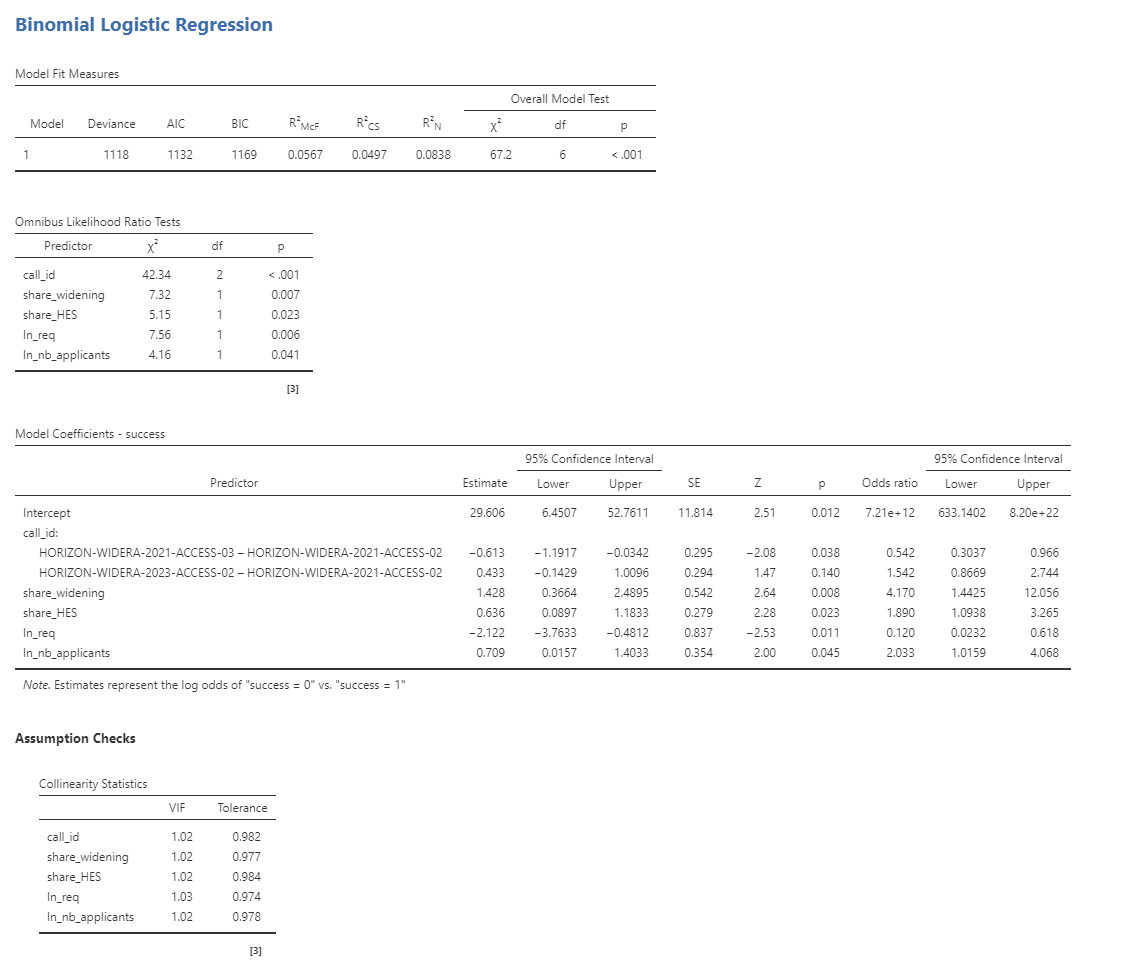
Output 1: Failure model – results of the binary logistic regression for the probability of not being funded p(success=0) for Twinning proposals under Horizon Europe (2021–2023). Statistical analysis was performed in jamovi (version 2.3), using R and the car package for regression diagnostics [2,3,4].
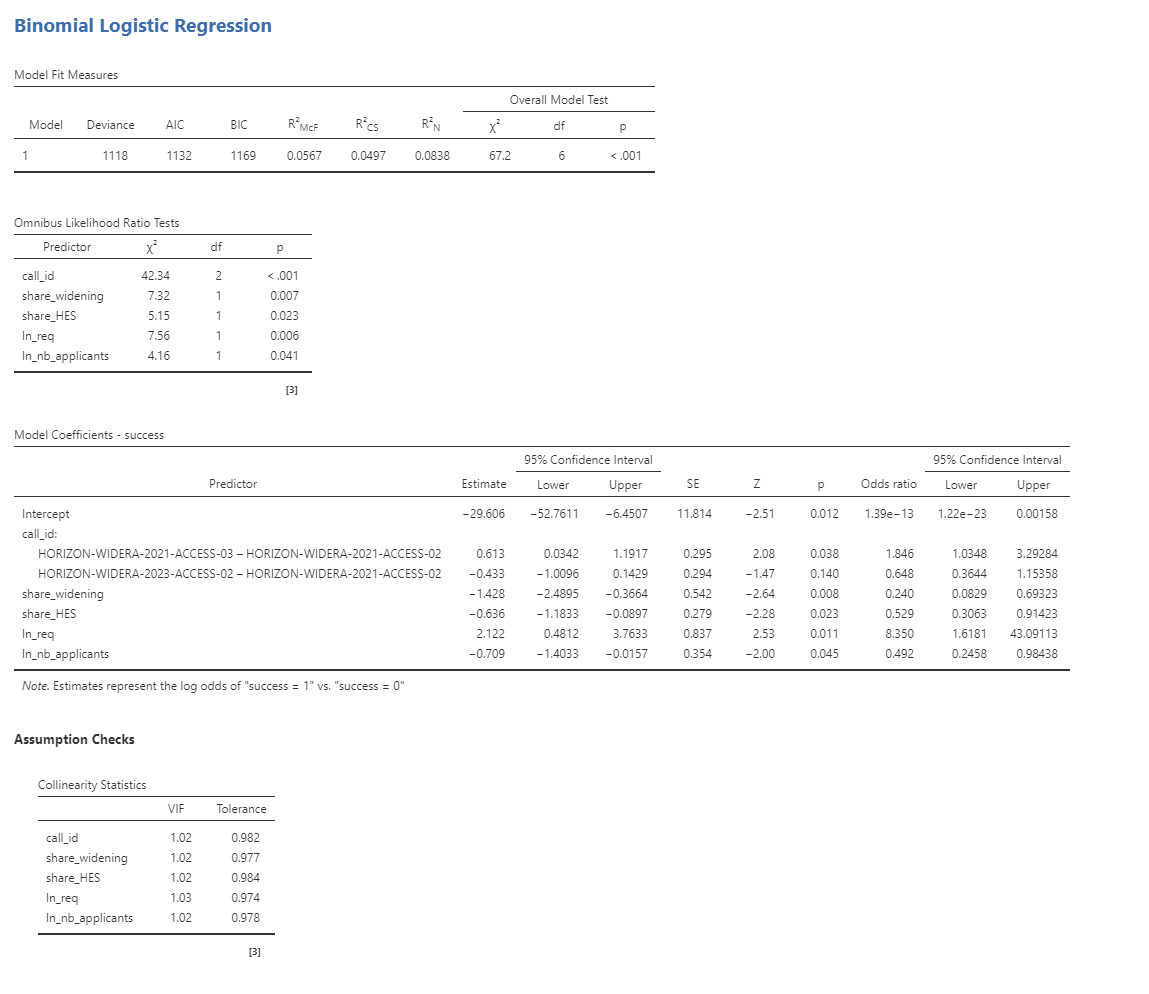
Output 2: Success model – results of the binary logistic regression for the probability of being funded p(success=1) for Twinning proposals under Horizon Europe (2021–2023). Statistical analysis was performed in jamovi (version 2.3), using R and the car package for regression diagnostics [2,3,4].
7. Limitations of the analysis and the logistic model
Logistic regression identifies structural factors associated with Twinning proposal success, but interpretive possibilities are limited by data availability. The model does not include proposal quality or the evaluation process and explains only part of the variability in funding outcomes. The identified relationships therefore represent statistical associations between consortium characteristics and the probability of success, not direct causal effects. The limitations are discussed in more detail below.
Proposal quality not included
The model uses only structural characteristics of the consortium (share of Widening partners, sector, size, budget, call). The actual quality of the proposal—scientific excellence, relevance and the implementation plan—is not contained in the data. These factors, however, strongly influence expert evaluation. The model therefore does not explain the outcome of individual proposals but identifies general structural patterns.
Low explained variance is expected
The model’s pseudo-R² is approximately 0.06–0.08. In the context of project proposal evaluation, such values are common because funding decisions depend on many unobserved factors (e.g., proposal quality, evaluators, panel composition, thematic relevance). Low R² therefore does not mean the model is weak; it means it explains only the part of variation captured by the available data.
Structural vs. causal interpretation
Logistic regression identifies statistical associations, not causal relationships. For example, the finding that a higher share of Widening partners is associated with lower success does not mean that Widening partners themselves reduce project proposal quality. The result likely reflects the structural nature of Twinning, which focuses on transferring excellence to one institution rather than on broad cooperation among multiple Widening organisations.
Aggregation into shares
share_widening and share_HES aggregate heterogeneous institutions into simple proportions. The model does not distinguish types of Widening institutions, their quality, or their role in the consortium. Two projects with the same Widening share may have very different collaboration structures.
Limited representation of consortium size
Consortium size is represented by the natural logarithm of the number of partners, a standard and methodologically appropriate transformation, but still a simplification. The model does not capture role hierarchies, intensity of participation, or collaboration quality.
Differences between calls
The variable call_id captures differences between Twinning calls, but these differences may be driven by multiple factors simultaneously (call budget, thematic scope, competition). The model cannot fully separate these influences; therefore, interpretation of call effects is contextual rather than purely structural.
Uneven distribution of combinations
Some combinations of structural characteristics are rare (e.g., very high numbers of Widening partners). Estimates in these areas are more uncertain, as reflected in wider confidence intervals. Results are therefore most reliable within the range of typical Twinning consortia (3–5 partners; 0–2 additional Widening partners).
8. Conclusion and implications for preparing Twinning proposals
The analysis of more than 1,300 Twinning proposals under Horizon Europe shows a robust and statistically significant relationship between consortium structure and proposal success. Both logistic regression and descriptive statistics consistently confirm that the share of partners from Widening countries is the strongest negative predictor of the odds of funding in the Twinning calls analysed to date. Proposals with a higher representation of Widening institutions have substantially lower success rates than proposals with fewer such partners; this pattern is observed across calls and remains stable after controlling for other consortium characteristics.
A negative association with success is also observed for larger consortia and a higher share of higher-education-sector partners, although these effects are weaker than the effect of the Widening share. By contrast, the requested contribution shows only a weak and marginal relationship and cannot be considered a robust determinant of funding outcomes.
The distribution of success rates by the number of Widening partners further confirms this structural pattern: success rates decline as the representation of Widening institutions in the consortium increases across all calls. It should be noted that the coordinator is always an institution from a Widening country; the category “0 Widening partners” therefore refers to consortia with no additional Widening partners beyond the coordinator. For example, in HORIZON-WIDERA-2021-ACCESS-03 the success rate decreases from 31.6% for consortia without additional Widening partners to 6.3% for consortia with three additional Widening partners alongside the coordinator.
From a proposal preparation perspective, the results suggest several structural factors associated with higher odds of funding. More successful proposals tend to have a more compact consortium structure with a limited number of partners. Excessive expansion beyond the minimum requirements may reduce thematic focus and increase organisational complexity, which on average is associated with lower odds of funding. The involvement of additional Widening institutions beyond the coordinator is associated with lower odds of success, suggesting that their participation should always be clearly justified by a specific role in knowledge transfer and institutional development of the coordinator. Sectoral composition may also matter: proposals with a higher share of universities show, on average, somewhat lower odds of funding than proposals with broader involvement of research organisations or other types of institutions.
These findings should, however, be interpreted with caution: the outcome of a specific proposal is primarily determined by its scientific quality, relevance and the quality of its implementation plan. Consortium structure is only one factor that may influence funding odds, and the logistic model explains only part of the variability in outcomes.
The results are also consistent with the official logic of Twinning, which is conceived as a targeted institutional partnership aimed at strengthening the capacity of a coordinating organisation from a Widening country through cooperation with a limited number of top-class partners from stronger research systems. In this context, the analysis can be seen as empirical support for the instrument’s design: proposals whose consortium structure corresponds to this targeted partnership model and avoids unnecessary consortium expansion may, on average, be associated with higher odds of funding [5,6].
Author: Daniel Frank, TC Prague, frank@tc.cz, 27.2.2026
Publication or dissemination of this article (blog) or any part thereof, including its appendices, in any form and in Czech or any other language is permitted only with proper attribution of the source and the author in accordance with standard citation practices. Any modifications or adaptations of the article (other than purely formal edits) require the author’s consent. The text has not undergone language editing.
References:
[1] Technologické centrum Praha. (2025). Rozšiřování účasti a šíření excelence (Widening) – Vademecum Horizont Evropa. Available at: https://www.tc.cz/cs/publikace/219/rozsirovani-ucasti-a-sireni-excelence-widening
[2] The jamovi project. (2022). jamovi (Version 2.3) [Computer software]. Available at.: https://www.jamovi.org
[3] R Core Team. (2021). R: A language and environment for statistical computing (Version 4.1) [Computer software]. Vienna: R Foundation for Statistical Computing. https://cran.r-project.org
[4] Fox, J., & Weisberg, S. (2020). car: Companion to Applied Regression [R package]. Dostupné z: https://cran.r-project.org/package=car
[5] European Research Executive Agency (REA). (2026). Twinning – Horizon Europe Widening Participation and Spreading Excellence. Dostupné z: https://rea.ec.europa.eu/funding-and-grants/horizon-europe-widening-participation-and-spreading-excellence/twinning_en
[6] European Research Executive Agency (REA). (2026). Horizon Europe Widening – Who Should Apply. Available at: https://rea.ec.europa.eu/horizon-europe-widening-who-should-apply_en