Success in the prestigious Horizon Europe programme is driven not only by the research quality and ambition of a proposal, but also by the applicant’s ability to comply meticulously with every formal requirement and eligibility rule. Before a proposal can enter peer review, it must first pass an admissibility and eligibility check, carried out in most calls by the European Commission’s executive agencies. Proposals that fail this screening are excluded long before their scientific or innovation merit can be assessed.
Drawing on eCORDA data (cut-off May 2025), our analysis follows three categories of proposals that never reach expert evaluation—Inadmissible (formal errors), Ineligible (breaches of eligibility rules) and Withdrawn (voluntarily removed by applicants)—and reveals sharp differences in their shares across European countries and action types.
-
The leading cause of exclusion is ineligibility—violations of Horizon Europe participation rules—accounting for two-thirds of all non-evaluated proposals.
-
Purely formal errors remain below one percent, while withdrawals are concentrated in individual schemes such as ERC and MSCA-PF.
-
Consortium actions are far more prone to administrative pitfalls (5.8 %) than mono-beneficiary schemes (1.2 %).
Administrative-readiness levels correlate strongly with national innovation performance: countries with a high Synthetic Innovation Index (EIS 2024) show persistently low inadmissibility and ineligibility rates, whereas applicants from less innovative states face a higher risk of failure at this first gate.
The Czech Republic in context
Out of 1 835 Czech proposals, only 0.49 % were classified as inadmissible, 1.80 % as ineligible and 0.11 % were withdrawn. The overall exclusion rate of 2.40 % compares favourably with the Horizon Europe aggregate of 3.65 %. Czech proposals therefore meet formal and eligibility requirements as well as— or better than —those of most other participating countries.
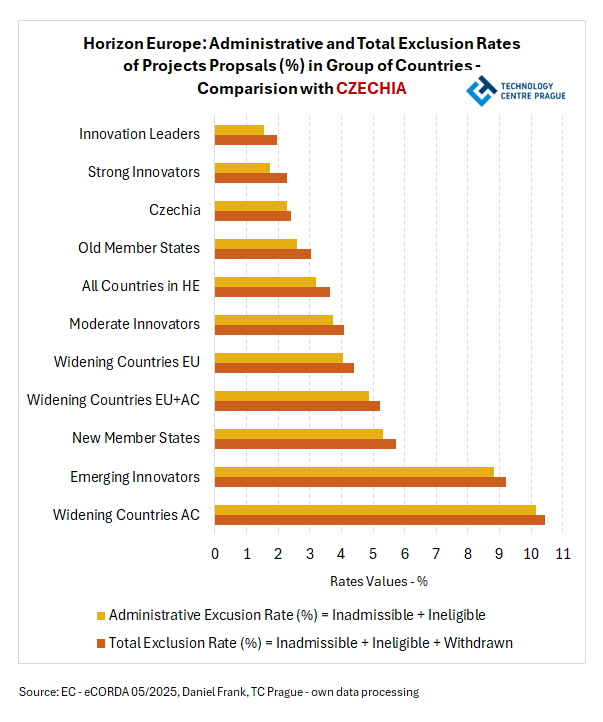
Figure: Comparison of the Czech Republic with European country groups by the share of project proposals excluded prior to peer-review evaluation
Full findings are presented in two detailed studies in Czech (here and here). They lead to the following recommendations for raising administrative-readiness levels when submitting proposals to EU framework programmes:
-
Targeted support for lower-performing countries
Expand training, mentoring and NCP services for Emerging and Moderate Innovators.
-
Systematic pre-submission compliance checks
Introduce or strengthen institutional review mechanisms, especially in less experienced organisations.
-
Heightened focus on high-risk schemes
Provide specialised guidance for action types with elevated exclusion rates (CSA, PCP, PPI, Joint Undertakings).
-
Continuous analytics and evaluation
Maintain regular monitoring of non-evaluated proposals via eCORDA to refine support measures and prevent recurring errors.
-
Use exclusion rates as a complementary national indicator
Track administrative exclusions alongside success rate and grant share to gauge research-system efficiency.
Daniel Frank, Technology Centre Prague – frank@tc.cz, 24 June 2025