The post from May 17, 2023 dealt with the structure of the Czech participants of the Horizon Europe programme according to their legal form as of April 26, 2023. Let us now look at the development of the representation of participants’ legal forms from 2015 to 2022. The data source for this post is the eCORDA grant agreement and participant database as of August 22, 2022 (for the Horizon 2020 programme) and June 19, 2023 (for the Horizon Europe programme).
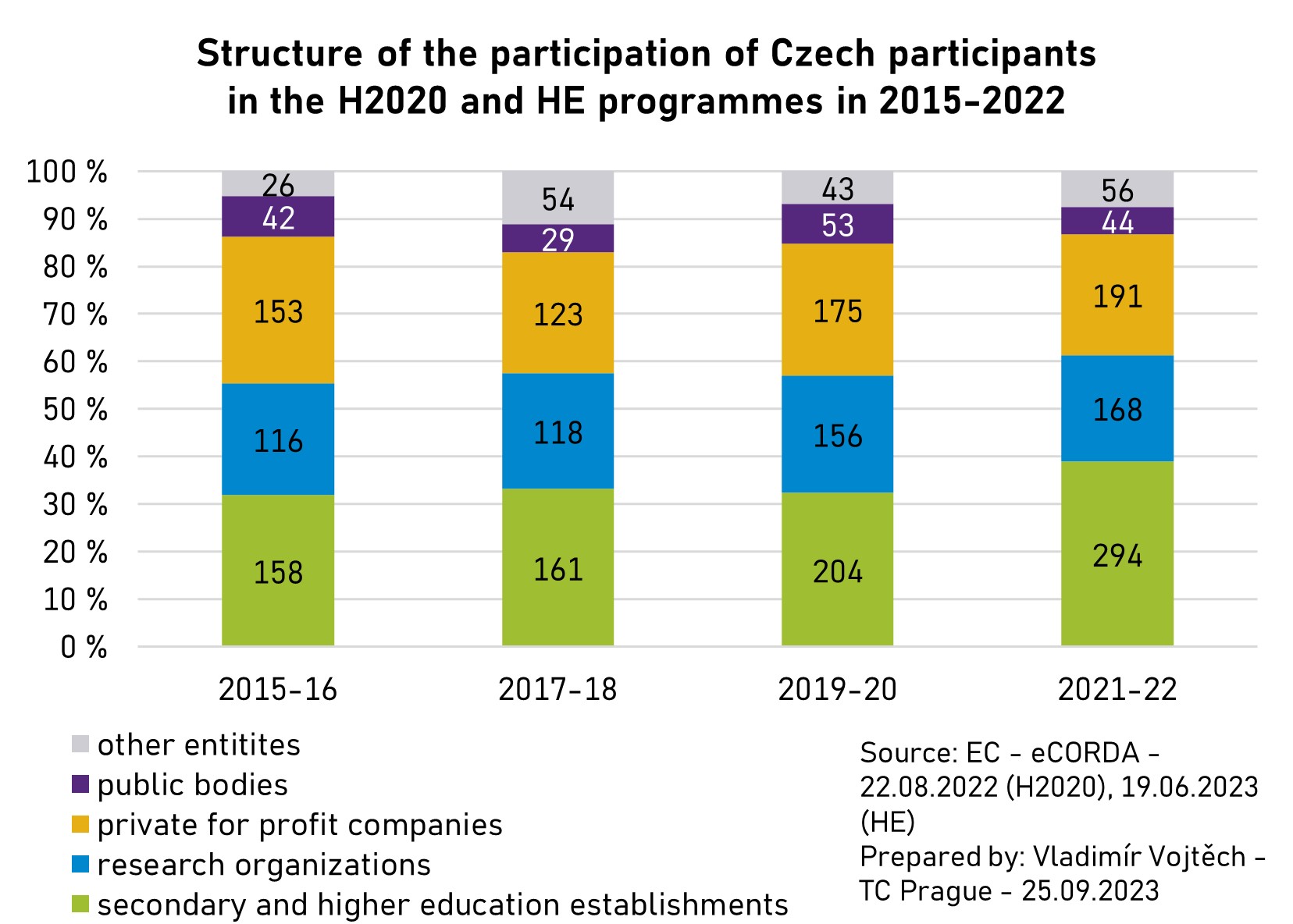
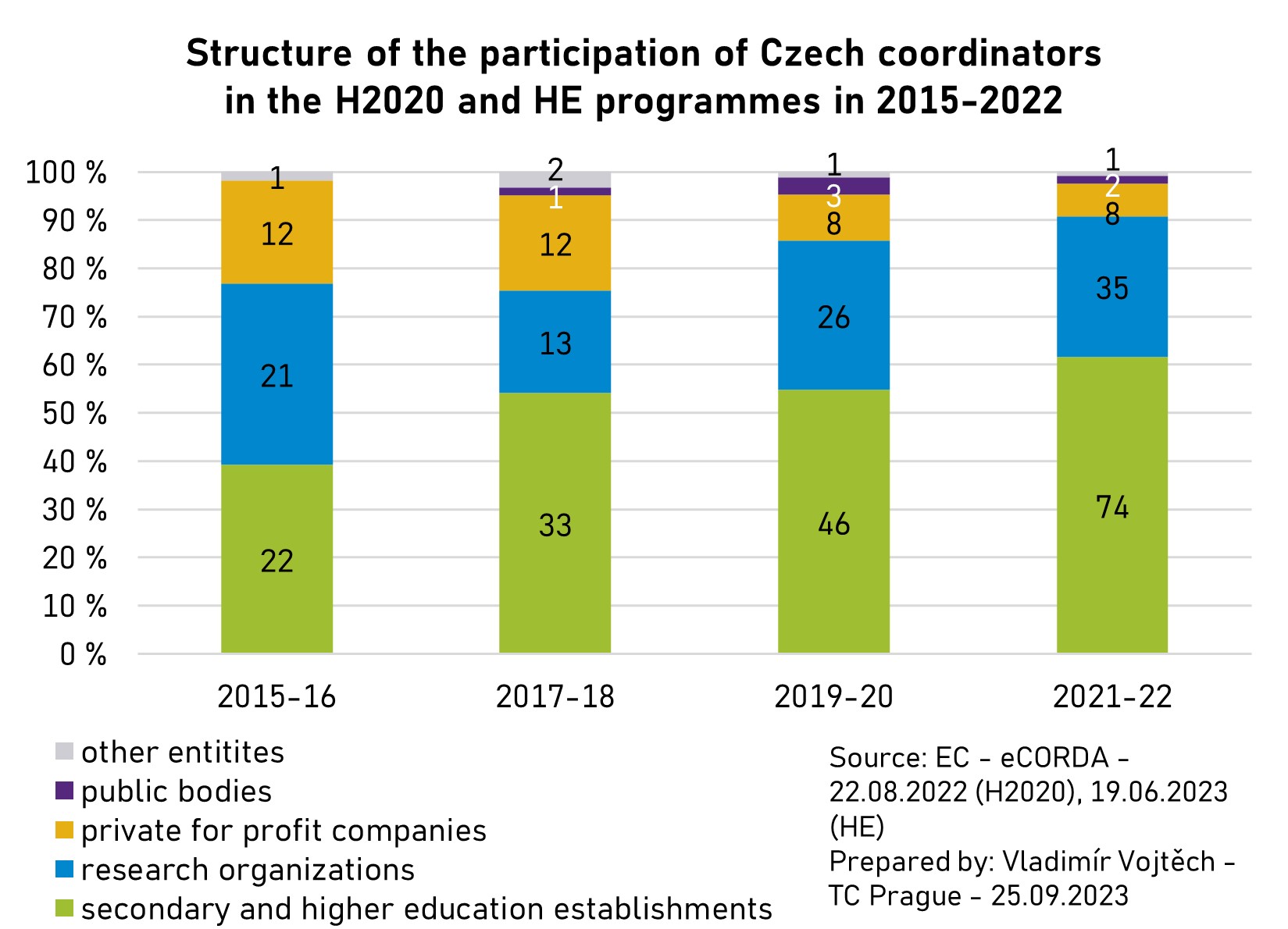
In terms of participation, the representation of higher education institutions grew in the observed period (from approx. 32 to 39%); the representation of research organizations remained stable (between 22 and 25%). On the contrary, the representation of private for-profit companies decreased (from 31 to 25%). In terms of project coordination, the representation of higher education institutions increased significantly in the 2015–2022 period – in 2021–2022, higher education institutions coordinated three fifths of all Czech projects in the Framework Programme.
The structure of Czech participation according to the net EU contribution is more varied. However, in summary, we can say that higher education institutions are getting an increasing share of the net EU contribution among the Czech participants of the Framework Programmes (from 35% in the period 2015–2016 to 46% in the period 2021–2022). On the contrary, the representation of research organizations and private for-profit companies is decreasing. The representation of the public sector and other organizations has been negligible for a long time.
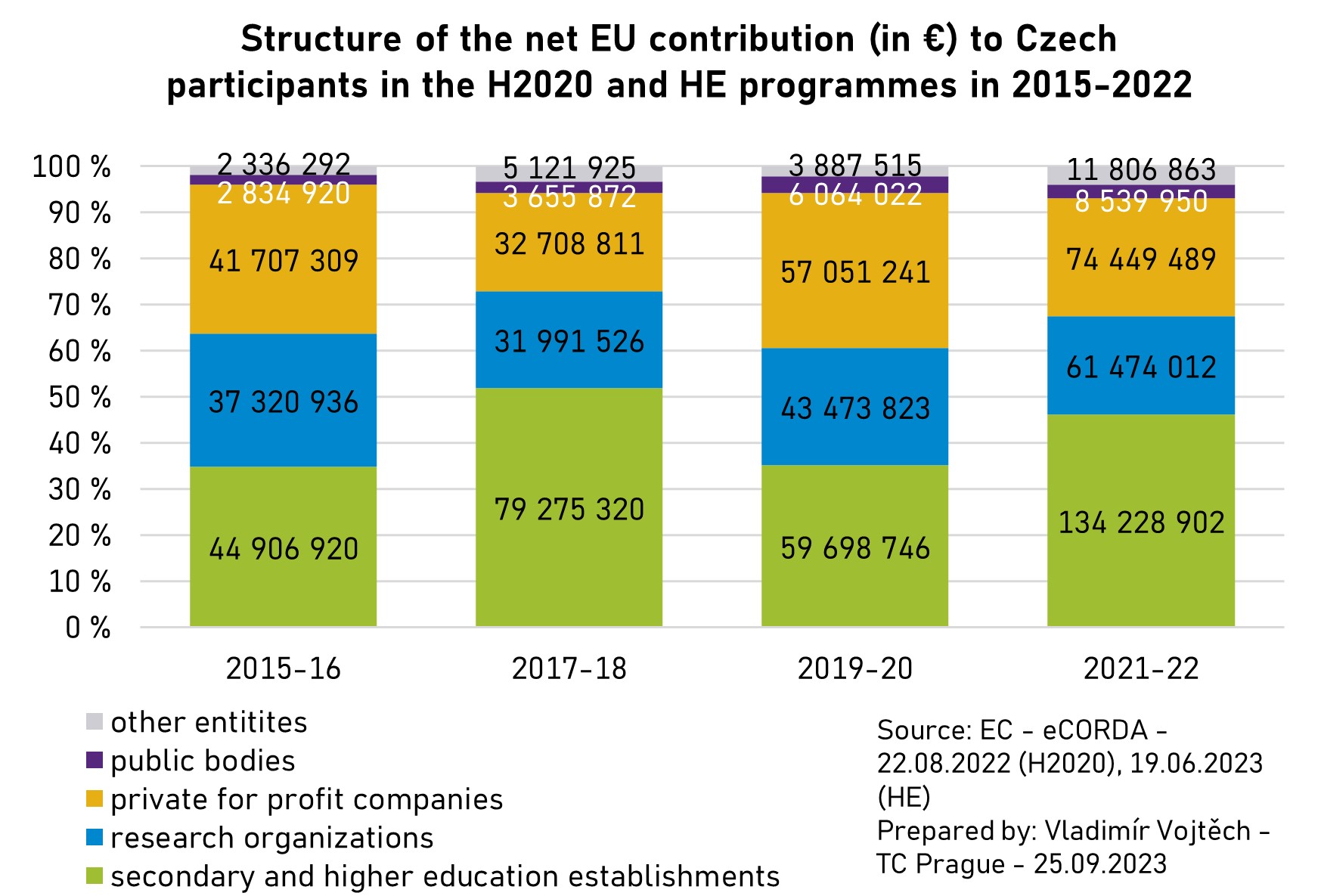
Summary: Despite data fluctuations between individual years (or between two-year periods), globally we can say that the participation of Czech higher education institutions in Framework Programmes is increasing (both in terms of the participation, the amount of claimed net EU contribution, the number of coordinated projects, and from the point of view of the representation of higher education institutions among the participants).
Author: Vladimír Vojtěch, TC Prague, vojtech@tc.cz, 25.09.2023