The article (ECHO, No 5–6/2022) briefly discusses the possibility of using purchasing power parity as an alternative financial indicator for assessing the participation of individual EU and associated countries in the Horizon 2020 programme and in other framework programmes.
Given the different price levels in Europe, a significant difference in the way in which projects under the EU Framework Programmes for Research and Development are evaluated has been identified. The application of purchasing power parity can serve as an alternative view of how the Czech Republic is doing financially within these programmes. The example of the H2020 programme shows that financial indicators for the Czech Republic (and for a number of other new EU Member States) are not nearly as unfavourable as it seems when working only with nominal values (see the Figure below). At the same time, it is possible to identify a positive trend in the growth of the number of participations and the acquisition of a higher amount of EU contribution at a lower price level in the Czech Republic and some of the new EU Member States.
The alternative view of the participation of the new member countries, including the Czech Republic, presented in this article thus raises a number of questions about the legitimacy of the demand by a number of representatives of these countries to equalize the level of personnel costs in FPs projects despite differences in countries' economic performance. When evaluating the participation of the Czech Republic in the FPs, it is also necessary to bear in mind that the purpose of participation in the FPs is not only to obtain funds per se or to remediate budgetary deficiencies in the regional, research and innovation policy of the Czech Republic and the EU, but especially the international scientific and research cooperation necessary for solving challenges of a transnational nature and scope, including the accrual of scientific prestige resulting from it.
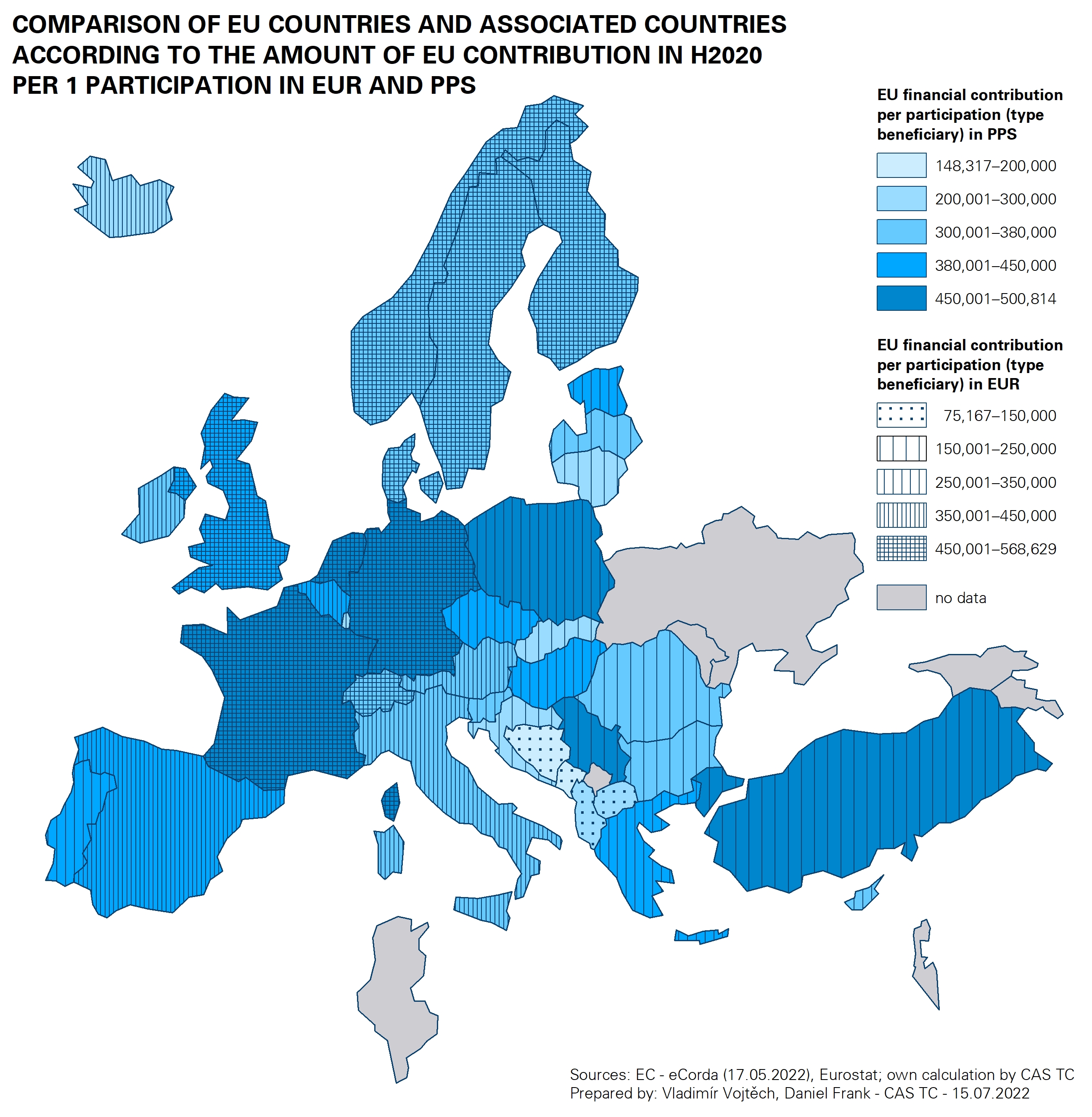
Authors: Vladimír Vojtěch, Daniel Frank, CAS TC, 30.09.2022