Joint projects involving businesses, research organisations and universities should remain at the heart of the next Framework Programme, FP10. Their advocates, however, point to two simultaneous pressures: increasing grant sizes and a potential squeeze on the budget for collaborative research.
Bruno Feignier, Deputy CEO of the French research organisation CEA (Commissariat à l’énergie atomique et aux énergies alternatives), calls for stronger support for pan-European research collaboration in an article published by Science|Business on 9 November 2026. He argues that connecting businesses, research organisations and universities provides the core European added value of the Framework Programmes. Supporting leading researchers through the ERC and start-ups through the EIC is important, but translating research results into industrial applications also requires lasting partnerships and infrastructure for developing, testing and validating technologies.
Findings reported in Juliette Portala’s article of 20 October 2026 add another dimension to this debate. Drawing on European Commission data, the article highlights the concentration of funding in larger grants. So far, Horizon Europe’s Pillar 2 has allocated €32.9 billion to 5,271 projects. Under the corresponding parts of Horizon 2020, 13,580 projects received a total of €39.2 billion. The average contribution therefore amounts to approximately €6.2 million per project in Horizon Europe, compared with €2.9 million in Horizon 2020. These are nominal amounts from different periods, so the comparison does not account for inflation.
Moreover, the figures cover the whole of Horizon 2020 but only approximately the first two-thirds of Horizon Europe. The lower number of projects funded so far should therefore not be presented as the final difference between the programmes. COFUND actions were excluded from the calculation.
The EARTO chart accompanying Feignier’s article illustrates a further pressure: Pillar 2’s declining share of the programme budget. Under the proposals shown, its share would fall from 56% in the current Horizon Europe programme to around 43% in FP10. Nevertheless, the Commission’s proposal envisages a nominal increase in funding for the pillar from €53.5 billion to €75.9 billion, thanks to a larger overall programme budget. A smaller share therefore does not automatically mean less money.
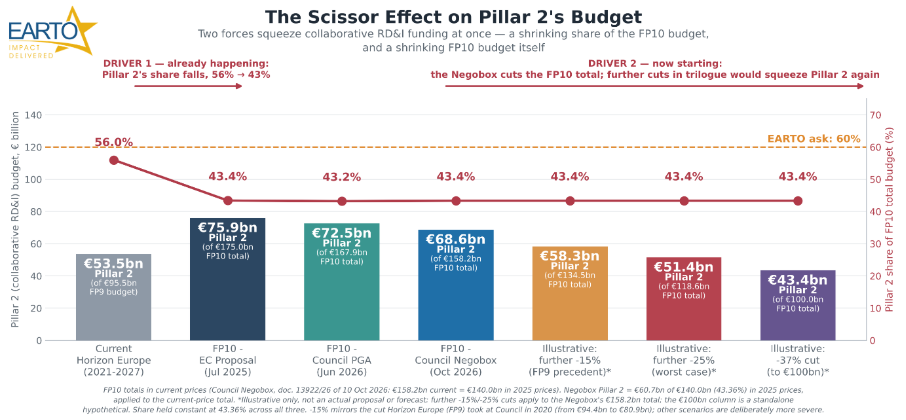
Chart: Pillar 2’s budget under a double squeeze — a declining share and potential cuts to the overall FP10 budget
Chart source: EARTO, published in Bruno Feignier’s article in Science|Business, 9 November 2026. Amounts are expressed in current prices. The final three columns show illustrative scenarios involving further cuts, rather than agreed budgets. The dashed orange line marks EARTO’s call for 60% of the programme budget to be allocated to collaborative R&D.
However, budget cuts could progressively erase this increase. Alongside the Commission’s proposed €75.9 billion, the chart shows subsequent negotiating options allocating €72.5 billion and €68.6 billion to Pillar 2. EARTO also presents three illustrative scenarios: if the pillar retained a share of approximately 43%, further cuts of 15% or 25% to the overall budget, relative to the last negotiating option shown, would reduce its funding to €58.3 billion or €51.4 billion respectively. With an overall FP10 budget of €100 billion, the pillar would receive €43.4 billion. These amounts are expressed in current prices and do not account for inflation.
The two articles thus raise two related questions: how much funding will be available for collaborative research, and how many projects it will support. If average grant sizes continued to grow while the budget was reduced, there could be less scope to fund additional consortia. This is a possible consequence of the two trends combined, rather than a conclusion demonstrated by the chart alone.
Speaking on behalf of CEA and together with EARTO, the European Association of Research and Technology Organisations, Feignier calls for an overall FP10 budget of €200 billion, with 60% allocated to collaborative R&D. His article is an opinion piece sponsored by EARTO and reflects the position of this part of Europe’s research community.
Sources:
Prepared by Daniel Frank, Technology Centre Prague, based on articles by Bruno Feignier and Juliette Portala published in Science|Business on 9 November 2026 and 20 October 2026 respectively.