The text below was taken from Science Business. and subsequently edited (shortened). Use the original source for citations.
Success rates are up, UK and Swiss participation down, and Widening countries edge up to the EU 27 average. And on the third anniversary of Brexit, the UK’s five top universities, usually among the biggest winners of EU R&D funding, are feeling the pinch.
Horizon Europe is heading into its third year, and the latest statistics offer a glimpse of how the EU is spending its €95.5 billion research funding pot.
To date, the Commission has disbursed €11.83 billion, or around 12.4% of the budget, in the first two years of the seven-year programme.
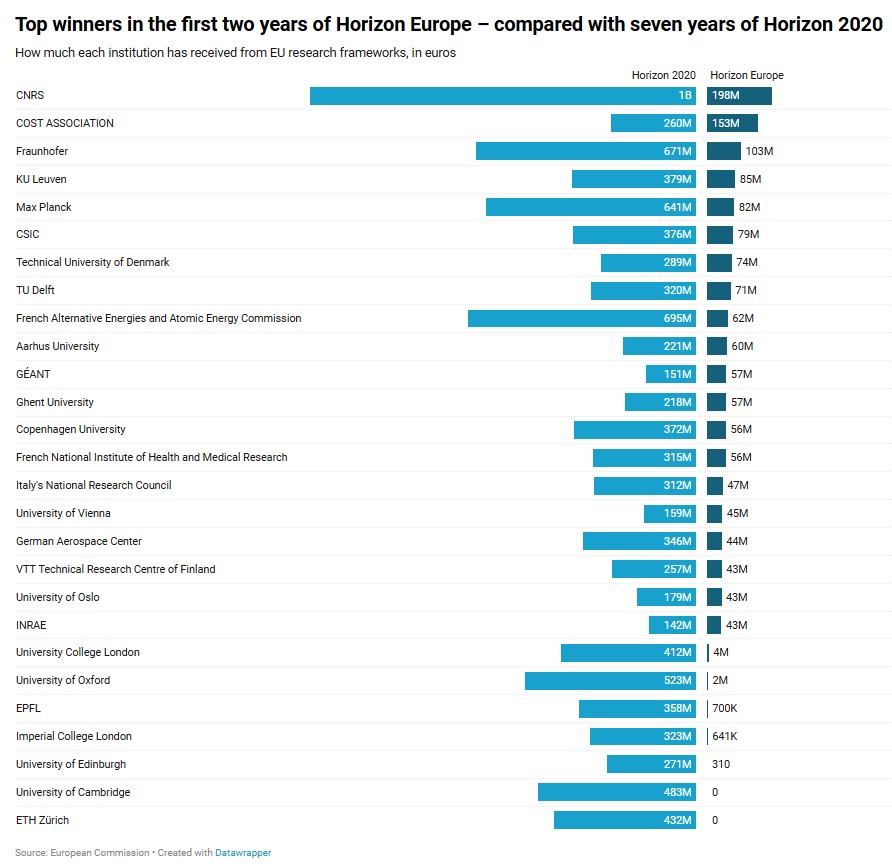
What is most startling about the data, is the impact of Brexit and the country’s subsequent non-association, on the level of UK participation, and in particular on its five leading universities. Despite a national safety net that replicates EU funding, participation by UK companies, universities and individuals has fallen by half.
Oxford University, which won €523 million over the seven years of Horizon 2020, has been awarded €2 million in the first two years of Horizon Europe. Cambridge University, recipient of a total of €483 million from Horizon 2020, has not received any Horizon Europe funding to date.
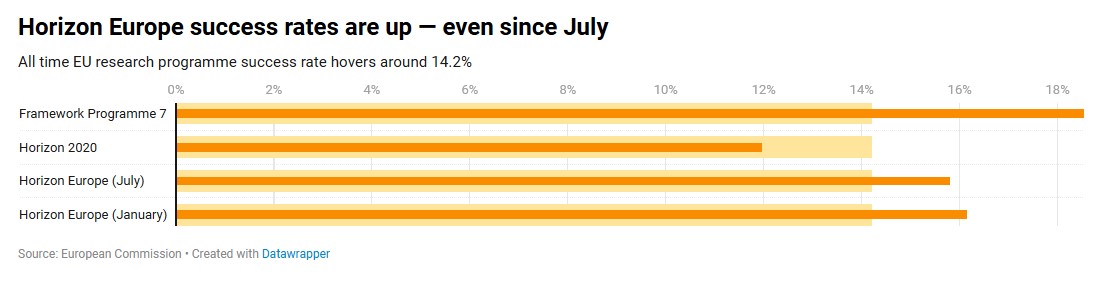
On the bright side, with almost 5,000 grants signed, success rates are up. According to the latest (January) statistics, the number is just over 16%, up from 15.8% in July 2022. While many excellent proposals get turned away, the situation is better than Horizon 2020, where the success rate was 12%.
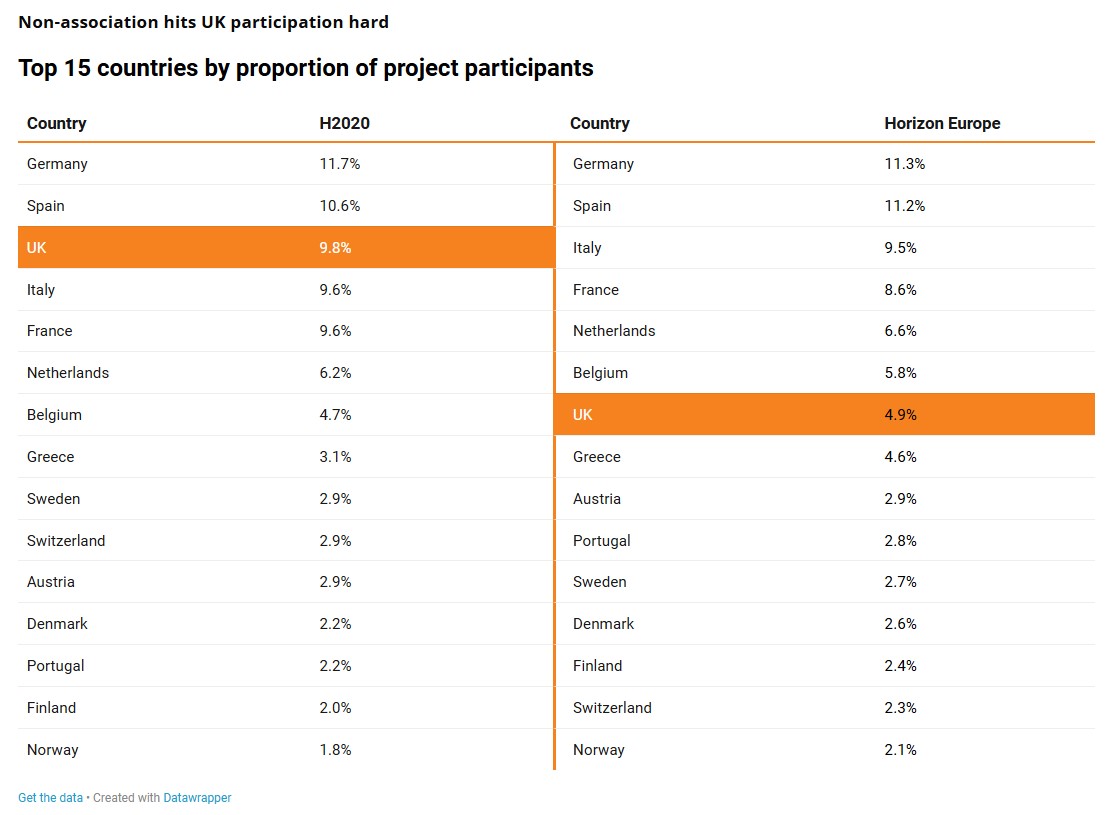
UK participation in Horizon Europe – that is the percentage of total participants the UK accounts for, not the absolute number - has fallen by half compared to Horizon 2020. Having been one of the top three countries by number of participating entities – be they individuals, universities or companies – the UK is now beaten by Belgium in the league table of Horizon Europe activity.
And notably, UK overall participation has fallen much more steeply than for Switzerland, which is also not associated to Horizon Europe because of the dispute about its wider relationship with the EU.
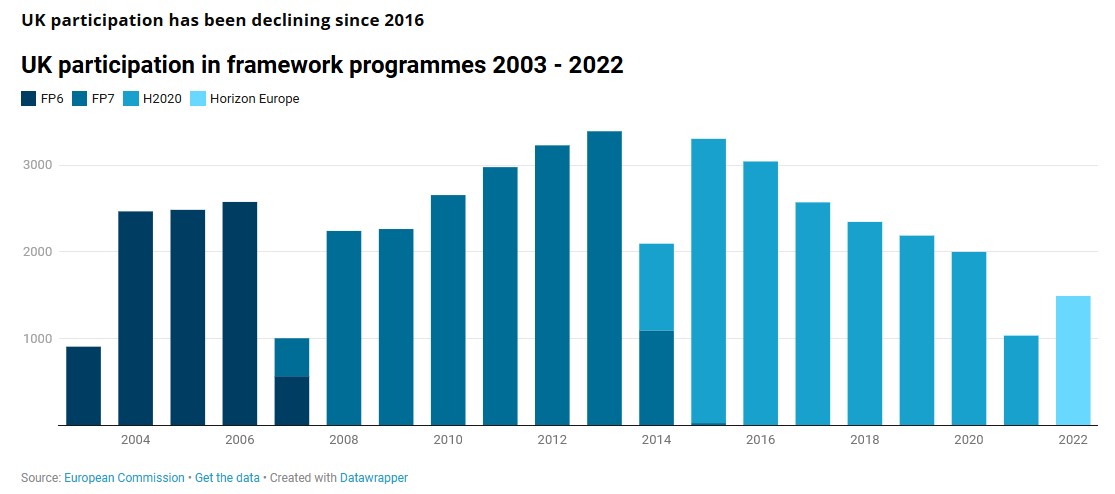
UK engagement in EU research has been waning since 2016, when the country voted to leave the EU. Normally, each year of a framework programme sees more engagement than the last, as it cranks into gear. But the opposite trend was visible for the UK in Horizon 2020.
It is approaching a decade since the Widening participation and spreading excellence programme was launched with the goal of closing the innovation gap between Europe’s top and low performers.
The extent to which Widening measures have worked is an open and ongoing debate, but the latest Horizon Europe figures do suggest a certain level of success in terms of the percentage of grant proposals from Widening countries that are accepted.
As the table above shows, the average success rate of Widening countries in obtaining funding through Horizon Europe is about equal to the EU 27 average, at just over 20%.
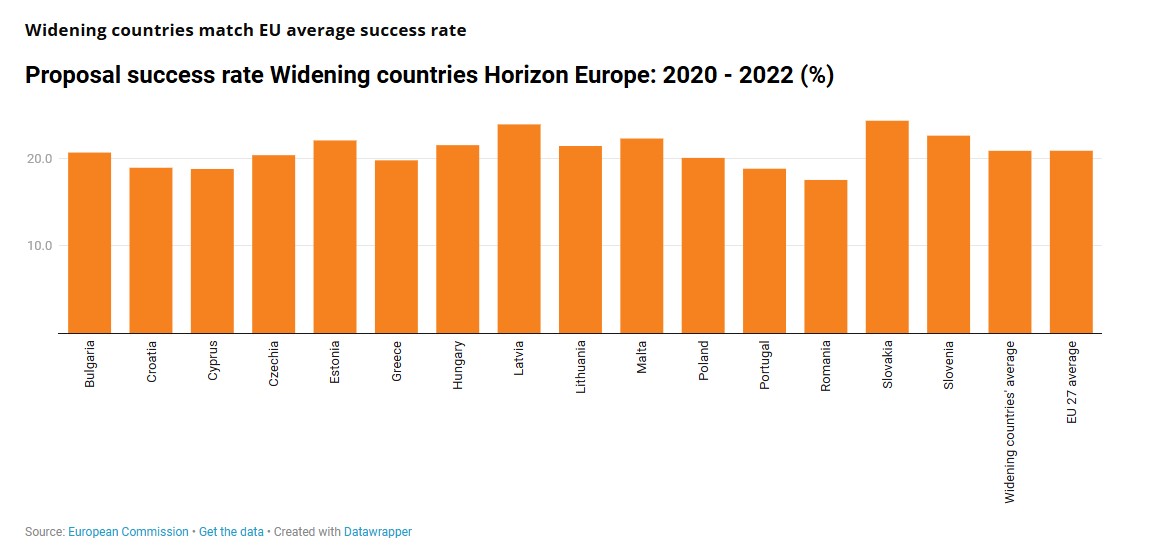
While this may seem positive for Widening countries, other metrics show just how far they have to go to close the innovation gap.
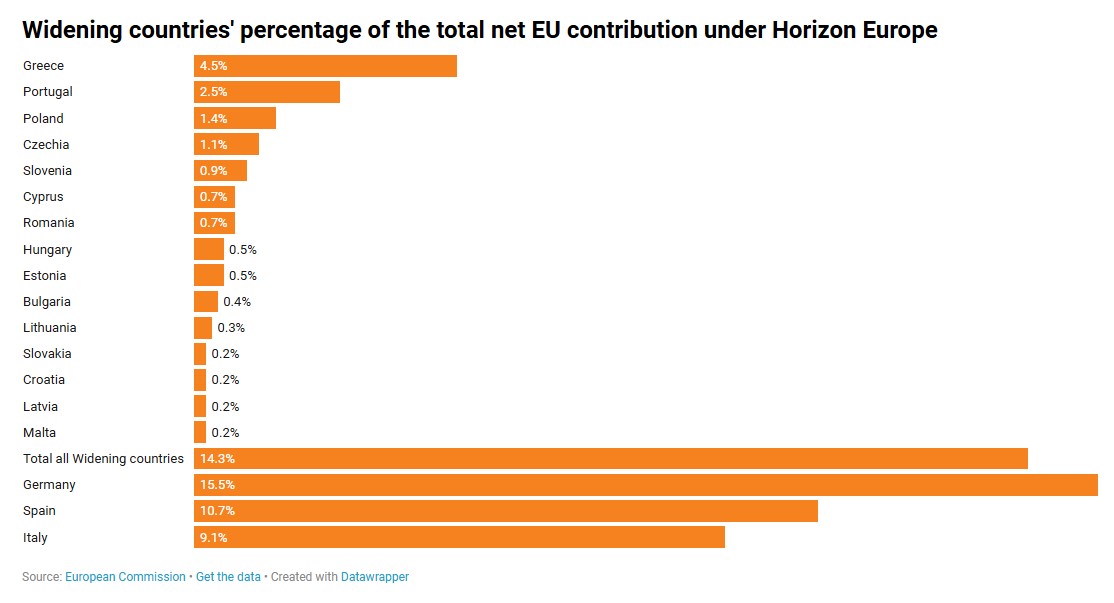
The table below shows the percentage of total net EU contributions that Widening countries have received under Horizon Europe. The top-performing country, Germany, has proportionally received more than all of the Widening countries put together.
With the UK and Switzerland out of Horizon Europe, the money flows to Europe’s biggest research institutions are changing – drastically so, in the case of the UK’s top five universities.Aside from UK and Swiss institutions, most of the top 20 biggest beneficiaries in Horizon 2020 keep their place in the leaders’ table.UK and Swiss exclusion has allowed some of the bigger European universities, such as Aarhus University and Ghent University, to climb into the top 20.
Source: Science Business. Here’s what the first two years of Horizon Europe look like in numbers | Science|Business. Welcome to Science|Business | Science|Business [online]. Copyright © 2023 [cit. 01.02.2023]. Available at: https://sciencebusiness.net/news/Horizon-Europe/heres-what-first-two-years-horizon-europe-look-numbers
The full text of the article can be found here.