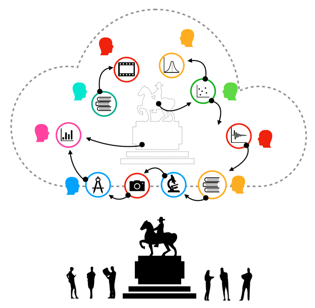
The European Commission has launched a dialogue with Member States on the joint creation of a Collaborative Cloud for Cultural Heritage to help safeguard European cultural treasures through a digital infrastructure. The Cloud aims at fostering cooperation and co-creation among cultural, creative and technology sectors.
The European Collaborative Cloud for Cultural Heritage will be a one-of-a-kind framework that will enable unparalleled transdisciplinary and large-scale collaboration between cultural heritage professionals on shared topics. This forward-looking initiative aims to develop and protect Europe’s cultural heritage through cutting edge digitisation techniques. It will provide tools for digitising artefacts, studying artworks, and documenting data, all of which will improve preservation, conservation and restoration procedures. Finally, it will open up new prospects for our museums, including regional and smaller ones for better access to Europe's rich cultural content.
The European Collaborative Cloud for Cultural Heritage will:
- Build a digital infrastructure that will enable inclusive cooperation across the cultural, artistic, and technological sectors by allowing partners to communicate and collaborate in a safe, secure, and trustworthy manner.
- Become a long-term infrastructure for research projects having open access to share datasets and data files with collaborative workspaces and workgroups.
- Store data under European jurisdiction with highly sophisticated encryption and signature facilities.
For whom? The European Cloud for Cultural Heritage is for museum professionals such as cultural heritage scholars, curators, archivists and conservators from all over Europe. It will facilitate access to advanced technologies and remove barriers for smaller and remote cultural institutions. The Cloud will act as a lever for small and remote museums to tap into EU funding for going digital.
How? The Cloud for Cultural Heritage will bring together well developed, but often isolated solutions into a genuine network. It will link new technologies and tools to existing data spaces at the EU and Member States’ levels. To this new and cutting edge services and tools will be added, based on the latest technological findings and new research.
When? The work has just started and this is only the launch of a co-creation process. Following an ex-ante impact assessment by eight prominent experts, the European Commission aims at launching several calls under Horizon Europe for 2023 and 2024, with a total envisaged budget of € 110 million. To make the cloud a lasting construction, the Commission and the Members States have now embarked on establishing a long term governance model combining existing national and European structures with new high end technologies and research.
Source: European Commission