In our previous articles, we discussed Czech Republic's business participation in the Horizon Europe programme (hereinafter "HE") as a whole and in its specific parts (in so-called joint undertakings). The purpose of this article is to present Czech Republic’s participation in Pillar III, which, as its name "Innovative Europe" suggests, focuses on supporting and strengthening innovation activities, primarily in small and medium-sized enterprises and start-ups. As of October 21, 2025, the European Commission's eCORDA database recorded 6,216 participations in 2,480 projects in Pillar III, with a claimed net EU contribution of €4.8 billion. In terms of the claimed net EU contribution, this pillar thus represents approximately one-eleventh of the HE programme.
The highest number of participations in Pillar III were reported by Germany (792 participations), Spain (698 participations), France (677 participations), Italy (537 participations), and the Netherlands (487 participations). The highest net EU contribution was claimed by participants from Germany (€978 million, i.e. one-fifth), Spain (€622 million), France (€522 million), the Netherlands (€485 million), and Belgium (€402 million).
The data published in the eCORDA database as of October 21, 2025, includes the results of calls for 2021, 2022, 2023, and part of 2024, i.e., half of the successful participations and project proposals. When interpreting the data in the eCORDA database, it should be borne in mind that the data is cleaned and validated before being entered into the database and is therefore published in the database with a certain delay.
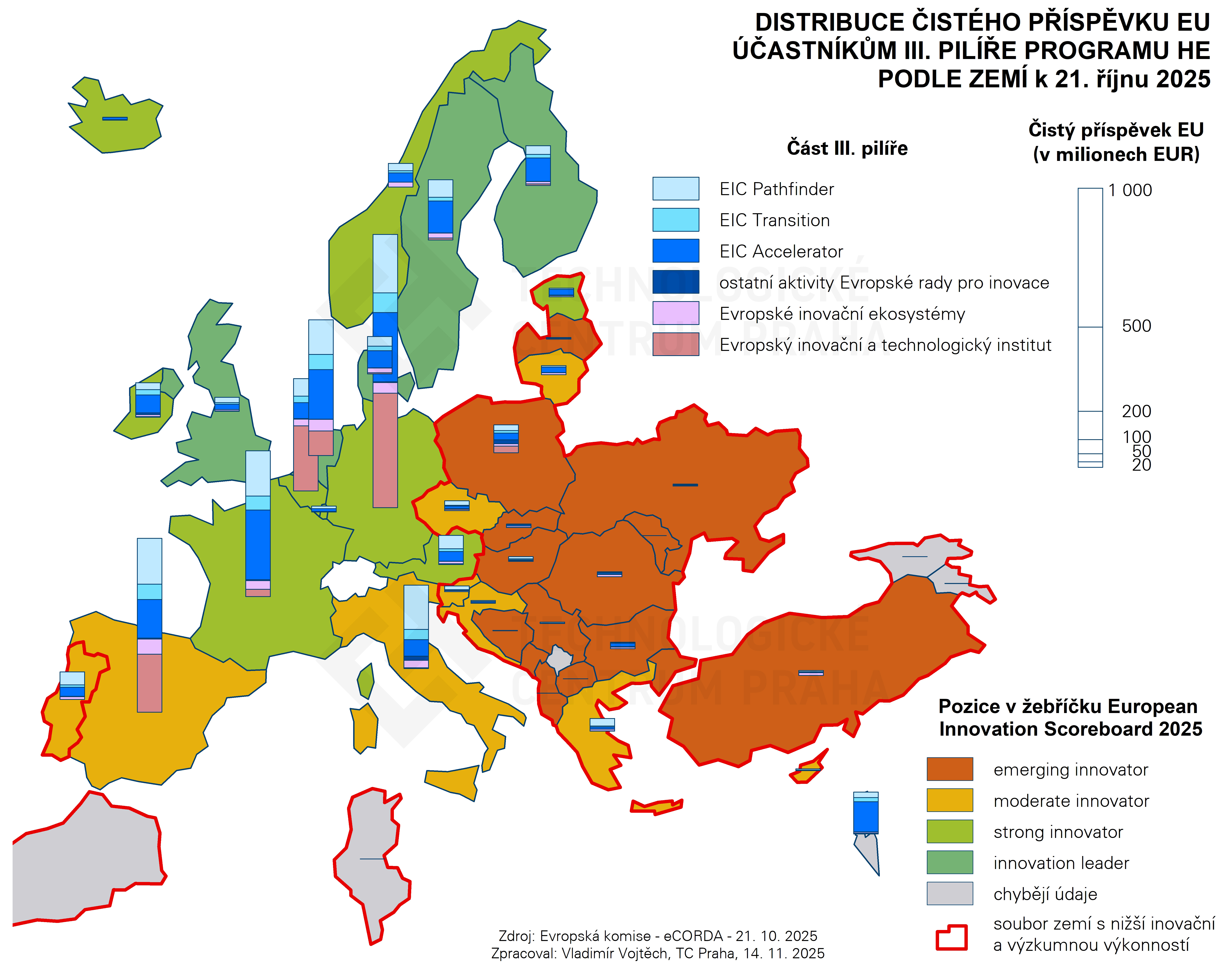
Note: Distribution of the net EU contribution to Pillar III participants by countries as of October 21, 2025. Legend: Part of Pillar III – light blue EIC Pathfinder, med blue EIC Transition, blue EIC Accelerator, dark blue other activities of EIC, violet European Innovation Ecosystems, coral European Institute of Innovation and Technology; net EU contribution in € million; Country’s position in the European Innovation Scoreboard 2025 – grey no data; Widening countries in red outline.
Source: European Commission – eCORDA – 21.10.2025
According to Regulation (EU) 2021/695 of the European Parliament and of the Council establishing the HE Framework Programme for Research and Innovation, Pillar III shall foster "all forms of innovation, including non-technological innovation, primarily within SMEs, including start-ups, by facilitating technological development, demonstration, and knowledge transfer, and strengthen deployment of innovative solutions." Pillar III is divided into three basic elements:
- The European Innovation Council's instruments focus "mainly on breakthrough and disruptive innovation, targeting especially market-creating innovation, while also supporting all types of innovation, including incremental innovation.” The Pathfinder instrument focuses on "advanced research, supporting future and emerging breakthrough, market-creating and/or deep tech technologies." The Transition instrument is aimed at transforming research outputs into innovation. The Accelerator instrument enables "bridging the funding gap between the late stages of R&I activities and market take-up, to effectively deploy breakthrough, market-creating innovation and scale up companies, where the market does not provide viable financing."
- European innovation ecosystems aim to improve the functioning of the innovation environment across the EU so that it offers effective support to researchers and entrepreneurs engaged in innovation. This includes activities focused on connecting actors, stimulating their cooperation, creating networks, and exchanging knowledge between actors at the regional, national, and international levels. Activities supported in European Innovation Ecosystems complement the activities of the European Innovation Council and the European Institute of Innovation and Technology. The European Innovation Ecosystems programme is divided into two main destinations. CONNECT focuses on developing a connected and inclusive innovation system in Europe and strengthening cooperation between innovation actors to improve support for innovative businesses. INNOVSMES focuses on financing the European Partnership on Innovative SMEs. The SCALEUP calls concerned strengthening the interconnection of networks within innovation ecosystems in order to accelerate the sustainable growth of businesses with high societal value.
- The European Institute of Innovation and Technology is primarily active in linking education, entrepreneurship, and research, with a strong emphasis on entrepreneurial talent and innovation skills. It operates primarily through Knowledge and Innovation Communities (KICs), which are large-scale European partnerships between entities in the fields of education and training, entrepreneurship, and research.
As of October 21, 2025, 4,942 participations were registered in the European Innovation Council instruments, with a claimed net EU contribution of €3.4 billion (i.e., 71% of the net EU contribution in Pillar III).
European innovation ecosystems reported 1,042 participations with a claimed net EU contribution of €394 million. The European Institute of Innovation and Technology reported 232 participations with a claimed net EU contribution of €1 billion.
Czech organizations in Pillar III reported 70 participations (in 63 projects) and claimed €35 million. This represents 6% of the total net EU contribution claimed by participants from the Czech Republic in the HE programme. Among the 45 HE member countries and the countries associated with the programme, the Czech Republic ranks 19th in terms of participation and 18th in terms of the claimed net EU contribution. Czech Republic’s participation in Pillar III is therefore in line with country’s participation in the HE programme as a whole.
By comparison, Estonia reported 66 participations in Pillar III with a claimed net EU contribution of €31 million, Lithuania 49 participations and €32 million, Bulgaria 64 participations and €23 million, and Slovenia 48 participations and €21 million (see the map diagram).
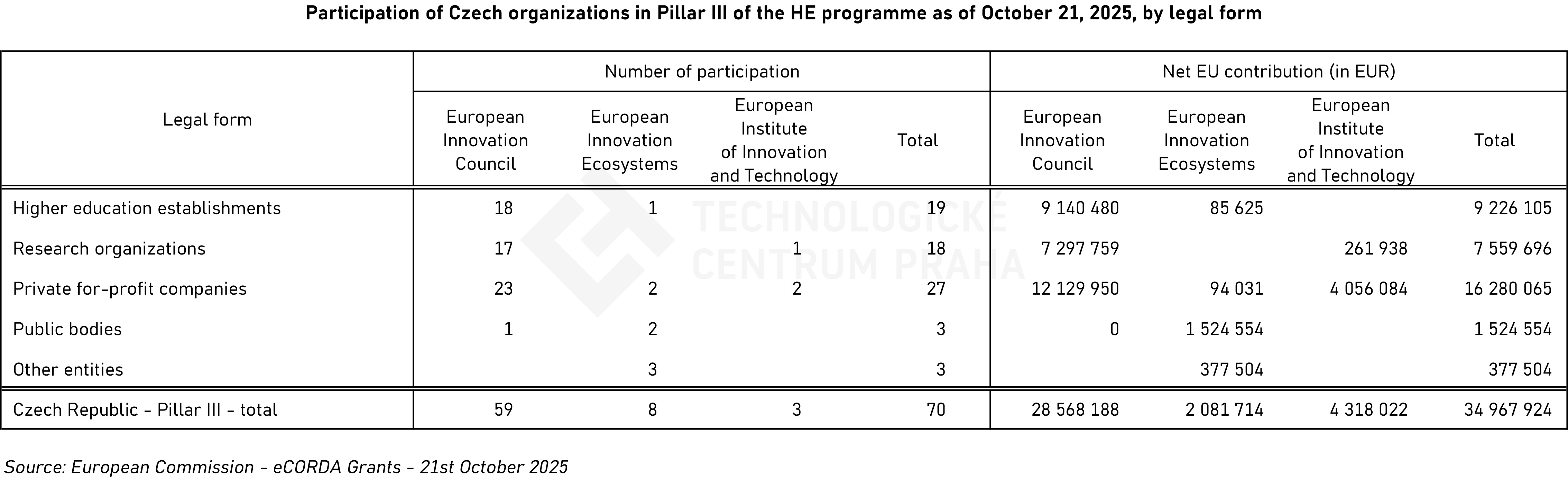
Given the nature of Pillar III, private for-profit companies dominate among Czech participants – 27 participations (i.e., two-fifths) with a claimed net EU contribution of €16.3 million (almost half of the net EU contribution in Pillar III). Small enterprises with 10–49 employees were the most represented among Czech business participants (13 participations, €8 million), followed by micro-enterprises (up to 9 employees; 10 participations, €5.3 million). Medium-sized enterprises with 50-249 employees reported 4 participations with €3 million claimed. Higher education institutions and research institutions have a similar number of participations (19 and 18), with higher education institutions claiming €9.2 million and research institutions €7.6 million.
Four-fifths of the participation and claimed EU funds are accounted for by the European Innovation Council instruments. Within these, the highest number of Czech participations is accounted for by Pathfinder instrument (39 participations with a claimed net EU contribution of €16.4 million). The Accelerator instrument reported 14 Czech participations and a claimed net contribution of €9.6 million, while the Transitions instrument reported 4 participations and €2.5 million. (Compare with the map diagram, where countries in the position of innovation leaders and some innovation-strong countries claim more EU funds from the Accelerator instrument.)
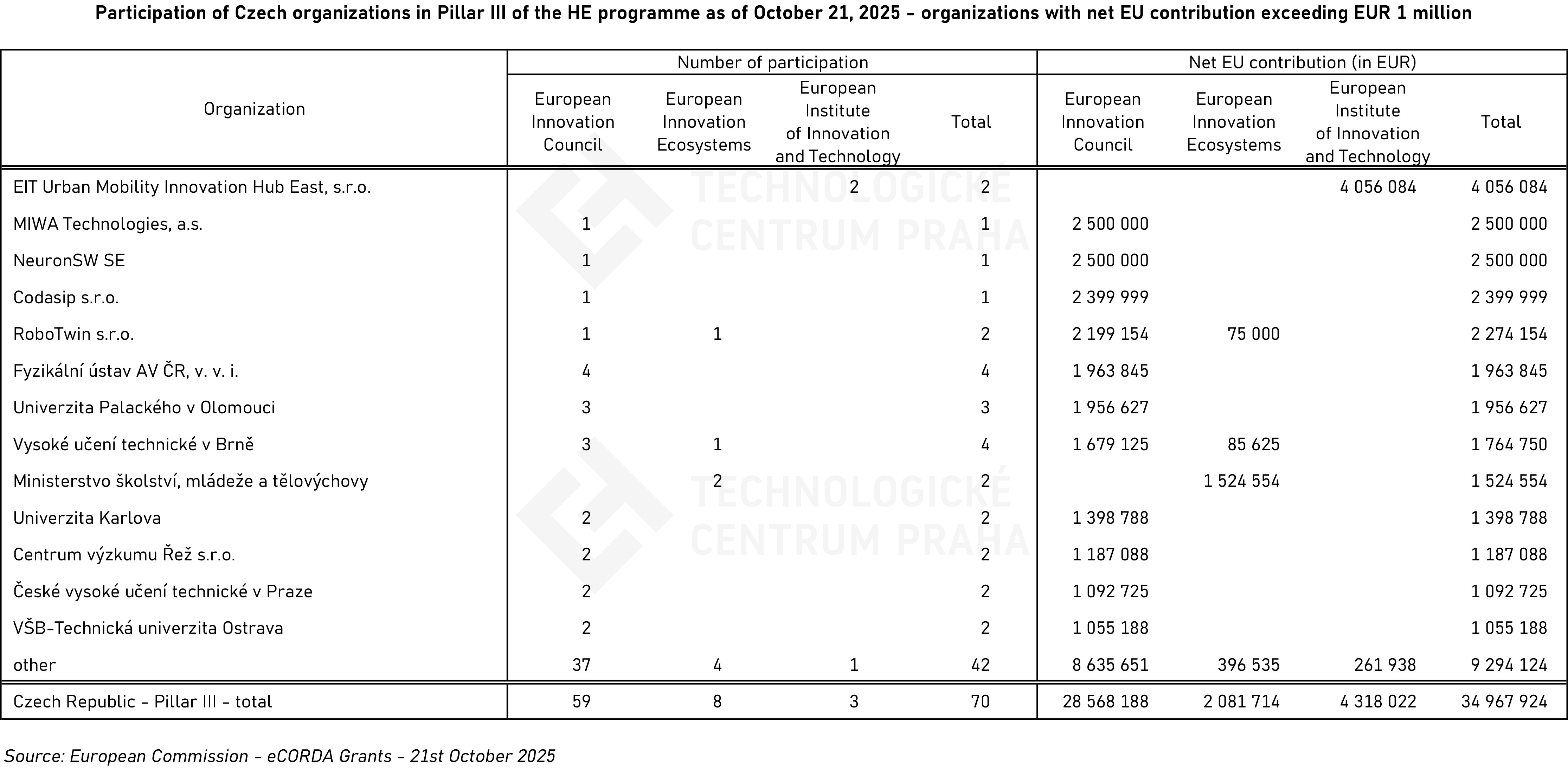
The participation of individual Czech organizations that claimed a net EU contribution of more than €1 million under Pillar III of the HE program as of October 21, 2025, is shown in the table below. The highest net EU contribution is claimed by the regional hub of the EIT Urban Mobility knowledge and innovation community (€4.1 million), followed by MIWA Technologies, a.s., NeuronSW SE (both €2.5 million), Codasip s.r.o. (€2.4 million) and RoboTwin s.r.o. (€2.3 million). Among research organizations, the Institute of Physics of the Czech Academy of Sciences received the highest EU contribution (€2 million), while among higher education institutions, Palacký University in Olomouc (€2 million) and Brno University of Technology (€1.8 million) received the highest ones.
In terms of Czech Republic’s participation in eligible project proposals in Pillar III, eCORDA recorded 543 participations (in 473 project proposals) as of October 21, 2025, with a required net EU contribution of €445 million. Czech entities are involved in successful project proposals in Pillar III on average. The overall success rate of participants from the Czech Republic in Pillar III is 9%, while the success rate of all participants from EU member states and countries associated with the HE programme is 10%. In this case, however, it should be noted that the success rate of Czech participation in European Innovation Council and European Innovation Ecosystems projects varies.

Summary:
Pillar III, “Innovative Europe,” accounts for roughly one-tenth of the HE programme in terms of the claimed net EU contribution. Seventy Czech participations with a claimed net EU contribution of €35 million correspond to the Czech Republic’s position in the Horizon Europe programme as a whole. Almost half of the EU's net contribution goes to Czech private for-profit companies (especially micro and small enterprises).
The largest part of Pillar III is the European Innovation Council. Within this framework, Czech organizations participate most in the Pathfinder instrument, which focuses on advanced research, support for future and emerging industrial technologies, technologies creating market opportunities, or cutting-edge technologies. (Conversely, across all 45 EU member states and countries associated with the HE programme, a higher amount is claimed in the Accelerator instrument, which aims to bridge the funding gap between the late stages of research and innovation and their introduction to the market.)
Prepared by Vladimír Vojtěch, vojtech@tc.cz, TC Prague, 18.11.2025