“I remember that around this time of year, a wandering repairman always appeared in the village...” Regular visitors to the HorizontEvropa.cz website may paraphrase the words of the chairman of the Křečovice agricultural cooperative from the Czech cult film My Sweet Little Village and say from 2023 onwards, at the turn of winter and spring, they can regularly read brief information about the participation of Czech entities in Horizon Europe projects and other EU financial instruments and programmes (published on April 17, 2023, March 18, 2024, and April 1, 2025). Thanks to this, we can in this article present to the reader a longer time series tracking the development of the representation of Czech participants in projects of Horizon Europe and selected other EU financial instruments and programmes. The time series below for 2023–2026 shows that Czech entities have long participated in approximately 6% of Horizon Europe projects. At the same time, we can identify a significant increase in the participation of Czech organizations in the Digital Europe and EU4 Health programmes. On the contrary, the involvement of Czech organizations in the European Defence Fund is declining significantly. The Czech Republic's involvement in Innovation Fund projects has been practically negligible for a long time.
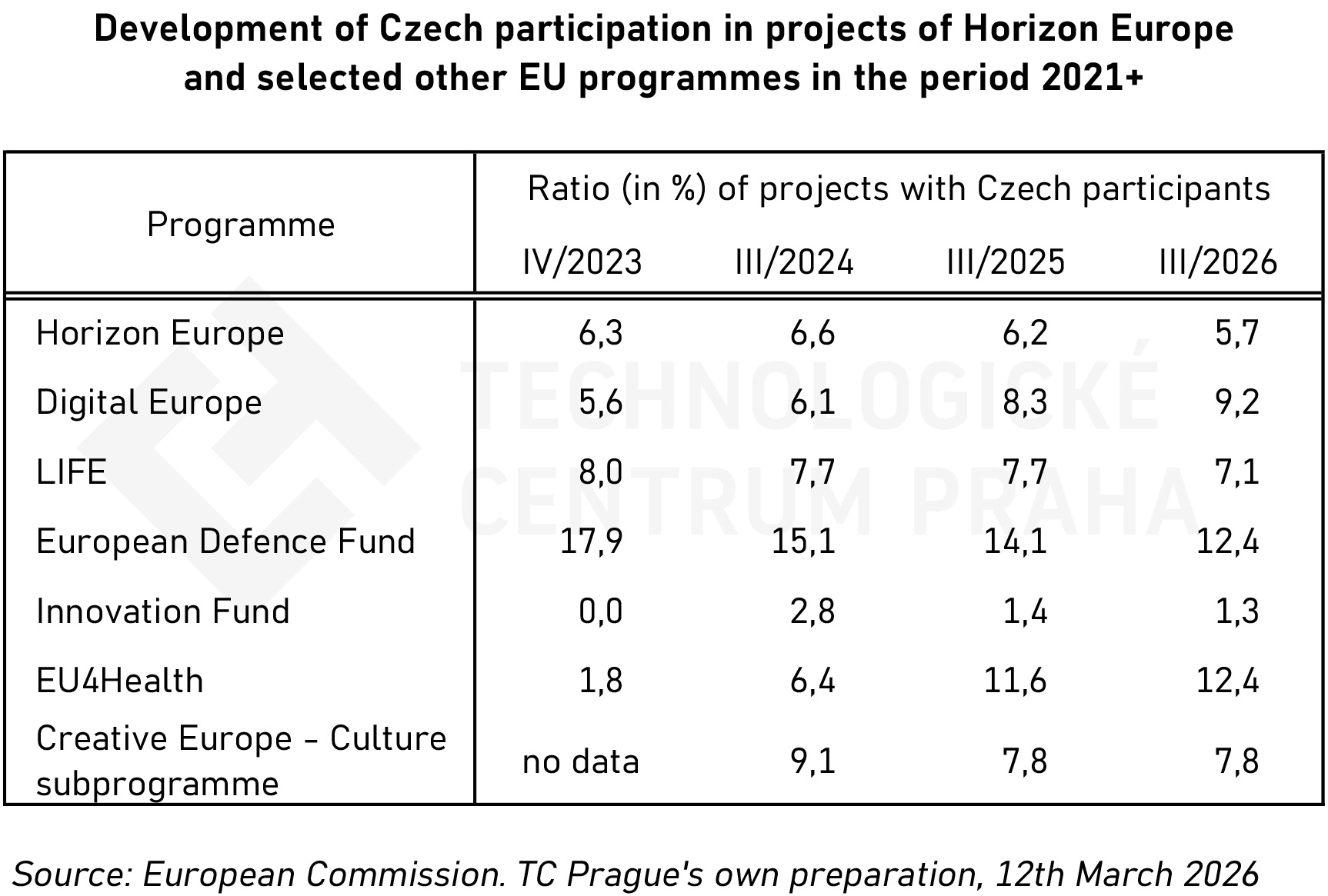
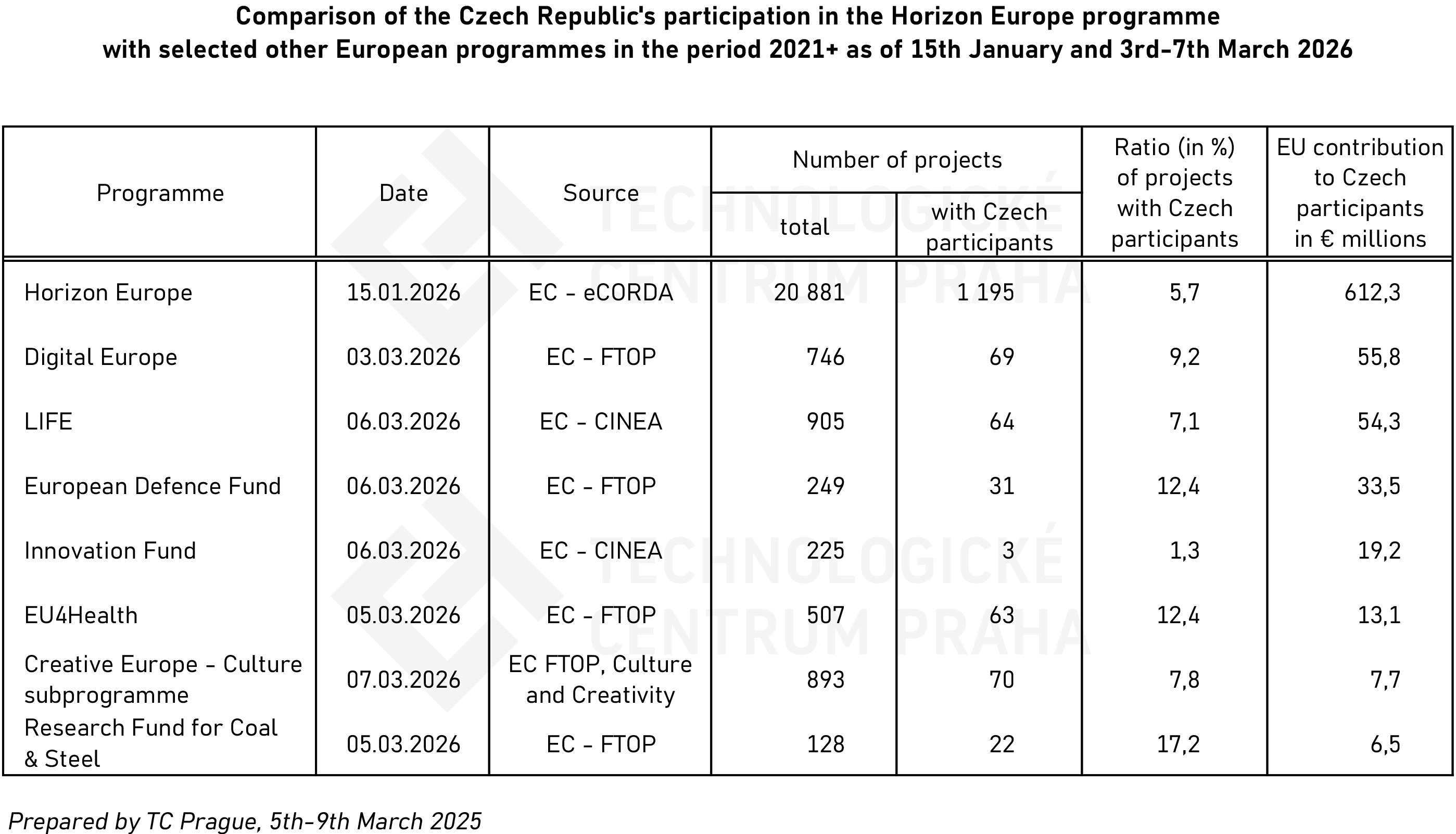
The above data clearly shows that Czech entities participate in the EU's climate and environment programme LIFE to a similar extent as they do in the Horizon Europe programme. 111 Czech teams participated in 64 projects in the LIFE programme – the most were SEVEn, The Energy Efficiency Center, z.ú. (12 participations), CEE Bankwatch Network z. s. (6 participations), ENVIROS, s.r.o. (5 participations), and the Czech Technical University in Prague (4 participations). The highest EU contribution was received by the Nature Conservation Agency of the Czech Republic (€23 million). Military Forests and Farms of the Czech Republic received €2.7 million, CEE Bankwatch Network z. s. €2.6 million, the ONYX branch of the Czech Union for Nature Conservation €2.4 million, and Masaryk University €2.3 million. SEVEn, The Energy Efficiency Center, z.ú., the Ministry of the Environment, the South Moravian Agency for Public Innovation JINAG, the Passive House Center and the University of South Bohemia in České Budějovice also received more than €1 million from the EU. Czech entities coordinated 26 projects, which brought €39.1 million to Czech participants in the LIFE programme, i.e., three-quarters of all EU funds for participants from the Czech Republic in this programme.
Third, the same applies to Czech participation in the Creative Europe programme – Culture sub-programme. 74 teams from the Czech Republic participate in 70 projects, 18 of them as coordinators. Czech teams in the Creative Europe – Culture sub-programme claim an EU contribution of €7.7 million. MeetFactory o.p.s. has the highest number of participations and the highest EU contribution (4 participations and €2.2 million). Companies reported 19 participations with a net EU contribution of €1.7 million – the highest EU contribution is claimed by Signal Productions s.r.o. (€340 thousand), Větrné mlýny s.r.o. (€200 thousand) and iShowroom s.r.o. (€184 thousand).
Czech entities participated in the Digital Europe programme to a somewhat higher extent – 9%. The Czech Republic reported 168 participations (including 25 coordinations) in 69 projects. The highest number of participations was reported by VŠB-Technical University of Ostrava and Czech Technical University in Prague (10 participations each), Brno University of Technology (9 participations), and Masaryk University (8 participations). The highest EU contribution was claimed by Czech Technical University in Prague (€8.5 million), CyberSecurity Hub, z. ú. (€5.1 million), the National Cyber and Information Security Agency (€5.0 million), Brno University of Technology (€4.6 million), and VŠB-Technical University of Ostrava (€4.5 million). Raiffeisenbank a.s., Masaryk University, and Charles University also received more than €2 million of EU contribution. Among companies, IXPERTA s.r.o. and Avast Software s.r.o. are also worth mentioning, each receiving an EU contribution of approximately €1 million. Regional innovation centres were represented in the Digital Europe programme by 7 organizations, with the highest EU contributions going to ARR - Regional Development Agency in Liberec (€1.1 million – EDIH NEB and EDIH NEB 2.0 projects), JIC (€1.0 million – EDIH-DIGIMAT, EDIH-DIGIMAT 2.0, and Czech Semiconductor Centre projects), and the Central Bohemian Innovation Centre (€0.8 million – Brain 4 Industry and Brain 4 Industry II projects). The coordination of 25 projects brought EU contribution of €24.6 million to Czech participants, i.e. two-fifths of all EU funds for participants from the Czech Republic in the Digital Europe programme.
Czech entities in the European Defence Fund reported participation of 39 teams in 31 projects. The EDF records project coordination of two Czech armament factories – these are projects aimed at expanding production. The Military Research Institute, the University of Defence and University of Hradec Králové each had three participations. The highest EU contribution was claimed by Explosia a.s. (€10 million), STV GROUP a.s. (€5 million), ecs Defence s.r.o. (€2.2 million) and Honeywell International (€2 million). In total, Czech companies reported 19 participations with an EU contribution of €24.3 million. This is three quarters of the EU contribution to Czech participants in the EDF.
In the EU4Health programme, 75 participations from the Czech Republic were registered in 63 projects. 6 projects were coordinated by Czech entities and the coordination brought them EU contribution of €5 million (i.e. two fifths of all EU funds claimed by Czech participants in the EU4Health programme). The highest number of participations was registered by the National Institute of Public Health (10 participations), the Institute of Health Information and Statistics of the Czech Republic, the Ministry of Health of the Czech Republic (9 participations each), the State Institute for Drug Control (7 participations) and Charles University (5 participations). The highest EU contribution was claimed by the National Institute of Public Health (€3.3 million), the Institute of Health Information and Statistics of the Czech Republic (€3.2 million), Vysočina Region (€1.1 million), the State Institute for Drug Control (€848,000), Charles University (€750,000) and the General University Hospital in Prague (€733,000).
On the other hand, Czech entities participate minimally in projects from the Innovation Fund. For the Czech Republic, the Innovation Fund records only 3 projects. The project focused on the production of clean hydrogen for transport and other sectors is coordinated by Veolia Energie ČR, a.s. VALEO VÝMĚNÍKY TEPLA s.r.o. is a common participant in the project aimed at the construction of a production line for electric vehicle battery coolers. AGC Flat Glass Czech a.s., a member of the AGC Group, plays the same role in a project aimed at the design and construction of a new hybrid glass furnace combining electric melting and oxy-gas combustion. The latter project is also the most costly – the Czech participant claims a net EU contribution of €12.2 million. Among the new EU Member States, Poland is the main participant in Innovation Fund projects (16 participations in 12 projects with an EU contribution of €476 million). Six participations in five projects with an EU contribution of €138 million Croatia has registered. Bulgaria registers two participations in one project with a claimed EU contribution of €190 million. (The amounts claimed by Bulgaria and Croatia through cement industry projects under the Innovation Fund are almost on par with the amounts claimed by these countries in the Horizon Europe programme.)
Twenty-five Czech teams participated in 22 projects under the Research Fund for Coal and Steel. Three projects were coordinated by Czech entities. In total, Czech entities claimed €6.5 million in EU contributions from the RFCS. The most participation was reported by VUHU a.s. (6 participations), VŠB-Technical University of Ostrava (4 participations), and the University of Chemistry and Technology Prague (3 participations). The largest amounts of EU contribution were claimed by MKP Kompozit s.r.o. (€2.0 million), VUHU a.s. (€811,000), and the University of Chemistry and Technology Prague (€802,000).
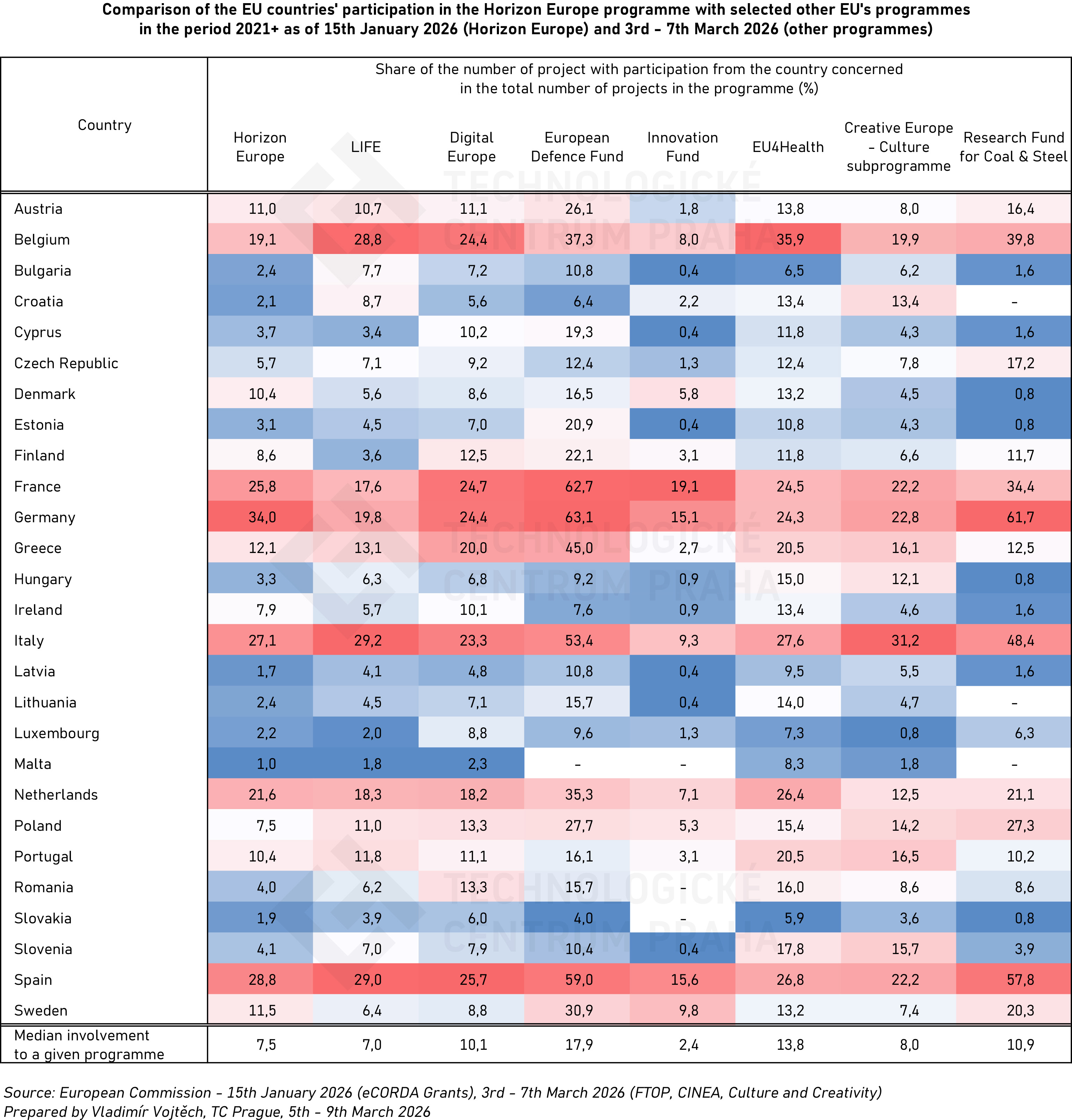
In previous similarly focused articles, we compared the level of Czech Republic’s participation in Horizon Europe projects with the level of its participation in other EU’s programmes. In this article, the table below compares the Czech Republic's participation in individual EU programmes with other countries. The application of this approach comes out rather unfavourably for the Czech Republic in all programmes, as it is around the median value or slightly below it. In terms of project participation, the Czech Republic ranks 15th (out of 27 EU member states) in most programmes studied. Positive exceptions are the Czech Republic's participation in projects of the Research Fund for Coal and Steel, where the Czech Republic ranks 9th, and the LIFE programme, where the Czech Republic ranks 13th. On the other hand, the Czech Republic ranks 18th in participation in European Defence Fund projects and 19th in EU4Health projects.
Summary:
Czech entities participate in approximately 6% of projects in the Horizon Europe programme. The smaller ones – LIFE, Digital Europe and Creative Europe’s Culture sub-programme – also have a similar level of Czech participation. Compared to other EU countries, Czech entities participate below average in the Innovation Fund and the European Defense Fund. In other EU programmes, as in Horizon Europe, the amount of EU funds claimed by Czech entities is significantly influenced by project coordination.
Author: Vladimír Vojtěch, TC Praha, vojtech@tc.cz, 12.03.2026